Traders end protest against taxes at northern border pass linking Pakistan to China

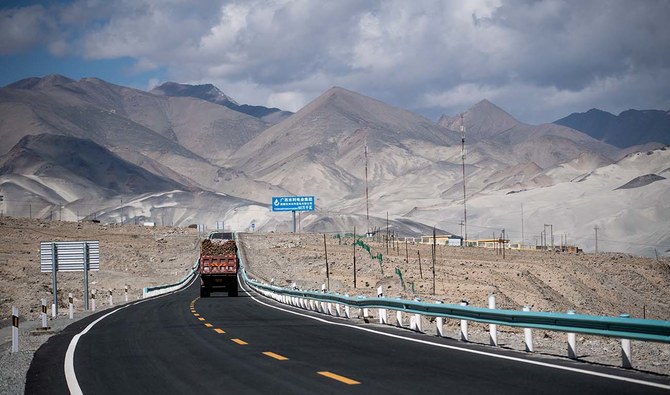
This picture taken on June 27, 2017 shows a truck driving along the China-Pakistan Friendship Highway before the Karakorum mountain range near Tashkurgan in China's western Xinjiang province. (AFP/File)
Short Url
Updated 11 August 2024
Follow

Traders end protest against taxes at northern border pass linking Pakistan to China

  • Protesters blocked high-altitude Khunjerab Pass connecting Pakistan to China for 17 days over taxes on Chinese imports
  • Taxes will only be applicable on imports from China that are transported to other regions, says GB information minister 

KHAPLU, Gilgit-Baltistan: Traders in the northern Gilgit-Baltistan region on Sunday called off a 17-day sit-in protest against taxes on imports at an important border pass linking Pakistan to China, following successful negotiations with the government that will pave the way for trade to resume at the key crossing. 
Trade and transportation at the high-altitude Khunjerab Pass connecting Pakistan and China remained suspended since July 26 after traders staged a sit-in protest at the Sost dry port against taxes on Chinese imports. 
On July 20, the GB Chief Court declared illegal the collection of income tax, sales tax and additional sales tax by Pakistani revenue authorities on goods imported from China through the Khunjerab Pass. 
Protesters accused the federal government of violating the court’s orders and collecting taxes on imports that arrived through the pass.
“The customs department has accepted the GB Chief Court’s order and the unanimous resolution of the GB assembly,” Imran Ali, president of the GB Chamber of Commerce and Industry, told Arab News via a text message. 
“So now, we have announced to call off the protest.” 
Muhammad Iqbal, president of the GB Importers and Exporters Association, said a three-member team representing the traders met GB Chief Minister Hajji Gulber Khan and Minister for Kashmir Affairs and GB Amir Muqam in Islamabad to resolve the issue. 
“And they promised to fulfill our demands after assurances with the FBR,” Iqbal said. “From today, the border is open for all kinds of trade and transport.”
Bakhtiar Muhammad, a spokesperson for the Federal Board of Revenue (FBR) said the customs department was willing to implement the GB court’s interim order subject to the provision of monetary security during the case proceedings to safeguard government revenue. 
“Traders finally agreed to provide post-dated cheques as security and customs negotiated a standard operating procedure for the clearance, to which they agreed,” Muhammad said. 
 GB Information Minister Eman Shah shared details of the agreement, saying that local traders in GB would not be taxed for imports through the Khunjerab Pass. 
“However, a checkpost will be installed at the Thakot Bridge by customs where all taxes will be applicable on imported things being transported to another region,” he revealed.
Ninety-six percent of trade between Pakistan and China consists of China’s exports to Pakistan, while Pakistan’s share of exports to China is only 4 percent, as per the Trade Development Authority of Pakistan (TDAP).

The main items imported from China into Pakistan include electronic items, shoes, garments and spare parts while Pakistan exports gemstones, dry fruits, medicinal herbs and some clothing items to the neighboring country. 


IMF mission begins talks in Islamabad as Pakistan seeks next program review

Updated 5 sec ago
Follow

IMF mission begins talks in Islamabad as Pakistan seeks next program review

  • Finance ministry confirms ‘kick-off meeting’ with visiting IMF delegation
  • Review critical for next tranche under $7 billion bailout program

Karachi: Pakistan began formal talks with a visiting International Monetary Fund (IMF) delegation on Monday as the country prepares for the next review of its $7 billion bailout program.

The IMF team is in Pakistan to conduct a review under the Extended Fund Facility (EFF) approved in September 2024, a multi-year program aimed at stabilizing the economy after a balance-of-payments crisis, high inflation and dwindling foreign exchange reserves.

Pakistan has so far received roughly $3 billion of the EFF. Successful completion of the latest review could pave the way for the release of the next tranche of funds, subject to IMF board approval.

Separately in 2024, Pakistan also secured about $1.3 billion under the IMF’s Resilience and Sustainability Facility, a climate-focused funding window aimed at strengthening the country’s capacity to manage environmental and disaster-related risks.

“Kick-off meeting with IMF Mission held today,” the finance ministry said on Monday as it shared visuals of Finance Minister Muhammad Aurangzeb and senior officials meeting the delegation in Islamabad.

IMF country representative in Pakistan, Mahir Binici, told Arab News in an emailed statement; 

“An IMF mission led by Ms. Iva Petrova has started discussions with the authorities in Karachi and Islamabad on the third review of Pakistan’s Extended Fund Facility (EFF) arrangement and the second review of the Resilience and Sustainability Facility (RSF).”

The discussions are expected to focus on Pakistan’s fiscal performance, revenue collection targets, structural reform implementation and broader macroeconomic stability measures agreed under the program.

The review comes at a sensitive time for Pakistan’s economy, with rising global oil prices and regional instability adding pressure to inflation and external accounts. Analysts say continued IMF engagement remains crucial for maintaining investor confidence and securing external financing.

Pakistan entered the IMF program to restore macroeconomic stability, strengthen public finances and rebuild foreign exchange reserves. Authorities have repeatedly described the reform agenda as necessary to ensure long-term economic resilience.

Further meetings between technical teams are expected over the coming days.