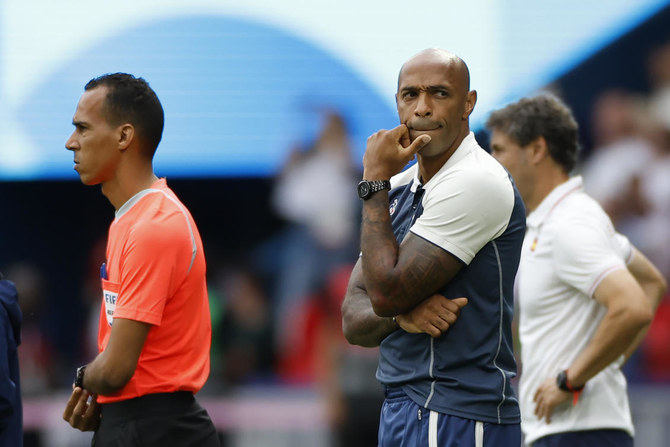
Henry the coach comes of age on France’s run to Olympic silver

France’s head coach Thierry Henry, is seen during the men’s soccer gold medal match between France and Spain at the Parc des Princes during the 2024 Summer Olympics on Aug. 9, 2024, in Paris. (AP)
Short Url
Updated 10 August 2024
Follow

Henry the coach comes of age on France’s run to Olympic silver

  • Henry had struggled to make a name for himself in coaching and agreeing to lead his country into the Olympics at home was a risk
  • His hopes of building a squad good enough to win football gold for France for the first time since 1984 were compromised from the beginning

PARIS: Thierry Henry was unable to leave the Olympics with the gold medal he craved but the France great has enhanced his reputation as a coach after taking the hosts to the men’s football final.
France pushed Spain all the way in an epic match in Paris on Friday, eventually losing 5-3 and settling for silver having earlier recovered from 3-1 down to force extra time.
Now almost 47, Henry is a France all-time great after a playing career in which he won the World Cup and European Championship while also starring for Arsenal and Barcelona.
But he had struggled to make a name for himself in coaching and agreeing to lead his country into the Olympics at home was a risk.
Henry’s hopes of building a squad good enough to win football gold for France for the first time since 1984 were compromised from the beginning.
Clubs are not obliged by FIFA to release players, which meant Henry was unable to call upon Kylian Mbappe, the France senior team captain, despite the superstar striker making clear his desire to feature.
Mbappe’s new club Real Madrid said no, while hopes of enrolling the services of others such as Antoine Griezmann were dashed too.
Henry was left to mold a hotchpotch of players into a cohesive team, which he did with considerable success.
France beat Argentina in the quarter-finals and showed character to come back against Egypt in the semis.
Henry labelled his team “the crazy guys” and repeatedly said he was “living a dream” at the Olympics.
“It’s been a great run and we leave with a medal, so these will be great memories,” he admitted.
It is just under a year since Henry was appointed France Under-21 coach and also given the task of leading his country into the Olympics.
That marked a return to the role of number one for Henry for the first time since his departure from Montreal Impact in early 2021.
Before that there was a disastrous three-month stint at Monaco, the club where he started his playing career.
Henry has also been an assistant coach with Belgium but had developed a better reputation as a pundit during television appearances in Britain, France and across the Atlantic.
His knowledge and his past experience on the pitch mean players are in awe of him.
“The coach was a great player so he has great experience and it is very easy to follow his advice. We know that everything he says is because he has been through it too,” said Alexandre Lacazette, the captain of France’s Olympic team.
Some of his comments while at Monaco betrayed a frustration with players who were inevitably below the standards he himself reached.
Now, however, Henry appears to understand how to get the best out of a team.
“They are educating me. There is stuff that at times I need to let go,” he said of his France squad.
“They know already that I am not the type of guy that will be on their back every single second.
“When we work, we work, but other than that I would like to think I am pretty cool.”
Henry’s success in the dugout at the Olympics makes him a more enticing proposition to clubs and national teams on the lookout for a coach.
There have been reports that the United States would like him to lead their men’s national team into the 2026 World Cup, which they will co-host.
He has also been linked to the Wales job, although he remains under contract with the France Under-21 team until next year.
Not that Henry was in the mood for discussing his future following Friday’s Olympic final.
“My future is to go to eat with the guys later on. Tomorrow morning hopefully I will wake up,” was his laconic response.


Pakistan bowler Tariq and his unusual delivery courts controversy at the T20 World Cup

Updated 13 February 2026
Follow

Pakistan bowler Tariq and his unusual delivery courts controversy at the T20 World Cup

  • Offspinner’s unconventional bowling action has already mesmerized some of the big names
  • As is often the case in cricket, the reasons for Usman Tariq’s potential illegal delivery are complicated

ISLAMABAD: With a momentary pause in his delivery and his statue-like pose at the crease, Pakistan spin bowler Usman Tariq has created plenty of attention at cricket’s Twenty20 World Cup.
Just enough, it seems, to throw off opposing batters.
With it has come a fair share of controversy — that his pause-and sling style of bowling is an illegal delivery, or in cricket parlance, chucking. He’s already been reported twice, but cleared, by Pakistani cricket authorities.
The 28-year-old offspinner’s unconventional bowling action has already mesmerized some of the big names in shortest format of the game and has seen him taking three wickets against an inexperienced United States in Sri Lanka this week in what was his first T20 World Cup game.
As is often the case in cricket, the reasons for Tariq’s potential illegal delivery are complicated.
First there is the so-called “15-degree debate” — that bowlers cannot exceed the ICC’s 15-degree elbow flex limit, which is nearly impossible for on-field umpires to judge accurately in real time.
Another talking point has been the pause in Tariq’s delivery stride. Some critics, including former India cricketer Shreevats Goswami, compare it to a football penalty run-up that would be ruled illegal if the shooter stops midway.
Baffling the batters
Batters like Cameron Green of Australia and South African Dewald Brevis are a few notable players that were flummoxed by Tariq’s bowling action.
Power-hitter Brevis fell to Tariq’s only second ball in T20 international cricket in November. Green shook his head in disbelief and mocked Tariq’s bowling action close to the boundary line — but later apologized — when he walked back after slicing a wide delivery straight to the cover fielder during Pakistan’s 3-0 sweep of Australia at Lahore.
Tariq’s rise in T20 cricket has also seen him taking a hat-trick at Rawalpindi when he took 4-18 against Zimbabwe during the tri-series in November. He has taken 11 wickets off his 88 balls in only four T20 internationals.
It was no surprise when selectors included Tariq in the 15-man T20 World Cup squad, knowing that pitches in Sri Lanka would suit slow bowlers more than pacemen.
Tariq’s journey to top-level cricket wasn’t a smooth one. He was twice reported for suspect bowling action during country’s premier domestic T20 tournament — the Pakistan Super League — over the last two seasons, but on both occasions he was cleared after testing at the National Cricket Academy in Lahore.
“I have two elbows in my arm,” Tariq said. “My arm bends naturally. I have got this tested and cleared. Everyone feels I bend my arm and all that. My bent arm is a biological issue.”
Tariq has also featured in the Caribbean Premier League and with his deceptive bowling action he was the tournament’s second-highest wicket taker for champions Trinbago Knight Riders.
Long pause a problem
“The batters are struggling to read Tariq because of the long pause the moment he steps on the bowling crease,” former Pakistan captain Sarfaraz Ahmed, who has played with Tariq in the PSL’s Quetta Gladiators, said.
“The long pause disturbs all the concentration of batters and when he bowls a fastish (delivery, after a long pause), or even a slow ball, it leaves the batters clueless.”
Less than three months ago, Tariq said he had dreamed about playing against archrival India. And after Pakistan withdrew its boycott of Sunday’s game in the T20 World Cup, Tariq’s dream could come true if Pakistan uses five spinners against India.
“I wish there’s a match against India and I can win the game for Pakistan single-handedly,” Tariq said then. “My coaches have injected this thing in me that ‘you have to win matches single-handedly’.”
On Sunday against India, Tariq could do just that.