LONDON: Prime Minister Keir Starmer warned Friday that UK authorities must “stay on high alert” for more far-right riots, as courts issued the first jail sentences for online incitement during the recent disorder.
While England has had consecutive nights of relative quiet, disturbances have continued unabated in Northern Ireland where police have blamed pro-UK loyalist paramilitaries for fueling nightly violence in Belfast.
More than 1,000 anti-racism protesters massed in the Northern Irish capital on Friday amid a large police presence.
Several dozen anti-immigration demonstrators also showed up.
Starmer told reporters during a visit to the London police headquarters that “swift justice” handed out by courts was helping deter more disorder in English towns.
“But we have to stay on high alert going into this weekend because we absolutely have to make sure that our communities are safe and secure,” Starmer added.
A judge in Leeds, northern England, jailed a 28-year-old man for 20 months after he admitted publishing Facebook posts that met the criminal threshold for stirring racial hatred.
In the first case of its kind linked to the disturbances, a judge sentenced Jordan Parlour for posts last week encouraging people to attack a hotel in the city housing asylum seekers and refugees.
The hotel manager had to put the building into lockdown Saturday due to disorder in the city, and at least one window was broken after stones were thrown at it.
In Northampton, central England, a judge jailed 26-year-old Tyler Kay for 38 months after he called on social media for hotels housing asylum seekers to be set alight.
Speaking before the sentences — but after both had been convicted — Starmer said they were “a reminder to everyone that whether you’re directly involved or whether you’re remotely involved, you’re culpable.”
Social media executives and users should be “mindful of the first priority, which is to ensure that our communities are safe and secure.”
“We’re going to have to look more broadly at social media after this disorder but the focus at the moment has to be on dealing with the disorder,” Starmer said.
Police in England said nearly 600 arrests have been carried out linked to the unrest since July 30 and around 150 charges had been filed.
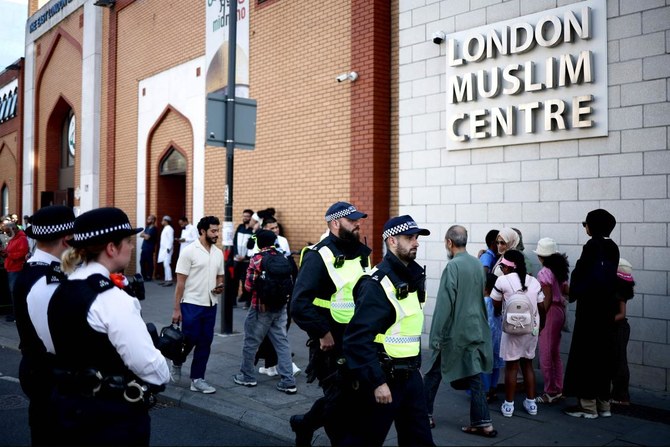
The disturbances, sparked by a July 29 knife attack in which three children were killed, have seen mosques and migrant-related facilities attacked alongside police and other targets.
Officials say false information spread on social media about the suspected perpetrator fueled the disorder.
Courts across England have started sentencing participants in the disorder, with about a dozen people jailed on Thursday.
In Northern Ireland, a number of Belfast businesses and libraries closed early on Friday after more disorder overnight and the latest protests.
Police there said 23 people have been arrested so far in Belfast following the disturbances, and 15 charged.
Officers have been granted additional powers to stop and search suspected troublemakers and ask them to remove face coverings, while additional manpower is being sent from the UK mainland, according to reports.
Britain’s monarch, King Charles III, praised the police and emergency services “for all they are doing to restore peace in those areas that have been affected by violent disorder.”
He hoped that the “shared values of mutual respect and understanding will continue to strengthen and unite the nation,” a palace spokesman added in a statement, his first reaction to the unrest
French President Emmanuel Macron offered his support to Starmer in a phone call with the prime minister Friday, said a statement from the French presidency.
Offering condolences to the families of the victims of the July 29 stabbing, Macron “firmly condemned the violence and disorder” in Britain in his conversation with Starmer, said the statement.


![]()

UK remains on ‘high’ riot alert as jail terms ordered for social media posts
Short Url
https://arab.news/v9jnd
UK remains on ‘high’ riot alert as jail terms ordered for social media posts
- Racist attacks and disorder have mostly targeted Muslims and migrants
- There are around 40 counter-protests due on Saturday, according to the Stand Up to Racism group


Latest updates


© 2026 SAUDI RESEARCH & PUBLISHING COMPANY, All Rights Reserved And subject to Terms of Use Agreement.