

High hopes in Bangladesh as Nobel-winning economist takes charge

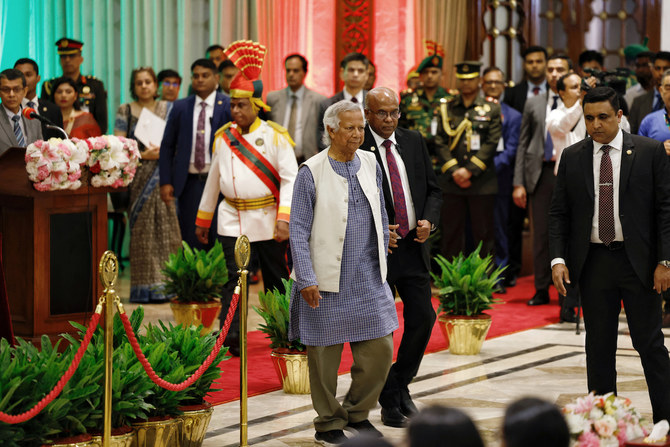
Muhammad Yunus walks off the stage after taking oath at the Bangabhaban as head of the interim government, in Dhaka, Bangladesh, August 8, 2024. (Reuters)
Short Url
Updated 09 August 2024
Follow

High hopes in Bangladesh as Nobel-winning economist takes charge

  • Muhammad Yunus heads interim government after a student-led uprising ousted former PM Sheikh Hasina
  • Among members of his Cabinet are top Bangladeshi technocrats and leaders of the student movement

DHAKA: Jubilant and hopeful, Bangladeshis welcomed on Friday their new interim government headed by the Nobel-winning economist Muhammad Yunus and manned by renowned lawyers, academics and leaders of the student movement that has ousted the previous regime.

The new administration took the oath of office at the presidential palace in Dhaka on Thursday night, three days after Prime Minister Sheikh Hasina was forced to resign and fled to neighboring India after weeks of nationwide demonstrations and a deadly crackdown on protesters.

“The brutal, autocratic regime is gone,” Yunus said in a televised address after he was sworn in by President Mohammed Shahabuddin along with more than a dozen members of his caretaker government.

He pledged that “democracy, justice, human rights, and full freedom of fearless expression will be enjoyed by all, regardless of party affiliation.”

The 84-year-old economics professor will lead the country as “chief adviser” and the titles of his Cabinet members advisers too, not ministers.

They include Nahid Islam and Asif Mahmud, top leaders of Students Against Discrimination, a group that led the protests that toppled Hasina, and civil servants such as former Attorney General A.F. Hassan Ariff, former Foreign Secretary Touhid Hossain, and Salehuddin Ahmed — economist and a former governor of the country’s central bank.

There are also Adilur Rahman Khan, a prominent human rights activist, Syeda Rizwana Hasan, an international award-winning environmental lawyer, and Asif Nazrul, a public intellectual, writer and professor of law at Dhaka University.

As the new administration took office, Bangladeshis were enthusiastic about the nominations and hopeful for their country’s future.

“After our total anarchy and a very serious uprising that we experienced very recently, this is a new dynamic,” Gautam Barua, an academic and researcher, told Arab News.

“I’m very hopeful, very, very much hopeful about this interim government … I think they will bring about a beautiful change.”

He was glad to see that famous lawyers and economists would be at the helm.

“This Cabinet, I think, has the finest of the fine of the country … They are globally recognized, and they are domestically, nationally, recognized,” Barua said.

“The country’s present economy needs a notch … It has gone down quite drastically in the last government’s regime. So, I believe they can notch it up. They can turn the wheel of the economy.”

There was also pride in having a government full of celebrity intellectuals and technocrats.

“I think they can bring us a positive change,” said Mahfuz Kaiser, a student in Dhaka. “Dr. Yunus is a very famous person. He’s a Nobel laureate. First Nobel winner in Bangladesh.”

An economics professor, Yunus is a social entrepreneur and banker who was awarded the 2006 Nobel Peace Prize for his pioneering microfinance work that helped alleviate poverty in Bangladesh and has been widely adopted around the world.

“He’s going to help us to build this nation again,” said Jannatul Ferdous Mawa, who is pursuing a degree in media studies and participated in the recent protests.

“I think whatever is happening right now, it’s good for us because we are learning something. From this protest, we learned one thing: that if we are together, we can build this nation again.”

Political transition in Bangladesh, ending 15 years of Hasina’s rule, comes after nationwide protests that began in early July against a quota system for government jobs, which was widely criticized for favoring those with connections to the ruling party.

The demonstrations soon turned violent as security forces clashed with demonstrators, leaving at least 300 people dead.

After the deadly clashes and a week-long communications blackout, the Supreme Court eventually scrapped most of the quotas, but the ruling was followed by a crackdown on protesters.

The arrests of 11,000 participants of the rallies, mostly students, triggered new demonstrations last week, culminating in a civil disobedience movement that on Monday forced Hasina to resign.

A day later, the president dissolved the parliament, clearing the way for the interim administration, which now will preside over new elections.

“There are lots of expectations from this government because this government is headed by the Nobel laureate Prof. Dr. Yunus. I think everyone is looking forward to his work, to his progress, to his visions. He used to say that there are three zeros: zero poverty, zero unemployment and zero net carbon. So, I think he will work on these three issues,” Dr. Rawnak Khan, who teaches anthropology at Dhaka University, told Arab News.

“Our institutional infrastructure, the whole situation — we need to build it up. The government needs to ensure transparency, accountability. My expectation of this government is very high. Not only mine; I think everyone’s because it is headed by Prof. Yunus and it depends on his ability to navigate the complex political landscape of Bangladesh.”


US House of Representatives passes war powers resolution backing Trump’s attacks on Iran

Updated 8 sec ago
Follow

US House of Representatives passes war powers resolution backing Trump’s attacks on Iran

WASHINGTON: The House narrowly rejected a war powers resolution Thursday to halt President Donald Trump’s attacks on Iran, an early sign of unease in Congress over the rapidly widening conflict that is reordering US priorities at home and abroad.
It’s the second vote in as many days, after the Senate defeated a similar measure. Lawmakers are confronting the sudden reality of representing wary Americans in wartime and all that entails — with lives lost, dollars spent and alliances tested by a president’s unilateral decision to go to war with Iran.
While the tally in the House, 212-219, was expected to be tight, the outcome provided a clarifying snapshot of political support for, and opposition to, the US-Israel military operation and Trump’s rationale for bypassing Congress, which alone has the power to declare war. At the Capitol, the conflict has quickly carried echoes of the long wars in Afghanistan and Iraq, and many Sept. 11-era veterans now serve in Congress.
“Donald Trump is not a king, and if he believes the war with Iran is in our national interest, then he must come to Congress and make the case,” said Rep. Gregory Meeks, the top Democrat on the House Foreign Affairs Committee.
House Speaker Mike Johnson warned that it would be “dangerous” to limit the president’s authority while the US military is already in conflict.
“We are not at war,” said Johnson, R-Louisiana, a close ally of Trump, contradicting others. He said the operation is limited in scope and duration, and the “mission is nearly accomplished.”
Republicans largely back Trump, and most Democrats oppose the war
Trump’s Republican Party, which narrowly controls the House and Senate, largely sees the conflict with Iran not as the start of a new war, but the end of a government that has long menaced the West. The operation has killed Iran’s Supreme Leader Ayatollah Ali Khamenei, which some view as an opportunity for regime change, though others warn of a chaotic power vacuum.
Republican Rep. Brian Mast of Florida, chairman of the House Foreign Affairs Committee, publicly thanked Trump for taking action against Iran, saying the president is using his own constitutional authority to defend the US against the “imminent threat” the country posed.
Mast, an Army veteran who worked as a bomb disposal expert in Afghanistan, said the war powers resolution was effectively asking “that the president do nothing.”
For Democrats, Trump’s attack on Iran, influenced by Israeli Prime Minister Benjamin Netanyahu, is a war of choice that is testing the balance of powers in the Constitution.
“The framers weren’t fooling around,” said Rep. Jamie Raskin, D-Md., arguing that the Constitution is clear that only Congress can decide matters of war. “It’s up to us.”
Crossover coalitions emerged among those in Congress. Two Republicans joined most Democrats in voting for the war powers resolution, while four Democrats joined Republicans to reject it.
The war powers resolution, if signed into law, would have immediately halted Trump’s ability to conduct the war unless Congress approved the military action. The president would likely veto it.
Trump officials provide shifting rationale for war
Trump has scrambled to win support for the nearly week-old conflict as Americans of all political persuasions take stock. Administration officials spent hours behind closed doors on Capitol Hill this week trying to reassure lawmakers that they have the situation under control.
Six US military members were killed over the weekend in a drone strike in Kuwait, and Trump has said more Americans could die. Thousands of Americans abroad have scrambled for flights, many lighting up phone lines at congressional offices as they sought help trying to flee the Middle East.
Trump said Thursday he must be involved in choosing Iran’s new leader. Yet Johnson, R-Louisiana, said this week that America has enough problems at home and is not about to be in the “nation-building business.”
Defense Secretary Pete Hegseth said that the war could extend eight weeks, twice as long as the president first estimated. Trump has left open the possibility of sending US troops into what has largely been a bombing campaign. More than 1,230 people in Iran have died.
The administration said the goal is to destroy Iran’s ballistic missiles that it believes are shielding its nuclear program. It has also said Israel was ready to act, and American bases would face retaliation if the US did not strike Iran first. The US said Wednesday it torpedoed an Iranian warship near Sri Lanka.
“This administration can’t even give us a straight answer of as to why we launched this preemptive war,” said Rep. Thomas Massie, the Republican from Kentucky, an outlier in his party.
Massie and Rep. Ro Khanna, D-Calif., who had teamed up to force the release the Jeffrey Epstein files, also pushed the war powers resolution to the floor, past objections from Johnson’s GOP leadership. Republican Rep. Warren Davidson of Ohio, a former Army Ranger, also voted for it. Democratic Reps. Henry Cuellar of Texas, Jared Golden of Maine, Greg Landsman of Ohio and Juan Vargas of California voted against.
“Congress must stand with the president to finally close, once and for all, this dark chapter of history,” said Rep. Michael McCaul, R-Texas.
Rep. Yassamin Ansari, D-Arizona, said that as the daughter of Iranian immigrants who fled their homeland, she opposes the regime but is concerned that a democratic transition for the people of Iran never seems to a priority for Trump or the officials who briefed Congress.
“War carries profound and deadly consequences for our troops, for the American people and for the entire world,” she said. “It’s the most serious decision that a nation can make.”
Other Democrats have proposed an alternative resolution that would allow the president to continue the war for 30 days before he must seek congressional approval. The House also approved a separate measure affirming that Iran is the largest state sponsor of terrorism.
Senators sit in their desks for solemn vote
In the Senate, Republican leaders have successfully, though narrowly, defeated a series of war powers resolutions pertaining to several other conflicts during Trump’s second term. This one, however, was different.
Underscoring the gravity Wednesday, Democratic senators sat at their desks as the voting got underway.
Senate Democratic leader Chuck Schumer of New York said that every senator will pick a side. “Do you stand with the American people who are exhausted with forever wars in the Middle East?” he asked. Or with Trump and Hegseth “as they bumble us headfirst into another war?”
Sen. John Barrasso, second in Senate Republican leadership, said, “Democrats would rather obstruct Donald Trump than obliterate Iran’s national nuclear program.”
The legislation failed on a 47-53 tally mostly along party lines, with Sen. Rand Paul, R-Kentucky, in favor and Sen. John Fetterman, D-Pennsylvania, against.