
DEIR AL-BALAH, Gaza Strip: Israeli troops launched a new assault Friday into the southern Gaza city of Khan Younis, targeting Hamas fighters who the military claims still operate there despite repeated offensives, as American, Qatari and Egyptian mediators renewed their push for Israel and Hamas to reach a ceasefire deal.
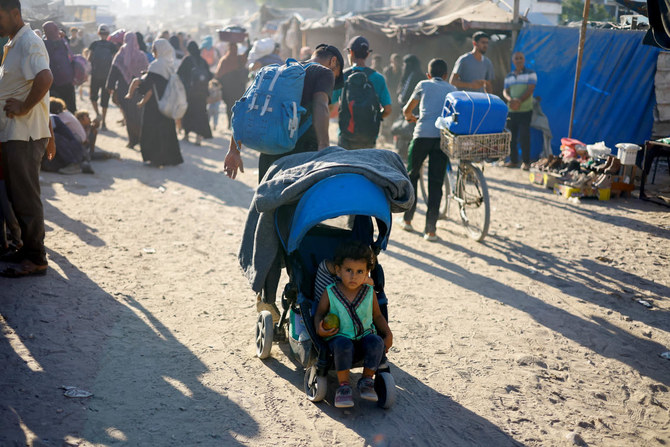
Israeli evacuation orders triggered yet another exodus of Palestinians from the heavily destroyed eastern districts of Khan Younis, where many had just returned less than two weeks ago — after the Israeli military’s last incursion into the city in July.
A wave of Israeli airstrikes in the city Friday killed at least 21 Palestinians, medics at the city’s Nasser Hospital said. Israeli bombardment also continued in central Gaza, with the bodies of seven people — four women and six children — arriving at Al-Aqsa Martyrs Hospital in Deir Al-Balah from airstrikes that hit towns nearby.
With tensions running high along the Israel-Lebanon border, an Israeli drone strike on Friday crashed into an SUV in the Lebanese city of Sidon, killing a Hamas official identified as Samer Al-Hajj on the main road to the southern port city, Lebanon’s state media reported.
The explosion engulfed Al-Hajj’s car in flames just outside the sprawling Palestinian refugee camp of Ein Al-Hilweh, where Lebanese media reported that he oversaw security matters. Israel confirmed it targeted Al-Hajj, describing him as a senior Hamas commander and accusing him of recruiting militants to attack Israel as well as directing rocket launches.
In the Gaza Strip, one of the airstrikes in Khan Younis hit the home of the Abu Moamar family, killing a Palestine TV journalist, his wife and three daughters.
Another strike smashed into tents housing displaced people in Mawasi, a costal community just west of Khan Younis that the Israeli military has designated as a humanitarian zone, killing a journalist for the Hamas-run Al Aqsa TV channel and five others. A third airstrike targeted a car in Khan Younis.
Thousands had fled the city Thursday, carrying essentials like small gas cylinders, mattresses, tents, backpacks and blankets.
It’s at least the third time that Israeli forces have launched a major incursion into Khan Younis, where Israeli and American officials have said they believe Yahya Sinwar, Hamas’ newly named top leader and one of the architects of the Oct. 7 attack on Israel, could be hiding. Hamas’ military wing, the Qassam Brigades, pledged allegiance to Sinwar as its new leader and promised to carry out his decisions.
Haniyeh’s swift replacement “shows that Hamas is coherent and strong,” said Abu Obaida, the group’s chief spokesperson.
The Israeli military said Friday its warplanes struck 30 Hamas targets in the city, including fighters and weapons storage sites. It said troops were searching for Hamas tunnels and other infrastructure while fighting “above and below ground.”
After 10 months of war in Gaza, the mediators’ push aims to resume indirect negotiations for a ceasefire that have been on hold since Sinwar’s predecessor, Ismail Haniyeh, was assassinated in a presumed Israeli blast in Tehran on July 31.
Israeli Prime Minister Benjamin Netanyahu’s office confirmed Thursday that it would send negotiators to talks that mediators have called for on Aug. 15, to be held in either Qatar’s capital of Doha or Egypt’s capital of Cairo.
Netanyahu’s far-right allies have resisted calls for a ceasefire, with Finance Minister Bezalel Smotrich calling the latest proposal a “dangerous trap” that amounts to an Israeli surrender.
On Friday, the White House sharply rebuked Smotrich for his opposition to negotiations, with US national security adviser John Kirby telling reporters that his criticism is “ridiculous” and “dead wrong.”
“The views expressed by Mr. Smotrich would in fact sacrifice the lives of Israeli hostages, his own countrymen,” Kirby said, in unusually pointed public comments.
There was no immediate response from Hamas, which announced Tuesday that Sinwar, the group’s leader in Gaza, would replace Haniyeh as the group’s top leader. Haniyeh previously served as the key interlocutor in the negotiations.
Haniyeh’s killing and that of a top Hezbollah commander in an Israeli airstrike in Beirut brought vows of retaliation from Hezbollah and Iran.
The head of the Iranian Revolutionary Guard’s Quds Force, which leads the guard’s operations around the region, repeated promises of retaliation in a letter to Sinwar, a copy of which was seen by The Associated Press. “We are preparing to avenge his blood,” Ismail Qaani wrote, referring to Haniyeh.
International diplomats have been scrambling to prevent an escalation and seal a deal to stop the fighting in Gaza and release the hostages still captive in the enclave.
In a joint statement, the United States, Egypt and Qatar called for the new round of talks, to be held either in Doha or Cairo, and pressed both sides to move ahead.
“There is no further time to waste nor excuses from any party for further delay,” they said, adding that the negotiators have already finalized a framework for the deal.
A key question hanging over the talks is the impact of Sinwar’s elevation to Hamas’ top leadership post. Seen as a hard-liner within the group, Sinwar has been hiding in the vast network of tunnels running under Gaza throughout the war as Israel vows to kill him.
Sinwar has already been closely involved in negotiations from behind the scenes. Hamas officials have said negotiators regularly sought his approval on the group’s positions as it pressed for guarantees that a deal would bring a complete end to the war and withdrawal of all Israeli troops from Gaza, in return for the release of all hostages.
Israel says it aims to destroy Hamas after the Oct. 7 attack, in which militants from Gaza stormed into southern Israel, killing around 1,200 people and abducting 250 others. After a round of release exchanges in November, Israel says 111 hostages remain in Gaza, including 39 bodies.
Israel’s campaign in Gaza has killed more than 39,600 Palestinians and wounded more than 91,700 others. More than 1.9 million of Gaza’s pre-war population of 2.3 million have been driven from their homes, fleeing repeatedly across the territory to escape offensives. Most are now crowded into ramshackle tent camps in an area about 50 square kilometers (19 square miles) on the Gaza coast.
With sanitation systems collapsed, diseases have run rampant, health officials say, and humanitarian groups are trying to feed the population. The United Nations says a half-million Palestinians facing catastrophic levels of food insecurity.
Israel’s military said Friday that its forces were still battling Hamas fighters in Gaza’s southernmost city, Rafah, in an assault there that has lasted three months. Its new assault in Khan Younis drove more people into the camps and neighboring areas.
Ghazi Abu Daka, one of the evacuees, told the AP that he and his family have been forced to flee Khan Younis four times now.
“Every day there is war. Every day there are rockets. There is no safe place in the eastern area. Now, we are displaced in the streets and don’t know where to go,” he said as he carried his son, a piece of cloth on his head to protect him from the heat.
Yasser Abu Alyan, another evacuee, said he was displaced six times from the Beni Seheila area east of the city. He said he took nothing with him except his two little girls: “Everything is gone.”