


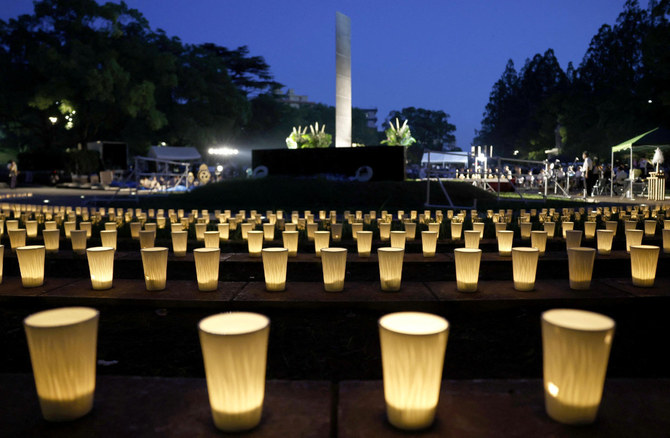

TOKYO: Nagasaki’s mayor said Thursday it was “unfortunate” that US and British ambassadors have refused to attend a ceremony marking the 1945 atomic bombing of the Japanese city because Israel was snubbed.
But he defended the decision not to invite Israel to Friday’s annual event, repeating that it was “not political” but to avoid possible protests related to the Gaza conflict.
“It is unfortunate that they have communicated to us that their ambassadors are not able to attend,” Shiro Suzuki told reporters.
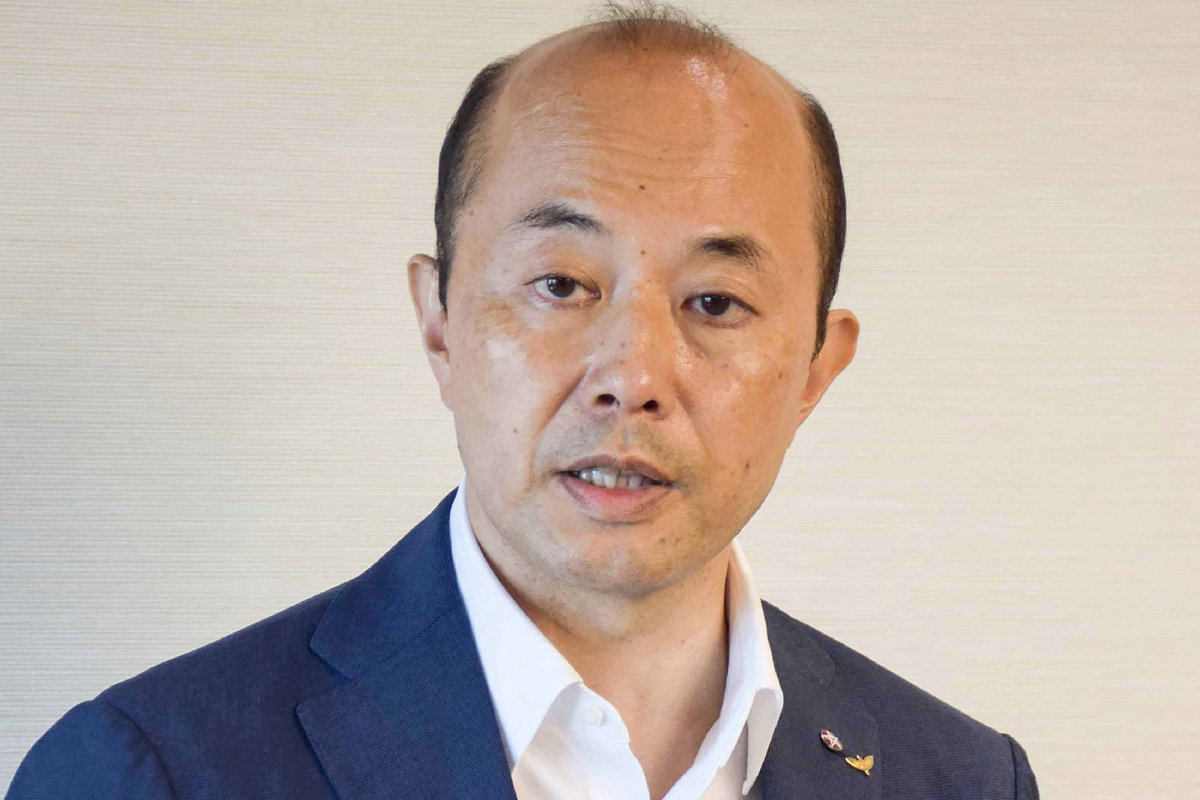
Nagasaki City Mayor Shiro Suzuki speaks to the media at the City Hall in Nagasaki on August 8, 2024, a day before the annual memorial to mark the 79th anniversary of the atomic bombing of the city. (JIJI Press via AFP)
“We made a comprehensive decision not for political reasons. We want to conduct a smooth ceremony in a peaceful and solemn environment.”
On August 9, 1945, the United States dropped an atomic bomb on Nagasaki, killing 74,000 people including many who survived the explosion but died later from radiation exposure.
This came three days after the first nuclear bomb on Hiroshima that killed 140,000 people.
Japan announced its surrender in World War II on August 15, 1945.
The United States, Britain, France, Italy and the European Union — plus reportedly Canada and Australia — are all sending diplomats below ambassador level to the ceremony.
Only the US and British embassies made an explicit link to Nagasaki’s decision not to invite Israel’s ambassador Gilad Cohen, although a source told AFP that Italy’s move was also a direct consequence.
In Washington, State Department spokesman Matthew Miller said the United States believed it was “important that the Israeli ambassador be invited as the ambassadors of other countries have been invited, that no country should have been singled out.”
“I think our position on it and our respect for Japan when it comes to this anniversary is well-documented, and goes beyond — far beyond — the ambassador not attending one event,” Miller said.
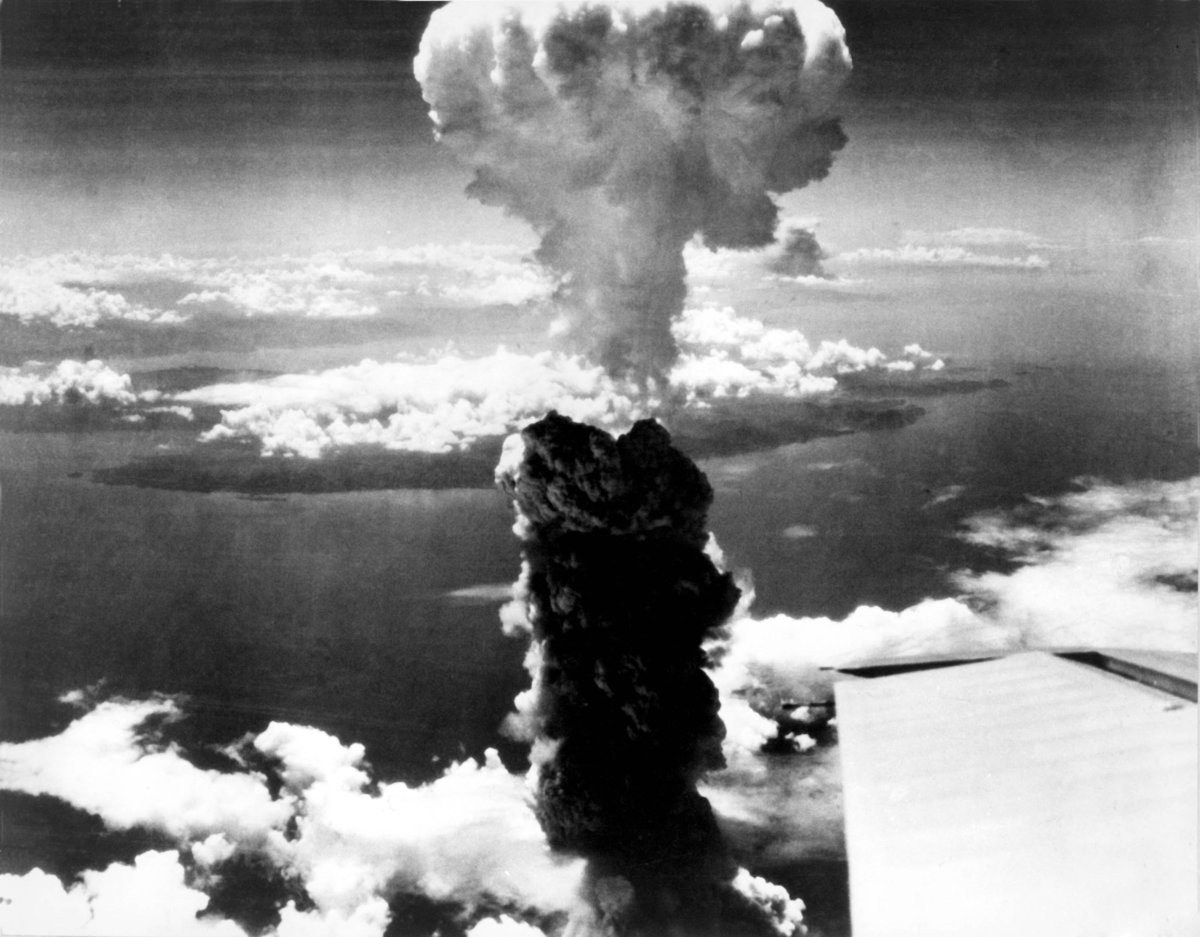
A mushroom cloud rises more than 60,000 feet into the air over Nagasaki, Japan after an atomic bomb was dropped by the US bomber "Enola Gay", Aug. 9, 1945. (Shutterstock)
US ambassador Rahm Emanuel, who was former president Barack Obama’s chief of staff, plans to go to a commemoration at a temple in Tokyo instead.
An Obama-named ambassador to Japan, John Roos, in 2010 became the first US representative to attend the Hiroshima commemoration and followed suit in Nagasaki two years later.
Obama visited Hiroshima in 2016. The United States has never apologized for the bombings, the only nuclear attacks in history.
The British embassy said leaving out Israel created “an unfortunate and misleading equivalency with Russia and Belarus — the only other countries not invited to this year’s ceremony.” Germany echoed that position.
A spokesperson for the French embassy called Suzuki’s decision “regrettable and questionable.”
Cohen, who attended a similar memorial ceremony in Hiroshima on Tuesday, said last week that the Nagasaki decision “sends a wrong message to the world.”
On Thursday Cohen thanked “all the countries that have chosen to stand with Israel and oppose its exclusion from the Nagasaki Peace Ceremony.”
“Thank you for standing with us on the right side of history,” Cohen said on X, formerly Twitter.


