Hottest oceans in 400 years endanger Great Barrier Reef, scientists say

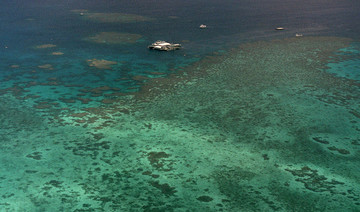
Since 2016, Australia’s Great Barrier Reef has experienced five summers of mass coral bleaching, when large sections of the reef turn white due to heat stress. These summers were during five of the six warmest years in the last four centuries. (AFP)
Short Url
Updated 09 August 2024
Follow

Hottest oceans in 400 years endanger Great Barrier Reef, scientists say

  • Ocean temperatures that were stable for hundreds of years began to rise from 1900 onwards as a result of human influence
  • Since 2016, the reef has experienced five summers of mass coral bleaching, when large sections of the reef turn white due to heat stress

SYDNEY: Water temperatures in and around Australia’s Great Barrier Reef have risen to their warmest in 400 years over the past decade, placing the world’s largest reef under threat, according to research published on Thursday.
The reef, the world’s largest living ecosystem, stretches for some 2,400 km off the coast of the northern state of Queensland. The research is rare in putting the effects of man-made climate change into historical context, as other surveys on damage to the reef have a shorter time frame.
A group of scientists at universities across Australia drilled cores into the coral and, much like counting the rings on a tree, analyzed the samples to measure summer ocean temperatures going back to 1618.


Combined with ship and satellite data going back around a hundred years, the results show ocean temperatures that were stable for hundreds of years begin to rise from 1900 onwards as a result of human influence, the research concluded.
From 1960 to 2024, the study’s authors observed an average annual warming for January to March of 0.12°C (0.22°F) per decade.
Since 2016, the reef has experienced five summers of mass coral bleaching, when large sections of the reef turn white due to heat stress, putting them at greater risk of death.
These summers were during five of the six warmest years in the last four centuries, the study showed.
“The world is losing one of its icons,” said Benjamin Henley, an academic at the University of Melbourne and one of the study’s co-authors.
“I find that to be an absolute tragedy. It’s hard to understand how that can happen on our watch in our lifetime. So it’s very, very sad.”
The last temperature data point, from January to March of this year, was the highest on record and “head and shoulders” above any other year, Henley said.
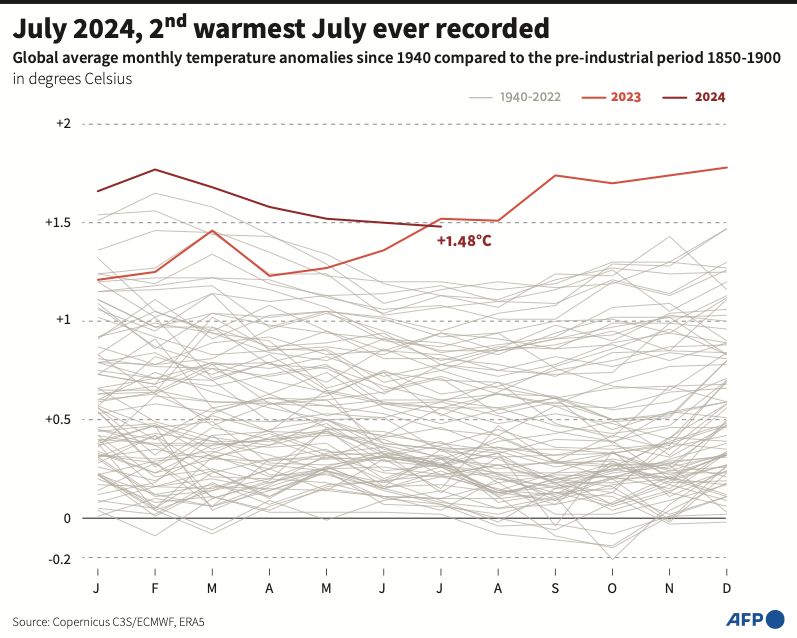

Coral reefs protect shorelines from erosion, are home to thousands of species of fish, and are an important source of tourism revenue in many countries.
At least 54 countries and regions have experienced mass bleaching of their reefs since February 2023 as climate change warms the ocean’s surface waters, the US National Oceanic and Atmospheric Administration (NOAA) has said.
The Great Barrier Reef is not currently on UNESCO’s list of world heritage sites that are in danger, though the UN recommends it should be added.
Australia has lobbied for years to keep the reef — which contributes A$6.4 billion ($4.2 billion) to the economy annually — off the endangered list, as it could damage tourism.
Lissa Schindler, Great Barrier Reef campaign manager at the Australian Marine Conservation Society, said the research showed Australia needed to do more to reduce its emissions.
“Australia must increase its ambition, action and commitments to battle climate change and protect our greatest natural asset,” she said.

The Yazidi nightmare
Ten years after the genocide, their torment continues

Enter


keywords

Second doctor in Matthew Perry overdose case sentenced to home confinement

Updated 17 December 2025
Follow

Second doctor in Matthew Perry overdose case sentenced to home confinement

  • Dr. Mark Chavez, 55, a onetime San Diego-based physician, pleaded guilty in federal court in October
  • Judge Sherilyn Peace Garnett also sentenced Chavez to 300 hours of community service

LOS ANGELES: A second California doctor was sentenced on Tuesday to eight months of home confinement for illegally supplying “Friends” star Matthew Perry with ketamine, the powerful sedative that caused the actor’s fatal drug overdose in a hot tub in 2023.
Dr. Mark Chavez, 55, a onetime San Diego-based physician, pleaded guilty in federal court in October to a single felony count of conspiracy to distribute the prescription anesthetic and surrendered his medical license in November.
Judge Sherilyn Peace Garnett also sentenced Chavez to 300 hours of community service. As part of his plea agreement, Chavez admitted to selling ketamine to another physician Dr. Salvador Plasencia, 44, who in turn supplied the drug to Perry, though not the dose that ultimately killed the performer. Plasencia, who pleaded guilty to four counts of unlawful drug distribution, was sentenced earlier this month to 2 1/2 years behind bars.
He and Chavez were the first two of five people convicted in connection with Perry’s ketamine-induced death to be sent off to prison.
The three others scheduled to be sentenced in the coming weeks — Jasveen Sangha, 42, a drug dealer known as the “Ketamine Queen;” a go-between dealer Erik Fleming, 56; and Perry’s former personal assistant, Iwamasa, 60.
Sangha admitted to supplying the ketamine dose that killed Perry, and Iwamasa acknowledged injecting Perry with it. It was Iwamasa who later found Perry, aged 54, face down and lifeless, in the jacuzzi of his Los Angeles home on October 28, 2023.
An autopsy report concluded the actor died from the acute effects of ketamine,” which combined with other factors in causing him to lose consciousness and drown.
Perry had publicly acknowledged decades of substance abuse, including the years he starred as Chandler Bing on the hit 1990s NBC television series “Friends.”
According to federal law enforcement officials, Perry had been receiving ketamine infusions for treatment of depression and anxiety at a clinic where he became addicted to the drug.
When doctors there refused to increase his dosage, he turned to unscrupulous providers elsewhere willing to exploit Perry’s drug dependency as a way to make quick money, authorities said. Ketamine is a short-acting anesthetic with hallucinogenic properties that is sometimes prescribed to treat depression and other psychiatric disorders. It also has seen widespread abuse as an illicit party drug.