

Pakistan cautions Palestine, Iran against fulfilling Netanyahu’s ‘wider war’ designs in avenging assassinations

1 / 2
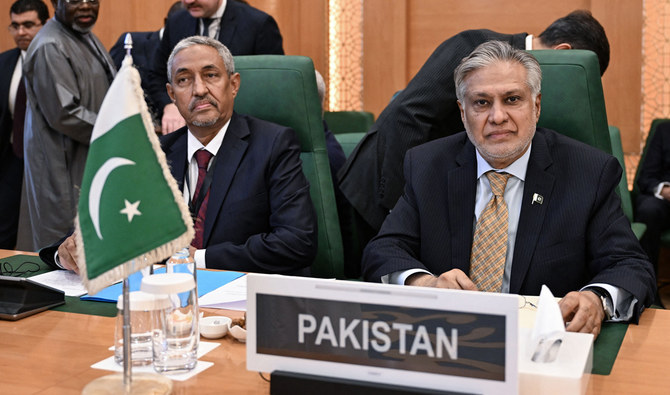
Pakistan’s Foreign Minister Ishaq Dar (R) attends the Organization of Islamic Cooperation (OIC) meeting in Jeddah on August 7, 2024. (AFP)
2 / 2
In this handout photograph, taken and released by Pakistan Ministry of Foreign Affairs, Pakistan’s Deputy Prime Minister and Foreign Minister Ishaq Dar (2L) gestures during a meeting with Hissein Brahim Taha (3R), secretary-general of the Organization of Islamic Cooperation, in Jeddah on August 7, 2024, on the sidelines of the Open-Ended Extraordinary Meeting of OIC Executive Committee. (Photo courtesy: MOFA)
Short Url
Updated 08 August 2024
Follow

Pakistan cautions Palestine, Iran against fulfilling Netanyahu’s ‘wider war’ designs in avenging assassinations

  • Deputy PM Dar is in Jeddah to attend an OIC Executive Council meeting on Palestine
  • Calls for trade, oil sanctions against Israel if it does not relent military campaign in Gaza

ISLAMABAD: Pakistan’s Deputy Prime Minister and Foreign Minister Ishaq Dar on Wednesday urged Iran and Palestine against fulfilling Benjamin Netanyahu’s designs for a “wider war” in the Middle East by avenging recent assassinations carried out by Israel.
Dar is in Jeddah to attend the OIC’s Executive Council meeting which was convened on requests by Palestine and Iran. The intergovernmental body discussed the ongoing Israeli aggression against Palestine and other regional states during the meeting. 
Tensions have escalated in the Middle East after Hamas’ political chief Ismail Haniyeh was killed in Tehran last week when a short-range projectile was fired at his accommodation. Iran blamed Israel for the attack, vowing vengeance against the Jewish state. 
“We fully understand the determination of the Islamic Republic of Iran and the Palestinian people to respond to and avenge the provocative and criminal assassinations by Israel and the flagrant violation of international law,” Dar told participants of the meeting.
“While such grave action must be avenged, we must not fulfill Netanyahu’s design for a wider war.”
Almost 40,000 Palestinians have been killed in an Israeli military campaign in Gaza triggered by a Hamas-led attack on southern Israel on Oct. 7 last year.

Dar urged OIC member states to respond to Israel with “several collective measures” if it does not relent from its military campaign in Gaza.
“We should make it clear: if the Israeli leadership continues to subvert the legally binding demand for an immediate and permanent ceasefire, the entire OIC membership would take several collective measures in response, including imposition of trade and oil sanctions,” he said.
The Pakistani minister urged OIC countries to enhance their assistance for Palestinians in Gaza so that their demands for food, medicines, energy and other essential supplies are met. He also called for Palestine’s admission as a “full member” of the United Nations. 
DAR MEETS OIC CHIEF
The Pakistani foreign minister separately met OIC Secretary-General Hissein Brahim Taha on the sidelines of the meeting. 

Both leaders discussed the situation in Gaza, Indian-administered Kashmir, Islamophobia, discrimination and violence against Muslims, Pakistan’s foreign ministry said in a statement.
“The foreign minister underscored the urgency of a ceasefire and unhindered supply of humanitarian assistance for the Palestinian people,” the statement said.
Dar also met the foreign ministers of Algeria and Malaysia to discuss bilateral ties and economic cooperation between the two countries.
In his meeting with Algeria’s Ahmad Attaf, the Pakistani minister noted the historic ties between the two countries, the foreign ministry added.
“Deputy Prime Minister Dar and Foreign Minister Attaf agreed to further strengthen bilateral economic ties through enhanced trade and investment,” it said.
With his Malaysian counterpart, Dar spoke about enhancing bilateral trade and investment, educational linkages, capacity building of workforce, and people-to-people contacts between the two countries.


Pakistan’s president defends ongoing strikes in Afghanistan, urges Kabul to dismantle militants

Updated 02 March 2026
Follow

Pakistan’s president defends ongoing strikes in Afghanistan, urges Kabul to dismantle militants

  • Afghanistan on Thursday launched attacks in retaliation for Pakistani airstrikes the previous Sunday
  • Pakistan’s military says it is only targeting Afghan military installations to avoid civilian casualties

ISLAMABAD: Pakistan’s president on Monday defended his country’s ongoing military strikes in neighboring Afghanistan, saying Islamabad tried all forms of diplomacy before targeting militants operating from Afghan territory, and called on the Taliban government in Kabul to disarm groups responsible for attacks in Pakistan.

Pakistan earlier said it is in “open war” with Afghanistan, alarming the international community. The border area remains a stronghold for militant organizations including Al-Qaeda and the Daesh (Islamic State) group.

“(The Afghan Taliban) must choose to dismantle the terror groups that survive on conflict and its war economy,” Asif Ali Zardari said during a speech to lawmakers, adding that “no state accepts serial attacks on its soil.”

Afghanistan on Thursday launched attacks in retaliation for Pakistani airstrikes the previous Sunday. Since then, Pakistan has carried out operations along the border, with Information Minister Attaullah Tarar claiming the killing of 435 Afghan forces and the capture of 31 Afghan positions.

Kabul has denied such claims.

In Afghanistan, the deputy government spokesman Hamdullah Fitrat said Pakistan’s military fired mortar shells at a refugee camp in eastern Kunar province, killing three children and injuring three others.

Afghanistan’s defense ministry said Afghan forces carried out strikes targeting a Pakistani military facility near Paktia province, causing “substantial losses and heavy casualties.”

Pakistan’s military did not respond to questions. It has said Pakistan is only targeting Afghan military installations to avoid civilian casualties.

Pakistan has witnessed a surge of violence in recent months and blames it on the outlawed Pakistani Taliban, known as Tehreek-e-Taliban Pakistan or TTP. It operates both inside Pakistan and from Afghan territory.
Islamabad accuses Afghanistan’s Taliban government of providing safe havens for the TTP, which Kabul denies.

The latest cross-border fighting ended a ceasefire brokered by Qatar and Turkiye in October. The two sides failed to reach a permanent agreement during talks in Istanbul.

Zardari reiterated Pakistan’s call for talks, saying, “We have never walked away from dialogue.”

The Pakistani leader again accused Afghanistan of acting as a proxy for India by sheltering militant groups.

“Stop being used by another country as a battlefield for their ambitions,” he said.

Zardari cited a recent report from the United Nations Security Council’s monitoring team that described the presence of militant groups in Afghanistan as an extra-regional threat.