

Pakistan cautions Palestine, Iran against fulfilling Netanyahu’s ‘wider war’ designs in avenging assassinations

1 / 2
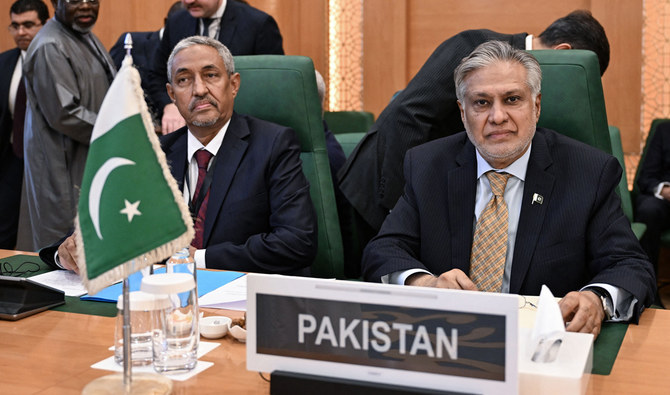
Pakistan’s Foreign Minister Ishaq Dar (R) attends the Organization of Islamic Cooperation (OIC) meeting in Jeddah on August 7, 2024. (AFP)
2 / 2
In this handout photograph, taken and released by Pakistan Ministry of Foreign Affairs, Pakistan’s Deputy Prime Minister and Foreign Minister Ishaq Dar (2L) gestures during a meeting with Hissein Brahim Taha (3R), secretary-general of the Organization of Islamic Cooperation, in Jeddah on August 7, 2024, on the sidelines of the Open-Ended Extraordinary Meeting of OIC Executive Committee. (Photo courtesy: MOFA)
Short Url
Updated 08 August 2024
Follow

Pakistan cautions Palestine, Iran against fulfilling Netanyahu’s ‘wider war’ designs in avenging assassinations

  • Deputy PM Dar is in Jeddah to attend an OIC Executive Council meeting on Palestine
  • Calls for trade, oil sanctions against Israel if it does not relent military campaign in Gaza

ISLAMABAD: Pakistan’s Deputy Prime Minister and Foreign Minister Ishaq Dar on Wednesday urged Iran and Palestine against fulfilling Benjamin Netanyahu’s designs for a “wider war” in the Middle East by avenging recent assassinations carried out by Israel.
Dar is in Jeddah to attend the OIC’s Executive Council meeting which was convened on requests by Palestine and Iran. The intergovernmental body discussed the ongoing Israeli aggression against Palestine and other regional states during the meeting. 
Tensions have escalated in the Middle East after Hamas’ political chief Ismail Haniyeh was killed in Tehran last week when a short-range projectile was fired at his accommodation. Iran blamed Israel for the attack, vowing vengeance against the Jewish state. 
“We fully understand the determination of the Islamic Republic of Iran and the Palestinian people to respond to and avenge the provocative and criminal assassinations by Israel and the flagrant violation of international law,” Dar told participants of the meeting.
“While such grave action must be avenged, we must not fulfill Netanyahu’s design for a wider war.”
Almost 40,000 Palestinians have been killed in an Israeli military campaign in Gaza triggered by a Hamas-led attack on southern Israel on Oct. 7 last year.

Dar urged OIC member states to respond to Israel with “several collective measures” if it does not relent from its military campaign in Gaza.
“We should make it clear: if the Israeli leadership continues to subvert the legally binding demand for an immediate and permanent ceasefire, the entire OIC membership would take several collective measures in response, including imposition of trade and oil sanctions,” he said.
The Pakistani minister urged OIC countries to enhance their assistance for Palestinians in Gaza so that their demands for food, medicines, energy and other essential supplies are met. He also called for Palestine’s admission as a “full member” of the United Nations. 
DAR MEETS OIC CHIEF
The Pakistani foreign minister separately met OIC Secretary-General Hissein Brahim Taha on the sidelines of the meeting. 

Both leaders discussed the situation in Gaza, Indian-administered Kashmir, Islamophobia, discrimination and violence against Muslims, Pakistan’s foreign ministry said in a statement.
“The foreign minister underscored the urgency of a ceasefire and unhindered supply of humanitarian assistance for the Palestinian people,” the statement said.
Dar also met the foreign ministers of Algeria and Malaysia to discuss bilateral ties and economic cooperation between the two countries.
In his meeting with Algeria’s Ahmad Attaf, the Pakistani minister noted the historic ties between the two countries, the foreign ministry added.
“Deputy Prime Minister Dar and Foreign Minister Attaf agreed to further strengthen bilateral economic ties through enhanced trade and investment,” it said.
With his Malaysian counterpart, Dar spoke about enhancing bilateral trade and investment, educational linkages, capacity building of workforce, and people-to-people contacts between the two countries.


Pakistan improves water management but remains highly vulnerable to floods, shortages — report

Updated 9 sec ago
Follow

Pakistan improves water management but remains highly vulnerable to floods, shortages — report

  • Asian Water Development Outlook says national water security score up 6.4 points since 2013 but service delivery still weak
  • ADB-linked report warns that groundwater dependence, urban demand and ecosystem decline remain critical risks

ISLAMABAD: Pakistan has strengthened its water governance and planning capacity over the past decade but continues to face serious risk from climate shocks, declining freshwater availability and weak service provision, according to the Asian Water Development Outlook 2025.

The regional water security assessment linked to the Asian Development Bank evaluates countries across Asia on water supply, governance, climate resilience, urban systems and environmental health. 

The study found that Pakistan has made policy progress since 2013, yet implementation remains inconsistent and the country is still exposed to extreme weather events, rapid population growth and stressed aquifers. The assessment warns that improvement has not kept pace with risk.

“Pakistan’s national water security score improved moderately from 2013 to 2025 by 6.4 points. At the same time, water governance performance, measured through SDG 6.5.1, rose from 50 percent in 2017 to 63 percent in 2023,” the report said. 

Despite these gains, rural supply and service reliability remain uneven. 

“Pakistan’s rural household water security remains under pressure due to ineffective service models, limited surveillance, and persistent contamination,” while economic performance is hampered by “falling per capita water availability, insufficient storage, and heavy reliance on poorly monitored groundwater resources for industrial activity,” according to the report.

Pakistan’s cities remain under pressure, with infrastructure struggling to match population growth and demand: 

“Urban water security has shown only modest gains, with rising demand, untreated wastewater and urban flooding straining infrastructure and service delivery.”

Environmental conditions have also deteriorated, driven by unchecked industrial discharge and limited regulatory enforcement. 

“Environmental water security has declined slightly, as rapid population growth, industrial activity, and untreated wastewater continue to degrade aquatic ecosystems,” the report added. 

Pakistan remains highly exposed to disasters including major floods, droughts and glacial lake outburst floods (GLOFs). The report cites the 2022 monsoon crisis, noting that it “affected over 24 million people.” 

While early-warning systems are improving, infrastructure investment and coordinated management remain inadequate.

The document concludes that Pakistan must convert policy gains into ground-level delivery by expanding financing, strengthening provincial coordination and scaling ecosystem protection to stabilize long-term water security.