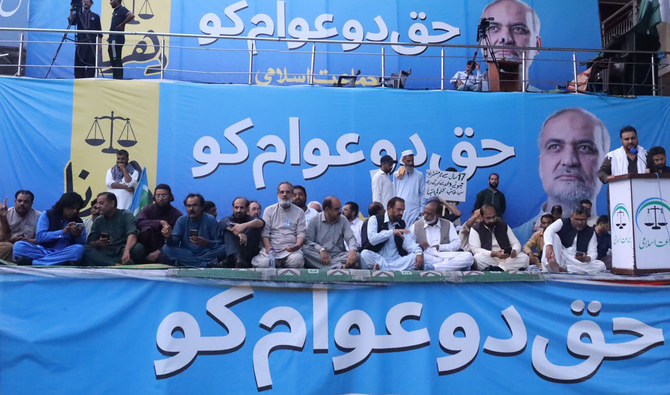
ISLAMABAD: Hafiz Naeem-ur-Rehman, the chief of the Jamaat-e-Islami party which has been holding a sit-in in the garrison city of Rawalpindi against inflation and high electricity costs, on Wednesday threatened to launch a civil disobedience movement if the government did not meet its demands.
Around 3,000 supporters of the religious political party, demanding that the government withdraw taxes on electricity to offset price hikes, have occupied a road in Rawalpindi since July 26, after being prevented by police from heading to the capital, Islamabad.
Several rounds of talks have been held between a government negotiating team and protest leaders but there has been no breakthrough so far.
“Our sit-in protest is continuing and we will march tomorrow [Aug. 8] on Murree Road [Rawalpindi], on Aug. 11 we will stage a sit-in protest outside the Chief Minister’s House in Lahore, on Aug. 12 we will protest in Peshawar, on Aug. 16 we will also hold a sit-in protest in Multan,” Rehman told reporters on Wednesday.
“We also have the option to call a strike. And if they [the government] still don’t change after all this, we also have the option to peacefully appeal to the people to not pay electricity bills. We don’t want things to get to that point.”
The government raised power prices 26 percent during the last fiscal year, which ended June 30, before tacking on another 20 percent increase on July 13. Officials say the increases were needed to meet conditions set by the International Monetary Fund for a $7 billion loan deal reached last month.
The government has also added a confusing bevy of taxes on top of the base price, adding up to a bill that has more than doubled for some Pakistanis.
“Striking is our democratic right, that we appeal to the people to peacefully shut down their businesses,” Rehman said. “Already they [government] have led to the collapse of people’s businesses.

Pakistani party holding protests against inflation threatens civil disobedience, new sit-ins
https://arab.news/gxtnc
Pakistani party holding protests against inflation threatens civil disobedience, new sit-ins
- Hafiz Naeem-ur-Rehman, chief of the Jamaat-e-Islami party, says will appeal to people not to pay electricity bills
- Around 3,000 supporters of the Jamaat-e-Islami have occupied a road in the garrison city of Rawalpindi since July 26
Pakistan reports current account surplus in Jan. owing to improved trade, remittances
- Pakistan’s exports crossed the $3 billion mark in Jan. as the country received $3.5 billion in remittances
- Last month, IMF urged Pakistan to accelerate pace of structural reforms to strengthen economic growth
ISLAMABAD: Pakistan recorded a current account surplus of more than $120 million in January, the country’s finance adviser said on Tuesday, attributing it to improved trade balance and remittance inflows.
Pakistan’s exports rebounded in January 2026 after five months of weak performance, rising 3.73 percent year on year and surging 34.96 percent month on month, according to data released by the country’s statistics bureau.
Exports crossed the $3 billion mark for the first time in January to reach $3.061 billion, compared to $2.27 billion in Dec. 2025. The country received $3.5 billion in foreign remittances in Jan. 2026.
Khurram Schehzad, an adviser to the finance minister, said Pakistan reported a current account surplus of $121 million in Jan., compared to a current account deficit of $393 million in the same month last year.
“Improved trade balance in January 2026, strong remittance inflows, and sustained momentum in services exports (IT/Tech) continue to reinforce the country’s external account position,” he said on X.
Pakistan has undergone a difficult period of stabilization, marked by inflation, currency depreciation and financing gaps, and international rating agencies have acknowledged improvements after Islamabad began implementing reforms such as privatizing loss-making, state-owned enterprises (SOEs) and ending subsidies as part of a $7 billion International Monetary Fund (IMF) loan program.
Late last month, the IMF urged Pakistan to accelerate the pace of these structural reforms to strengthen economic growth.
Responding to questions from Arab News at a virtual media roundtable on emerging markets’ resilience, IMF’s director of the Middle East and Central Asia Jihad Azour said Islamabad’s implementation of the IMF requirements had been “strong” despite devastating floods that killed more than 1,000 people and devastated farmland, forcing the government to revise its 4.2 percent growth target to 3.9 percent.
“What is important going forward in order to strengthen growth and to maintain the level of macroeconomic stability is to accelerate the structural reforms,” he said at the meeting.
Azour underlined Pakistan’s plans to privatize some of the SOEs and improve financial management of important public entities, particularly power companies, as an important way for the country to boost its capacity to cater to the economy for additional exports.
“This comes in addition to the effort that the authorities have made in order to reform their tariffs, which will allow the private sector of Pakistan to become more competitive,” the IMF official said.


