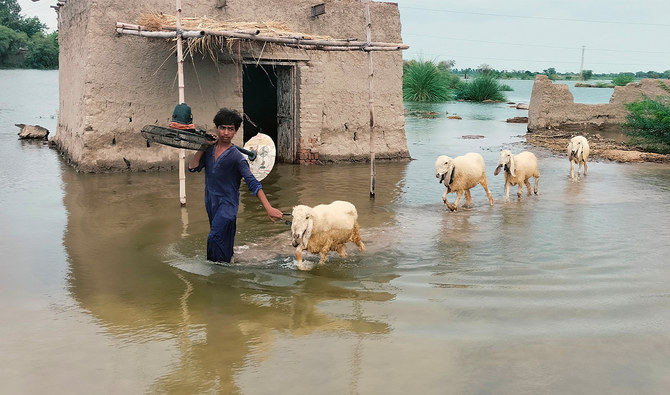
ISLAMABAD: The Provincial Disaster Management Authority (PDMA) of Punjab said on Wednesday it relocated about 60 people along with livestock to safer locations while conducting relief work in the low-lying flood-affected areas along the Indus River.
The authorities in the province announced a day earlier that 54 people had lost their lives during this year’s monsoon season in Pakistan, with 141 others injured in various rain-related incidents.
Two years ago, torrential rains triggered flash floods in many parts of the country, killing over 1,700 people, inflicting losses of around $30 billion, and affecting at least 30 million people.
The PDMA mentioned moderate flooding at Chashma and Taunsa on the Indus River in a statement, adding that five nearby villages had been submerged by floodwaters.
“Due to the proactive measures by PDMA and the provincial administration, there has been no loss of life or property,” Irfan Ali Kathia, the top PDMA official, said. “Residents and their livestock were timely rescued from the affected areas.”
“Eight boats and 34 rescue workers were engaged in relief activities in the flood-affected areas,” he added. “Sixty-one people were safely relocated to secure locations. More than 650 livestock were also moved to safe areas.”
Kathia said the authorities also provided food and free transport to the affected individuals.
He informed they also gave medicines and vaccination facilities to protect the livestock from diseases.
“Administrative officers remained present in the field at all times,” he said. “Relief activities will continue until the evacuation and rehabilitation of citizens are complete.”

Authorities in Pakistan’s Punjab relocate 60 citizens amid flood relief efforts along Indus River
https://arab.news/r46e2
Authorities in Pakistan’s Punjab relocate 60 citizens amid flood relief efforts along Indus River
- Five villages have been submerged due to moderate flooding at Chashma and Taunsa on the river
- Authorities say eight boats and 34 rescue workers have participated in relief activities in the area
Pakistan’s Punjab deploys satellites, drones, AI to combat smog
- Senior minister warns industrial masks may become necessary without a change in public attitudes toward pollution
- Cities in Punjab face worsening smog each winter, driven by crop burning, vehicle emissions and industrial pollution
ISLAMABAD: Punjab Senior Minister Marriyum Aurangzeb on Wednesday said Pakistan’s most populous province deployed satellites, drones and artificial intelligence to tackle smog, warning that industrial masks may become necessary if public attitudes toward air pollution did not change.
Punjab cities face worsening smog each winter, driven by crop burning, vehicle emissions and industrial pollution that threatens public health and daily life. The smog season typically begins in late October, peaks between November and January and can persist through February.
Smog causes symptoms such as sore throats, eye irritation and respiratory illnesses, while prolonged exposure raises the risk of stroke, heart disease and lung cancer. Children are more vulnerable due to higher breathing rates and weaker immune systems.
“We have the AI machine-learning forecasting system in place, surveillance drones and technology cameras,” Aurangzeb said while addressing an event.
“At present, what is considered one of the world’s best environmental protection forces — with training, equipment, technology and digitally integrated data — is operating in Punjab,” she added.
Aurangzeb said surveillance is now being carried out through drones.
“There is monitoring, technology, cameras,” she continued. “Everything is digital.”
The minister maintained the eastern corridor from India was a major source of smoke which becomes active during the winter season.
She said this was the first time a complete testing system was introduced by the Environmental Protection Agency to measure pollution released by vehicles.
She added the government has loaned 5,000 super seeders to farmers, which are agricultural machines that plant crops directly into fields without removing leftover stubble, reducing crop burning, and helping curb winter smog.
Aurangzeb warned the situation could reach a point where people may have to use industrial masks and carry therm around like a “purse or wallet.”
“This will become a mandatory item if we do not change our attitudes and habits toward air quality, climate and conservation.”
Pakistan’s main urban centers routinely rank among the most polluted cities in the world, with vehicular emissions remaining one of the top contributors to air pollution.
The severe air pollution also undermines economic productivity and diminishes the quality of life for millions of residents.


