

Pakistan urges citizens to leave Lebanon amid escalating tensions in Middle East

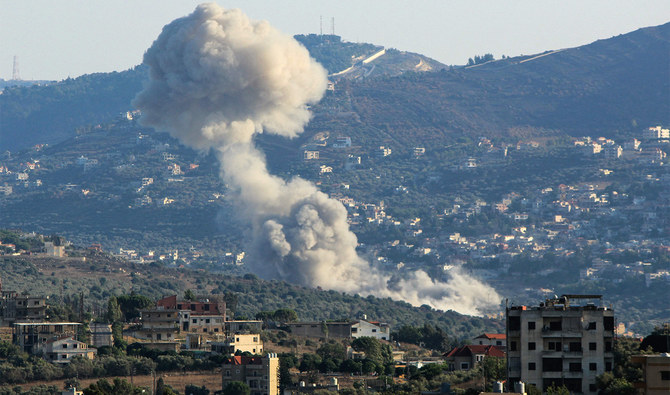
Smoke billows from the site of an Israeli strike on the southern Lebanese village of Kfar Kila on August 6, 2024. (AFP)
Short Url
Updated 07 August 2024
Follow

Pakistan urges citizens to leave Lebanon amid escalating tensions in Middle East

  • Tensions mounted in the region following the assassinations of a Hezbollah commander, Hamas political chief
  • The assassinations led to fears of a broader regional conflict as Iran threatened to retaliate against Israel

ISLAMABAD: Pakistan’s foreign office issued an advisory related to Lebanon on Tuesday, urging its citizens to leave the Arab country or avoid traveling there amid escalating security tensions in the region following the recent assassinations of a Hezbollah commander in Beirut and the Hamas political chief in Tehran.

The killings of Hezbollah’s Fouad Shukr and Hamas’s Ismail Haniyeh occurred within a span of a few hours in different parts of the Middle East last month, raising fears of a broader regional conflict as Iran threatened to retaliate against Israel in response to the latter event.

The Netanyahu administration did not claim responsibility for targeting Haniyeh, though it was widely believed to be behind the attack in Tehran while the Hamas leader was visiting Iran to attend the inauguration of its new president.

Iran-backed Hezbollah in Lebanon has already been engaged in skirmishes with Israel since the beginning of the conflict in Gaza on October 7.

“In view of the recent developments and the prevailing security situation in the region, all Pakistanis are advised to avoid travel to Lebanon till further notice,” the foreign office said in the advisory.

“All Pakistani nationals presently residing in Lebanon are advised to leave Lebanon while the commercial flights remain available,” it continued. “Those staying in Lebanon are advised to exercise extreme caution especially with regard to vulnerable areas.”

The foreign office also shared the contact details of its diplomatic mission Beirut, asking its citizens in Lebanon to remain in contact with its embassy.

Israel launched its air and ground offensive targeting Gaza last October following a surprise attack by Hamas in which around 1,200 people were killed and more than 250 were taken hostages.

The Palestinian group said its attack was in response to the deteriorating condition of Palestinian people living under occupation.

Israel’s response was widely viewed as disproportionate by the international community in which nearly 40,000 people, mostly women and children, have died.

Since the outset of the conflict, the international community has remained concerned the war could also spread to other parts of the Middle East.


US sees 18 percent rise in Pakistani students despite UGRAD pause, opens new USEFP headquarters

Updated 9 sec ago
Follow

US sees 18 percent rise in Pakistani students despite UGRAD pause, opens new USEFP headquarters

  • USEFP inaugurates purpose-built campus in Islamabad as Fulbright program marks 75 years in Pakistan
  • Undergraduate UGRAD program remains suspended but graduate scholarships and visas continue, US officials say

ISLAMABAD: The United States inaugurated a new purpose-built headquarters for the United States Educational Foundation in Pakistan (USEFP) this week, as American officials reported an 18 percent rise in Pakistani students studying in the US, despite the suspension of a major undergraduate exchange scheme earlier this year.

The launch comes as the Fulbright program completes 75 years in Pakistan, the world’s largest US-funded scholarship portfolio for master’s and PhD study. Officials said growing student mobility and stable visa issuance reflect continued academic engagement between the two countries, even after the UGRAD exchange program was paused in April.

USEFP Executive Director Peter Moran told Arab News that Pakistani students are still securing visas without unusual difficulty and enrollment levels remain strong.

“We are not finding that Pakistani students are facing undue difficulties getting their visas when they want to go and study on their own. The number of Pakistani students who are studying in the United States, actually based on data from the year before last, because you know there’s always a lag, it’s up 18 percent,” Moran said, citing 2023 figures.

He said nearly 10,000 Pakistanis are currently enrolled in US institutions, including self-funded students. While UGRAD, which previously sent 100–130 undergraduates per year, remains paused under US budget adjustments, Moran said there is hope it will return.

“So, the UGRAD program for now is on pause ... the UGRAD program sent undergraduate, actually high school students. That program ended in April. We don’t know when that will come back, but we sure hope that it will.”

USEFP clarified that no reductions have been applied to graduate programs.

“There is no cut on Fulbright… and we don’t anticipate there being any,” Moran added.

Around 65 Pakistani scholars left for the US through Fulbright this year, another 10–12 departed under the Humphrey Fellowship, and USEFP expects next year’s Fulbright cohort to rise to 75–80.

The inauguration of the new headquarters brought together US officials, scholarship alumni and education leaders.

US Embassy Minister Counselor for Public Diplomacy Andy Halus said the new facility reflects the depth of the bilateral academic partnership.

“We have over 9,000 students in Pakistan that have had experience in the United States on the Fulbright programs that started 70 years ago. Our commitment to sending more and more students to the United States on the Fulbright program is strong and it’s going to continue.”

Among attendees was Fulbright alumnus Aftab Haider, the CEO of Pakistan Single Window, the government-backed digital trade clearance platform. He credited the scholarship with shaping his career:

“I am a very proud Fulbrighter from 2008. I think it is one of the most transformational programs that can be offered to young Pakistanis to have the opportunity to be educated abroad, come back to Pakistan and contribute in public service delivery as well as in enhancement of the private sector.”