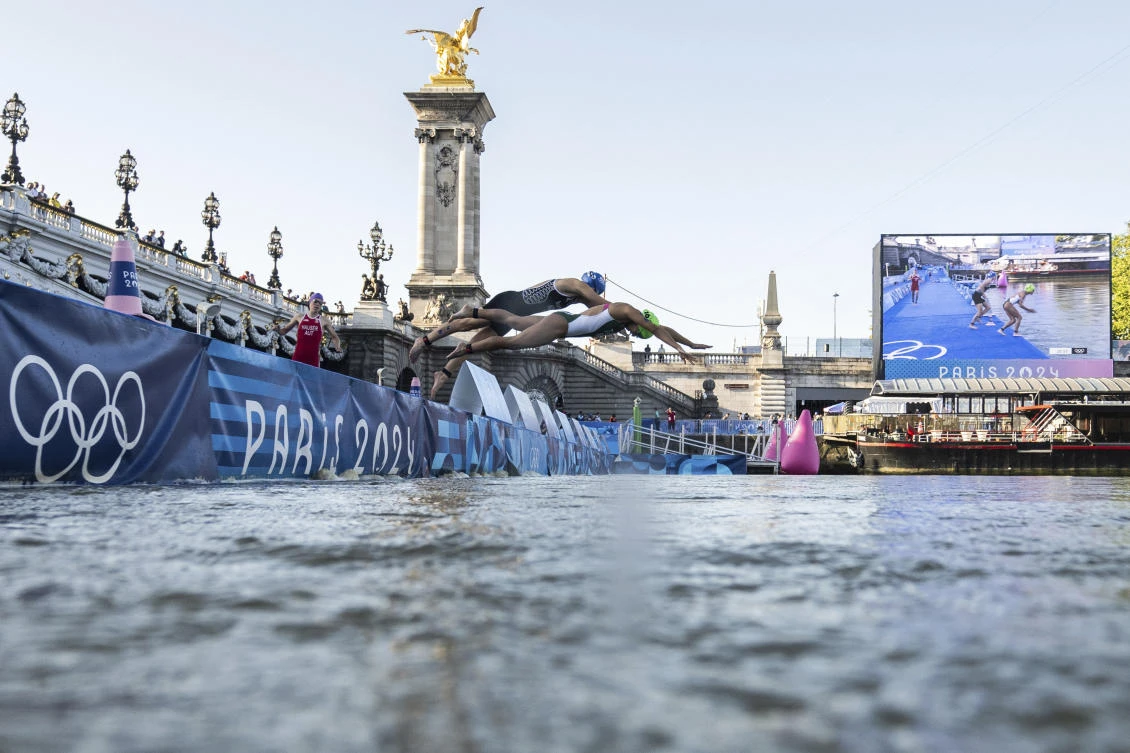
- World Aquatics made the decision to cancel the exercise at an early morning meeting, the organization said in a statement
- Another marathon swimming test event is scheduled for Wednesday, and organizers will decide early that morning whether it will go forward
PARIS: A test run meant to allow Olympic athletes to familiarize themselves with the marathon swimming course in the Seine River was canceled Tuesday over concerns about water quality in the Paris waterway.
World Aquatics made the decision to cancel the exercise at an early morning meeting, the organization said in a statement. Fluctuating bacteria levels in the long-polluted waterway have been a constant concern throughout the Games with the swimming portion of the triathlon and the marathon swimming events both planned in the river.
Another marathon swimming test event is scheduled for Wednesday, and organizers will decide early that morning whether it will go forward, the statement said. The women’s marathon swim competition is set for Thursday, while the men are scheduled to race Friday.
The cancelation of Tuesday’s marathon swimming test event comes a day after the triathlon mixed relay event was held in the river that runs through the center of the French capital. World Triathlon released data Tuesday showing that when the triathletes swam Monday, the levels of fecal bacteria E. coli and enterococci were within acceptable levels for the length of the triathlon relay course.
The swimming portion of the triathlon and the marathon swim both start and finish at the Pont Alexandre III, but the marathon swimming course extends farther down the river. Marathon swimmers do six laps on the 1.67-kilometer (1 mile) course for a total of 10 kilometers (6.2 miles.)
Water samples drawn early Monday showed E. coli levels ranging from “good” to “very good” at four collection points in the river, World Aquatics said.
It takes longer to cultivate enterococci samples, so the decision to cancel Tuesday’s test run relied on samples taken Sunday, organizers said. Monday’s enterococci levels were available by midmorning Tuesday and while they showed an improvement in the river’s water quality, one of four tests still fell short of World Aquatics standards.
Under both World Aquatics and World Triathlon guidelines, “good” water quality can include up to 1,000 colony-forming units of E. coli per 100 milliliters and up to 400 colony-forming units of enterococci per 100 milliliters.
A sample taken early Monday at Port du Gros Caillou, which is on the marathon swimming course but is beyond the point where triathletes turned around Monday, showed a level of 436 units of enterococci, data released Tuesday show.
Organizers said they “remain confident” that the marathon swimming events will happen in the Seine as planned based on “a favorable weather forecast and forward-looking analysis.”
Paris Mayor Anne Hidalgo, who took a highly publicized swim in the Seine last month to allay fears about water quality ahead of the Olympics, echoed that confidence.
“We will of course wait to get the results of the water quality but the event will take place because there’s been a clear improvement of the weather these past few days,” she said. “So I’m really proud and happy and to all those who want to continue saying it’s impossible to depollute a river, I tell them, ‘Yes it’s possible, we did it.’”
With a few exceptions, swimming in the Seine has been prohibited since 1923 because the water has been too toxic. Paris undertook ambitious plan, including 1.4 billion euros ($1.5 billion) in infrastructure improvements to ensure that some swimming events could be held in the river. That included the construction of a giant basin to capture excess rainwater and keep wastewater from flowing into the river, renovating sewer infrastructure and upgrading wastewater treatment plants.
Water quality in the Seine is closely linked to the weather. Heavy rains can cause wastewater and runoff to flow into the river, resulting in elevated bacteria levels, while warm temperatures and the sun’s ultraviolet rays can kill the germs and lower levels.
While the weather has mostly been hot and sunny during the Games, there have been several instances of drenching rains. Water quality concerns caused the cancelation of test swims in the Seine ahead of both the individual triathlon and triathlon mixed relay events and led to the postponement by a day of the men’s individual triathlon.
Four triathletes — of the more than 100 who competed in the men’s and women’s individual races last week — became sick in the following days, though it’s unclear whether the water was to blame.
Most strains of E. coli and enterococci are harmless, and some live in the intestines of healthy people and animals. But others are dangerous and even a mouthful of contaminated water can cause infections in the urinary tract or intestines. Several factors determine whether a person falls ill after exposure, chief among them a person’s age and general health.