

Putin asks Iran to avoid civilian casualties in Israel response, sources say

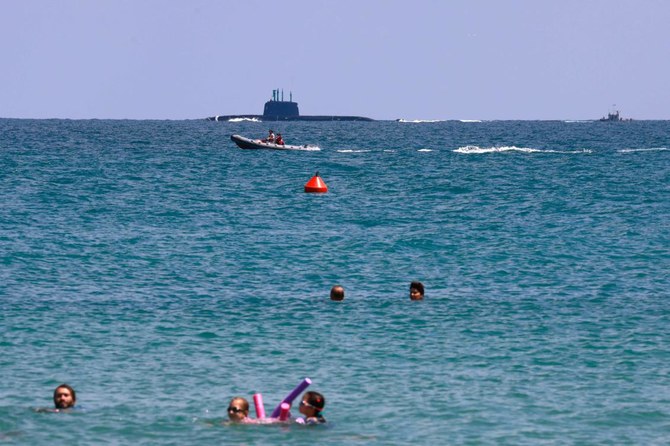
An Israeli navy submarine is pictured in the Mediterranean sea off the coast of Haifa on Aug. 6, 2024. (AFP)
Short Url
Updated 06 August 2024
Follow

Putin asks Iran to avoid civilian casualties in Israel response, sources say

  • The message, according to the sources, was delivered on Monday by Sergei Shoigu, a senior ally of the Kremlin leader, in meetings with top Iranian officials
  • Tehran also pressed Moscow for the delivery of Russian made Sukhoi Su-35 fighter jetsTehran also pressed Moscow for the delivery of Russian made Sukhoi Su-35 fighter jets

MOSCOW: Russian President Vladimir Putin has asked Iran’s Supreme leader Ayatollah Ali Khamenei for a restrained response to Israel’s suspected killing of the leader of Hamas, advising against attacks on Israeli civilians, two senior Iranian sources said.
The message, according to the sources, was delivered on Monday by Sergei Shoigu, a senior ally of the Kremlin leader, in meetings with top Iranian officials as the Islamic Republic weighs its response to the assassination of Ismail Haniyeh.
Tehran also pressed Moscow for the delivery of Russian made Sukhoi Su-35 fighter jets, the two Iranian sources, privy to the meeting in Tehran, the sources told Reuters.
In Moscow, the Kremlin did not respond to a request for comment. State-run RIA news agency reported on Tuesday that Shoigu said he discussed Haniyeh’s killing on his Tehran visit.
The two sources with knowledge of the matter did not provide further details on the talks with Shoigu, who was defense minister before becoming the secretary of Russia’s security council in May.
They said Shoigu’s visit was one of several avenues Moscow had used to relay to Iran the need for restraint while at the same time condemning Haniyeh’s killing as “a very dangerous assassination,” in a bid to prevent a Middle East war.
The Middle East, the sources said, was on the brink of a major war and those behind the assassination were clearly trying to trigger such a conflict.
Russia has cultivated closer ties with Iran since the start of its war with Ukraine and has said it is preparing to sign a wide-ranging cooperation agreement with Tehran.
There was no immediate comment from Iran’s Foreign ministry. On Monday it said Tehran did not seek to raise regional tensions but needed to punish Israel to prevent further instability.

DIPLOMACY NO LONGER AN OPTION
In Washington, an official from the Biden administration warned on Monday of the risks of a major regional conflict. The official, who spoke on condition of anonymity, emphasized that the scale of Iran’s and Hezbollah’s response would be a key factor in determining the extent of a potential conflict.
Despite efforts by Western and regional states to persuade Iran to retaliate in a measured way, or not at all, Tehran has told foreign officials it will respond “severely” to the killing of Haniyeh in Tehran, where he attended President Masoud Pezeshkian’s inauguration, four Iranian sources independently confirmed.
In Lebanon, a prominent Lebanese source close to Hezbollah said “a retaliatory strike is inevitable and diplomacy is no longer a viable option,” adding Iran wants the strike to be “severe” but not lead to a regional war. However, he said, this does not rule out the possibility of a war in Lebanon between Iran-backed Hezbollah and Israel.
A Middle East-focused senior US official said Washington was doing all it can “to dissuade all parties from going to a place they can’t get back from,” stressing that other states in the region and Europe should do more. A Qatari official said Doha was in constant discussion with Iran to lessen tensions.
Israeli Defense Minister Yoav Gallant warned on Monday that Israel must be prepared for anything, including a swift transition to offense.
The country’s response to any attack by Hezbollah or Iran would likely depend more on the damage caused rather than the scale of the attack, according to two sources familiar with recent Israeli assessments.
Israeli officials have not claimed responsibility for the killing. Iran backs Hamas, which is at war with Israel in Gaza, and also Hezbollah, with whom Israel has been trading fire since Hamas attacked Israel on Oct. 7 and ignited the Gaza conflict.

The Yazidi nightmare
Ten years after the genocide, their torment continues

Enter


keywords

Syrian army chief, SDF delegation discuss integration measures

The meeting addressed military deployment and administrative arrangements. (SANA)
Updated 9 sec ago
Follow

Syrian army chief, SDF delegation discuss integration measures

  • Iraqi and Syrian security officials told The Associated Press that the US military had begun moving its forces and equipment from the Qasrak base in Syria to Iraq’s semi-autonomous Kurdish region

DAMASCUS: Syrian Chief of Staff Maj. Gen. Ali Al-Naasan on Sunday met a delegation from the Syrian Democratic Forces to discuss steps for integrating SDF units into several brigades of the Syrian Arab Army.
The Defense Ministry said that the meeting also addressed military deployment and administrative arrangements.
Syria announced on Jan. 29 a comprehensive agreement with the SDF that includes a ceasefire, a phased integration of forces, and the return of state institutions and border crossings to government control.

BACKGROUND

Syria announced on Jan. 29 a comprehensive agreement with the SDF that includes a ceasefire and a phased integration of forces.

The media directorate of the presidency earlier announced that Brig. Gen. Ziad Al-Ayesh has been appointed as a presidential envoy to implement the Jan. 29 agreement.
The directorate said in a statement to SANA that the agreement enhances the state’s presence, removes obstacles and activates government services for citizens.
The deal includes a phased integration of military and administrative bodies, the deployment of security forces into Hasaka and Qamishli, and the state’s administration of civil institutions and border crossings.
The UN Security Council has welcomed the agreement. The council also praised the start of implementation and reaffirmed its commitment to Syria’s sovereignty and territorial integrity.
In a recent press statement, council members said the agreement must be upheld to ensure civilian protection, unhindered humanitarian access and Syria’s continued recovery.
Meanwhile, US forces were withdrawing from Qasrak base in northeastern Syria, in what appears to be part of a larger drawdown of US forces in the country.
Iraqi and Syrian security officials told The Associated Press that the US military had begun moving its forces and equipment from the Qasrak base in Syria to Iraq’s semi-autonomous Kurdish region.
AP journalists in the city of Qamishli in northeast Syria saw a convoy of dozens of trucks carrying military vehicles and equipment on Monday, with military helicopters circling overhead, moving toward the Iraqi border.
A senior Iraqi security official said evacuation of the base had begun Sunday and that on Monday, US forces and military equipment coming from the base crossed into Iraq’s semi-autonomous northern Kurdish region.
A Syrian security official said about 200 soldiers remained at the base on Monday and that work was underway to dismantle military jamming and air defense systems, and the engineering section at the base.
Earlier this month, CENTCOM and Syria’s Defense Ministry announced that US troops had left another base, Al-Tanf, located in eastern Syria near the border with Jordan.
Meanwhile, Syrian authorities are repairing key infrastructure at Deir Ezzor Civil Airport ahead of flights being resumed. 
Syria’s General Authority of Civil Aviation and Air Transport announced on Monday that technical and engineering teams were repairing the runway, essential facilities, and rebuilding the airport’s perimeter fence to meet international safety and security standards.