LONDON: The UK government said on Tuesday that 6,000 specialist police officers were ready to deal with far-right rioting that broke out following the murder of three children, triggering a week of violence.
On Monday, six people were arrested and several police officers injured when they were attacked by rioters hurling bricks and fireworks in Plymouth, southern England.
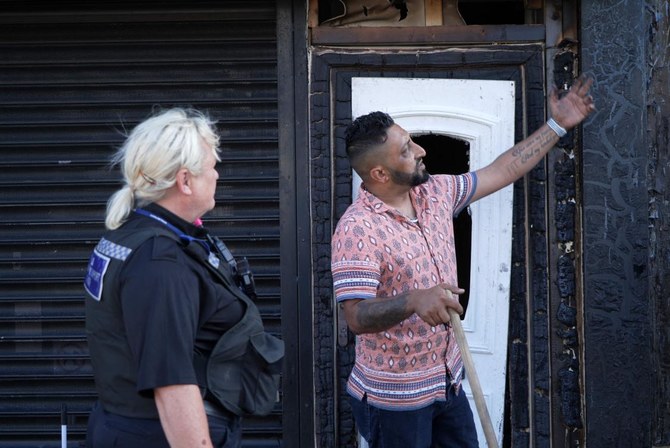
Officers in Belfast, Northern Ireland, were attacked as rioters attempted to set fire to a shop owned by a foreign national.
Police said a man in his 30s was seriously assaulted during the disorder and that they are treating the incident as a racially motivated hate crime.
Meanwhile, a group of men who gathered in Birmingham, central England, to counter a rumored far-right demonstration, forced a Sky News reporter off air shouting: “Free Palestine.” She was then followed by a man in a balaclava holding a knife.
Another reporter said he was chased by members of the group “with what looked like a weapon,” while police said there had also been incidents of criminal damage to a pub and a car.
The unrest broke out last Tuesday after three children were killed in a stabbing spree at a Taylor Swift-themed dance class in Southport, northwest England.
Riots have since flared up in several cities and towns, leading to hundreds of arrests.
Justice minister Heidi Alexander told BBC Radio 4 on Tuesday that the government had freed up an extra 500 prison places and drafted in 6,000 specialist police officers to deal with the ongoing violence.
“We will make sure that anyone who is given a custodial sentence as a result of the riots and disorder, there will be a prison place waiting for them,” she said.
Mobs threw bricks and flares, attacked police, burnt and looted shops, smashed the windows of cars and homes and targeted at least two hotels housing asylum seekers in a number of cities at the weekend.
Prime Minister Keir Starmer on Monday convened and emergency meeting of ministers and police chiefs to discuss the unrest.
The government will “ramp up criminal justice” to ensure that “sanctions are swift,” Starmer told the media after Monday’s meeting.
The National Police Chiefs’ Council (NPCC) said 378 people had so far been arrested and that others would be “brought to justice.”
Clashes broke out in Southport on Wednesday, the day after three young girls were killed and five more children critically injured during the knife attack there.
False rumors initially spread on social media saying the attacker was a Muslim asylum seeker.
The suspect was later identified as 17-year-old Axel Rudakubana, born in Wales. UK media reported that his parents are from Rwanda, which has very few Muslims.
That has not stopped mosques from being targeted by rioters.
The government has offered new emergency security to Islamic places of worship.
In Burnley, northwest England, a hate crime investigation was underway after gravestones in a Muslim section of a cemetery were vandalized with grey paint.
“What type of evil individual(s) would undertake such outrageous actions, in a sacrosanct place of reflection, where loved ones are buried, solely intended to provoke racial tensions?,” local councillor Afrasiab Anwar said.
The prime minister warned rioters on Sunday that they would “regret” participating in England’s worst disorder in 13 years.
Interior minister Yvette Cooper told the BBC on Monday that “there will be a reckoning.”
Cooper also said that social media put a “rocket booster” under the violence.
Starmer stressed that “criminal law applies online as well as offline.”
On Tuesday, Alexander criticized Elon Musk, owner of X, after he claimed “civil war” in the UK was “inevitable.”
“I think it is deeply irresponsible. I think everyone should be appealing for calm,” she said.
Police have blamed the violence on people associated with the now-defunct English Defense League, a far-right Islamophobic organization founded 15 years ago, whose supporters have been linked to football hooliganism.
The rallies have been advertised on far-right social media channels under the banner “Enough is enough.”

6,000 police at the ready to quell UK riots: government
Short Url
https://arab.news/mws45
6,000 police at the ready to quell UK riots: government
Anti-immigrant rhetoric and policies intensify across Europe
- A British lawmaker complained of seeing too many non-white faces on TV
- Despite mainstream parties condemning racist rhetoric, they are adopting tougher immigration policies
LONDON: In the past year, tens of thousands hostile to immigrants marched through London chanting “send them home!” A British lawmaker complained of seeing too many non-white faces on TV. And senior politicians advocated the deportation of longtime UK residents born abroad.
The overt demonization of immigrants and those with immigrant roots is intensifying in the UK — and across Europe — as migration shoots up the political agenda and right-wing parties gain popularity.
In several European countries, political parties that favor mass deportations and depict immigration as a threat to national identity come at or near the top of opinion polls: Reform UK, the Alliance for Germany and France’s National Rally.
President Donald Trump, who recently called Somali immigrants in the US “garbage” and whose national security strategy depicts European countries as threatened by immigration, appears to be endorsing and emboldening Europe’s coarse, anti-immigrant sentiments.
Amid the rising tensions, Europe’s mainstream parties are taking a harder line on migration and at times using divisive language about race.
“What were once dismissed as being at the far extreme end of far-right politics has now become a central part of the political debate,” said Kieran Connell, a lecturer in British history at Queen’s University Belfast.
Europe experiencing a growing sense of division
Immigration has risen dramatically over the past decade in some European countries, driven in part by millions of asylum-seekers who have come to Europe fleeing conflicts in Africa, the Middle East and Ukraine.
Asylum-seekers account for a small percentage of total immigration, however, and experts say antipathy toward diversity and migration stems from a mix of factors. Economic stagnation in the years since the 2008 global financial crisis, the rise of charismatic nationalist politicians and the polarizing influence of social media all play a role, experts say.
In Britain, there is “a frightening increase in the sense of national division and decline” and that tends to push people toward political extremes, said Bobby Duffy, director of the Policy Unit at King’s College London. It took root after the financial crisis, was reinforced by Britain’s debate about Brexit and deepened during the COVID-19 pandemic, Duffy said.
Social media has exacerbated the mood, notably on X, whose algorithm promotes divisive content and whose owner, Elon Musk, approvingly retweets far-right posts.
Across Europe, ethnonationalism has been promoted by right-wing parties such as Alliance for Germany, France’s National Rally and the Fidesz party of Hungarian Prime Minister Viktor Orbán.
Now it appears to have the stamp of approval from the Trump administration, whose new national security strategy depicts Europe as a collection of countries facing “economic decline” and “civilizational erasure” because of immigration and loss of national identities.
The hostile language alarmed many European politicians, but also echoed what they hear from their countries’ far-right parties.
National Rally leader Jordan Bardella told the BBC he largely agreed with the Trump administration’s concern that mass immigration was “shaking the balance of European countries.”
Racist rhetoric and hate crimes on the rise
Policies once considered extreme are now firmly on the political agenda. Reform UK, the hard-right party that consistently leads opinion polls, says if it wins power it will strip immigrants of permanent-resident status even if they have lived in the UK for decades. The center-right opposition Conservatives say they will deport British citizens with dual nationality who commit crimes.
A Reform UK lawmaker complained in October that advertisements were “full of Black people, full of Asian people.” Conservative justice spokesman Robert Jenrick remarked with concern that he “didn’t see another white face” in an area of Birmingham, Britain’s second-largest city Neither politician had to resign.
Many proponents of reduced immigration say they are concerned about integration and community cohesion, not race. But that’s not how it feels to those on the receiving end of racial abuse.
“There is no doubt it has worsened,” said Dawn Butler, a Black British lawmaker who says the vitriol she receives on social media “is increasing drastically, and has escalated into death threats.”
UK government statistics show police in England and Wales recorded more than 115,000 hate crimes in the year to March 2025, a 2 percent increase over the previous 12 months.
In July 2024, anti-immigrant and anti-Muslim violence erupted on Britain’s streets after three girls were stabbed to death at a Taylor Swift-themed dance class. Authorities said online misinformation wrongly identifying the UK-born teenage attacker as a Muslim migrant played a part.
In Ireland and in the Netherlands, protesters often demonstrate outside municipal meetings in communities where a new asylum center is proposed. Some protests have turned violent, with opponents of asylum-seekers throwing fireworks at riot police.
Across Europe, the main focus of protests has been hotels and other housing for asylum-seekers, which some say become magnets for crime and bad behavior. But the agenda of protest organizers is often much wider.
In September, more than 100,000 people chanting “We want our country back” marched through London in a protest organized by a far-right activist and convicted fraudster Tommy Robinson. Among the speakers was French far-right politician Eric Zemmour, who told the crowd that France and the UK both faced “the great replacement of our European people by peoples coming from the south and of Muslim culture.”
Outflanking the right
Mainstream European politicians condemn the “great replacement” conspiracy theory. Britain’s center-left Labour Party government has denounced racism and says migration is an important part of Britain’s national story.
At the same time, it is taking a tougher line on immigration, announcing policies to make it harder for migrants to settle permanently. The government says it is inspired by Denmark, which has seen asylum applications plummet since it started giving refugees only short-term residence.
Denmark and Britain are among a group of European countries pushing to weaken legal protections for migrants and make deportations easier.
Human rights advocates argue that attempts to appease the right just lead to ever-more-extreme policies.
“For every inch yielded, there’s going to be another inch demanded,” Council of Europe human rights commissioner Michael O’Flaherty told The Guardian. “Where does it stop? For example, the focus right now is on migrants, in large part. But who is it going to be about next time around?”
Calls for calmer rhetoric
Politicians of the political center also have been criticized for adopting the language of the far right. British Prime Minister Keir Starmer said in May that Britain risked becoming an “island of strangers,” a phrase that echoed a notorious 1968 anti-immigration speech by the politician Enoch Powell. Starmer later said he had been unaware of the echo and regretted using the phrase.
Germany’s center-right Chancellor Friedrich Merz has hardened his language on migrants as the Alternative for Germany has grown more powerful. Merz caused an uproar in October by saying Germany had a problem with its “Stadtbild,” a word that translates as “city image” or cityscape. Critics felt Merz was implying that people who don’t look German don’t truly belong.
Merz later stressed that “we need immigration,” without which certain sectors of the economy, including health care, would cease to function.
Duffy said politicians should be responsible and consider how their rhetoric shapes public attitudes — though he added that’s “quite a forlorn hope.”
“The perception that this divisiveness works has taken hold,” he said.
The overt demonization of immigrants and those with immigrant roots is intensifying in the UK — and across Europe — as migration shoots up the political agenda and right-wing parties gain popularity.
In several European countries, political parties that favor mass deportations and depict immigration as a threat to national identity come at or near the top of opinion polls: Reform UK, the Alliance for Germany and France’s National Rally.
President Donald Trump, who recently called Somali immigrants in the US “garbage” and whose national security strategy depicts European countries as threatened by immigration, appears to be endorsing and emboldening Europe’s coarse, anti-immigrant sentiments.
Amid the rising tensions, Europe’s mainstream parties are taking a harder line on migration and at times using divisive language about race.
“What were once dismissed as being at the far extreme end of far-right politics has now become a central part of the political debate,” said Kieran Connell, a lecturer in British history at Queen’s University Belfast.
Europe experiencing a growing sense of division
Immigration has risen dramatically over the past decade in some European countries, driven in part by millions of asylum-seekers who have come to Europe fleeing conflicts in Africa, the Middle East and Ukraine.
Asylum-seekers account for a small percentage of total immigration, however, and experts say antipathy toward diversity and migration stems from a mix of factors. Economic stagnation in the years since the 2008 global financial crisis, the rise of charismatic nationalist politicians and the polarizing influence of social media all play a role, experts say.
In Britain, there is “a frightening increase in the sense of national division and decline” and that tends to push people toward political extremes, said Bobby Duffy, director of the Policy Unit at King’s College London. It took root after the financial crisis, was reinforced by Britain’s debate about Brexit and deepened during the COVID-19 pandemic, Duffy said.
Social media has exacerbated the mood, notably on X, whose algorithm promotes divisive content and whose owner, Elon Musk, approvingly retweets far-right posts.
Across Europe, ethnonationalism has been promoted by right-wing parties such as Alliance for Germany, France’s National Rally and the Fidesz party of Hungarian Prime Minister Viktor Orbán.
Now it appears to have the stamp of approval from the Trump administration, whose new national security strategy depicts Europe as a collection of countries facing “economic decline” and “civilizational erasure” because of immigration and loss of national identities.
The hostile language alarmed many European politicians, but also echoed what they hear from their countries’ far-right parties.
National Rally leader Jordan Bardella told the BBC he largely agreed with the Trump administration’s concern that mass immigration was “shaking the balance of European countries.”
Racist rhetoric and hate crimes on the rise
Policies once considered extreme are now firmly on the political agenda. Reform UK, the hard-right party that consistently leads opinion polls, says if it wins power it will strip immigrants of permanent-resident status even if they have lived in the UK for decades. The center-right opposition Conservatives say they will deport British citizens with dual nationality who commit crimes.
A Reform UK lawmaker complained in October that advertisements were “full of Black people, full of Asian people.” Conservative justice spokesman Robert Jenrick remarked with concern that he “didn’t see another white face” in an area of Birmingham, Britain’s second-largest city Neither politician had to resign.
Many proponents of reduced immigration say they are concerned about integration and community cohesion, not race. But that’s not how it feels to those on the receiving end of racial abuse.
“There is no doubt it has worsened,” said Dawn Butler, a Black British lawmaker who says the vitriol she receives on social media “is increasing drastically, and has escalated into death threats.”
UK government statistics show police in England and Wales recorded more than 115,000 hate crimes in the year to March 2025, a 2 percent increase over the previous 12 months.
In July 2024, anti-immigrant and anti-Muslim violence erupted on Britain’s streets after three girls were stabbed to death at a Taylor Swift-themed dance class. Authorities said online misinformation wrongly identifying the UK-born teenage attacker as a Muslim migrant played a part.
In Ireland and in the Netherlands, protesters often demonstrate outside municipal meetings in communities where a new asylum center is proposed. Some protests have turned violent, with opponents of asylum-seekers throwing fireworks at riot police.
Across Europe, the main focus of protests has been hotels and other housing for asylum-seekers, which some say become magnets for crime and bad behavior. But the agenda of protest organizers is often much wider.
In September, more than 100,000 people chanting “We want our country back” marched through London in a protest organized by a far-right activist and convicted fraudster Tommy Robinson. Among the speakers was French far-right politician Eric Zemmour, who told the crowd that France and the UK both faced “the great replacement of our European people by peoples coming from the south and of Muslim culture.”
Outflanking the right
Mainstream European politicians condemn the “great replacement” conspiracy theory. Britain’s center-left Labour Party government has denounced racism and says migration is an important part of Britain’s national story.
At the same time, it is taking a tougher line on immigration, announcing policies to make it harder for migrants to settle permanently. The government says it is inspired by Denmark, which has seen asylum applications plummet since it started giving refugees only short-term residence.
Denmark and Britain are among a group of European countries pushing to weaken legal protections for migrants and make deportations easier.
Human rights advocates argue that attempts to appease the right just lead to ever-more-extreme policies.
“For every inch yielded, there’s going to be another inch demanded,” Council of Europe human rights commissioner Michael O’Flaherty told The Guardian. “Where does it stop? For example, the focus right now is on migrants, in large part. But who is it going to be about next time around?”
Calls for calmer rhetoric
Politicians of the political center also have been criticized for adopting the language of the far right. British Prime Minister Keir Starmer said in May that Britain risked becoming an “island of strangers,” a phrase that echoed a notorious 1968 anti-immigration speech by the politician Enoch Powell. Starmer later said he had been unaware of the echo and regretted using the phrase.
Germany’s center-right Chancellor Friedrich Merz has hardened his language on migrants as the Alternative for Germany has grown more powerful. Merz caused an uproar in October by saying Germany had a problem with its “Stadtbild,” a word that translates as “city image” or cityscape. Critics felt Merz was implying that people who don’t look German don’t truly belong.
Merz later stressed that “we need immigration,” without which certain sectors of the economy, including health care, would cease to function.
Duffy said politicians should be responsible and consider how their rhetoric shapes public attitudes — though he added that’s “quite a forlorn hope.”
“The perception that this divisiveness works has taken hold,” he said.
© 2025 SAUDI RESEARCH & PUBLISHING COMPANY, All Rights Reserved And subject to Terms of Use Agreement.


