

Two Palestinian students arrive at Pakistani university on COMSTECH scholarship program

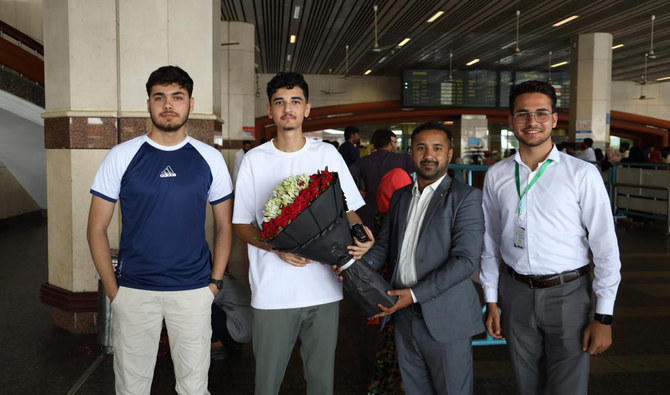
Palestinian students, Amir S. F. Rasas and Soltan Nasser Mahfouz Barakah (right) arrive in Pakistan on August 6, 2024. (COMSTECH)
Short Url
Updated 06 August 2024
Follow

Two Palestinian students arrive at Pakistani university on COMSTECH scholarship program

  • Fully funded bachelor’s program, launched in June 2021, pledges 5000 fellowships for Palestinian students
  • Significant number of Palestinian students to be placed in Pakistani universities in near future, says COMSTECH

ISLAMABAD: Two Palestinian students arrived at Pakistan’s Faisalabad University on Tuesday on a fully funded bachelor’s degree program backed by the Organization of Islamic Cooperation (OIC) Standing Committee for Science and Technology (COMSTECH), the OIC body said. 

COMSTECH launched the second phase of the scholarship program for Palestinian students in April, pledging an additional 5,000 fellowships for them. In the first phase in June 2021, the OIC body announced 500 scholarships for Palestinian students, with around 100 currently benefiting from the scheme in various Pakistani universities in which their tuition and hostel fees, along with monthly stipends, are covered. 

“The University of Faisalabad officials welcomed two more Palestinian students, Amir S. F. Rasas and Soltan Nasser Mahfouz Barakah, who have arrived to pursue their fully funded bachelor’s degree program under the COMSTECH Fellowship/Scholarship Program for Palestine,” COMSTECH said in a statement. 

COMSTECH said it has collaborated with the Association of Private Sector Universities of Pakistan (APSUP) and COMSTECH Consortium of Excellence (CCoE) member universities for the program. 

“A significant number of Palestinian students are expected to arrive in Pakistan in the near future under this program, who will be placed in various Pakistani universities,” the OIC body said. 

“COMSTECH, with the help of APSUP and CCoE member universities, will continue its efforts to support Palestinian students in their academic pursuits.”

At least 39,550 Palestinians have been killed in the Israeli military campaign in Gaza, according to the Gaza Health Ministry. Palestinian health officials say most of the fatalities have been civilians. 

Israel launched its military campaign in Gaza after Hamas launched a surprise attack inside the Jewish state, killing 1,200 and capturing 250 people as hostages. Its strikes in Lebanon and Iran last week, which killed top Hezbollah and Hamas leaders, have raised fears of a wider conflict breaking out in the Middle East. 


Pakistan’s HIV response under strain as global donors cut funding

Updated 16 sec ago
Follow

Pakistan’s HIV response under strain as global donors cut funding

  • Only 21% of people living with HIV in Pakistan know their status, just 18% receive treatment
  • UN agencies and civil society warn domestic funding must rise as international aid shrinks

ISLAMABAD: Funding reductions by international donors have forced sharp cutbacks in HIV prevention and support services across Pakistan, officials and experts say, raising fears that years of progress in reaching vulnerable populations could be reversed even as infections continue to rise.

Pakistan’s HIV response remains heavily dependent on financing from the Global Fund to Fight AIDS, Tuberculosis and Malaria (GFFATM), which has supported the country’s HIV programs for nearly two decades. The Global Fund reduced Pakistan’s total allocation from $250.8 million to $223.6 million under its Grant Cycle 7 (2023–2025), cutting $4 million from the national HIV/AIDS component.

The United Nations Development Program (UNDP), which has served as the principal recipient of Global Fund financing since 2021, says the funding squeeze has already begun to affect outreach services for key populations.

Pakistan’s HIV epidemic remains small in absolute numbers compared with global hotspots, but it is one of the fastest-growing in Asia. UNAIDS has repeatedly warned that Pakistan is among the few countries where new HIV infections continue to rise, driven largely by low testing rates and infections concentrated among marginalized communities. This makes sustained prevention and outreach funding critical to preventing a wider public health crisis.

“The steady supply of quality-assured anti-retroviral drugs is our number one priority,” Richard Cunliffe, GFFATM project manager at UNDP Pakistan, told Arab News.
“So the impact of the cuts has really been felt by community-based organizations doing outreach to key population groups.”

During the previous grant cycle, UNDP supported the expansion of HIV treatment by helping the government establish around 98 antiretroviral therapy (ART) centers across Pakistan. Under the current cycle, its role has narrowed largely to prevention among key populations and procurement of HIV medicines due to tighter funding.

“These are highly marginalized communities... so the more cuts there are, the fewer people we can reach,” Cunliffe said.

‘TOTALLY DEPENDENT’

According to estimates from the Joint United Nations Program on HIV/AIDS (UNAIDS), around 350,000 people are living with HIV in Pakistan. Yet only 21 percent know their status and just 18 percent of those diagnosed are receiving treatment.

Civil society groups warn the situation is more fragile than official figures suggest.

“The HIV response in Pakistan is totally dependent on Global Fund funding,” said Asghar Satti, national coordinator of the Association of People Living with HIV (APLHIV). “There is no meaningful domestic funding, and international donors have also reduced their support.”

Satti pointed to the Global Fund’s upcoming 2027–2029 replenishment cycle, where donor pledges have fallen more than $6 billion short of the $18 billion target.

“When cuts happen globally, treatment is always prioritized,” he said. “But testing, counselling, prevention and community services are the first to suffer.”

He warned that some community organizations in Pakistan have already faced budget cuts of 40–45%, forcing closures of services such as food assistance, medical support and prevention programs.

“These are people who are already vulnerable. If those services disappear, the gains made over the last 20 to 25 years are at serious risk,” Satti said.

A government official, who did not wish to be named, said HIV response and prevention were “high priority” areas for the government and that it was doing its “best to bridge the gap.”

The impact of declining funds is already visible on the ground.

Muhammad Usman, a representative of the Dareecha Health Society working with male and transgender individuals living with HIV, said funding cuts over the past year had forced the group to drastically scale back operations.

“At one point, Dareecha had three offices and around 70 staff members,” he said. “Now those three offices have merged into one, and we are left with about 30 people.”

Outreach in cities such as Bahawalpur has stopped entirely, according to Usman.

“These were technical people from within the community, outreach workers, counsellors, who understood the realities on the ground,” he said.

“When they were let go, awareness and engagement dropped immediately.”

DOMESTIC FINANCING 

Health experts warn that reduced outreach could further weaken Pakistan’s already fragile testing and treatment cascade, increasing the risk of undiagnosed infections and onward transmission.

“When fewer people are tested, more infections remain hidden,” Satti said. “That creates a serious public health risk.”

These pressures are compounded by deep-rooted stigma and the absence of sustained public awareness campaigns.

“HIV and people living with HIV are highly stigmatized and vulnerable,” Cunliffe said.
“It’s a very difficult disease because the disease is very much concentrated in these key population groups… which is often very criminalized and stigmatized.”

Modern antiretroviral therapy allows people living with HIV to lead normal lives and suppress viral loads, preventing transmission and enabling HIV-positive women to give birth to HIV-negative children.

“No one needs to die of HIV anymore,” Cunliffe said.

But with international funding expected to decline further after 2027, UNDP and civil society groups say Pakistan urgently needs to increase domestic financing to sustain its HIV response.

“The government is really going to have to bridge that gap and find ways to domestically finance [HIV response],” Cunliffe added.