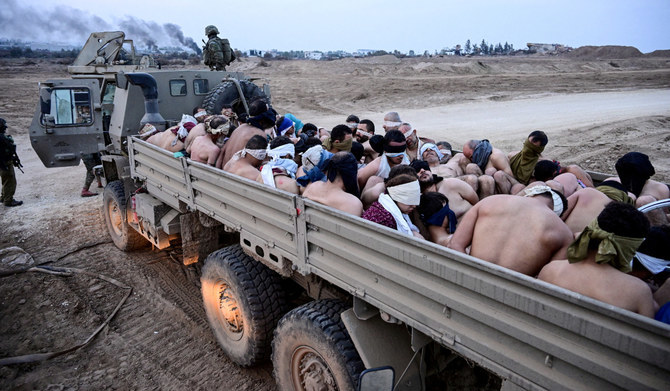
JERUSALEM: Israel has conducted a systematic policy of prisoner abuse and torture since the start of the war in Gaza, subjecting Palestinian detainees to acts ranging from arbitrary violence to sexual abuse, a report from Israeli rights group B’Tselem said on Monday.
The group said the report was based on interviews with 55 Palestinians from Gaza, the West Bank and Israel, who were detained in Israeli prisons since the Oct. 7 attack on Israel that set off the war, most of them without being tried.
“The testimonies clearly indicate a systematic, institutional policy focused on the continual abuse and torture of all Palestinian prisoners held by Israel,” the report said.
The report was issued days after the Israeli military detained nine soldiers accused of severe abuse of a prisoner in a military facility in the Negev desert. According to Israeli press reports, the soldiers are accused of sexually abusing a member of an elite Hamas unit.
A spokesperson for the Israel Prison Service said that all prisoners were treated according to the law and all basic rights were fully applied by professionally trained guards.
“We are not aware of the claims you described and as far as we know, no such events have occurred under IPS responsibility,” the spokesperson said, adding that detainees had the right to file complaints that would be fully examined and investigated.
B’Tselem detailed allegations that Palestinian prisoners were subjected to arbitrary beatings, degrading and humiliating treatment and sleep deprivation, as well as “the repeated use of sexual violence, in varying degrees of severity.”
“The overall picture indicates abuse and torture carried out under orders, in utter defiance of Israel’s obligations both under domestic law and international law,” the report said.
Allegations of prisoner abuse have surfaced repeatedly during the war in Gaza, adding to mounting international pressure on Israel over its conduct of the 10 month-old war.
The report from B’Tselem, a group that documents human rights violations by Israel in the occupied West Bank and other areas, said the treatment accorded to prisoners was a deliberate policy implemented under the direction of the hard-line National Security Minister Itamar Ben-Gvir.
The prison service spokesperson said that since the Oct. 7 attack, Ben-Gvir had ordered that prison conditions be made more strict to reverse an improvement in conditions allowed previously.
Qadura Fares, head of the Palestine Liberation Organization’s Commission for Prisoners and Ex-Detainees Affairs, reiterated a call for an international commission of inquiry into the treatment of prisoners to hold Israel accountable.
“We have documentation of the crimes committed by Israel against Palestinian detainees in its prisons and we have horrific testimonies of what detainees are subjected to, whether related to torture, rape and other crimes,” he said.


![]()


Israeli rights group says Palestinian prisoners subject to systematic abuse
Short Url
https://arab.news/7j8xz
Israeli rights group says Palestinian prisoners subject to systematic abuse
- Israel subjected Palestinian detainees to arbitrary violence and sexual abuse, says rights group
- Report based on interviews with 55 Palestinians prisoners from Gaza, West Bank and Israel
Iran says missile attacks to continue, US talks ‘not on agenda’
- Abbas Araghchi: ‘I don’t think talking with the Americans would be on our agenda anymore’
- Top envoy says Tehran had a “very bitter experience” during previous negotiations with the US
TEHRAN: Iran’s foreign minister said Tuesday that talks with the United States were not on the agenda as their war entered its 11th day.
“I don’t think talking with the Americans would be on our agenda anymore,” Abbas Araghchi told PBS News, saying Tehran had a “very bitter experience” during previous negotiations with the US.
On February 28, the US and Israel launched strikes against Iran that killed its supreme leader Ayatollah Ali Khamenei and triggered a war that has spread across the Middle East.
The Israeli and US attacks took place two days before Washington and Tehran were scheduled to hold talks following three prior rounds of negotiations. Omani mediators in those discussions had said there was “significant progress” in the talks.
Iran has responded to the US-Israeli attacks with drone and missile strikes targeting Israel and US interests across the region.
Shipping traffic through the strategic Strait of Hormuz, through which nearly 20 percent of the world’s crude oil usually transits, has been severely disrupted.
Iranian forces have repeatedly targeted oil tankers passing through the strategic waterway since the war began.
In the interview with PBS News, Araghchi insisted that Iran was acting in “self-defense.”
“We are prepared, we have been prepared to continue attacking them with our missiles as long as needed and as long as it takes,” he said.
Late Monday, Iranian deputy foreign minister Kazem Gharibabadi said some countries in the region and elsewhere had reached out to Iran to push for a ceasefire.
“China, Russia and France, and even some countries in the region, are in contact with us,” he told state TV.
“Some of them are willing to do something to stop this war or establish a ceasefire.”
French President Emmanuel Macron said France and its allies are preparing a “defensive” mission to reopen the Strait of Hormuz.
Gharibabadi said Iran “did not start the aggression and the war … we are defending ourselves.”
“I don’t think talking with the Americans would be on our agenda anymore,” Abbas Araghchi told PBS News, saying Tehran had a “very bitter experience” during previous negotiations with the US.
On February 28, the US and Israel launched strikes against Iran that killed its supreme leader Ayatollah Ali Khamenei and triggered a war that has spread across the Middle East.
The Israeli and US attacks took place two days before Washington and Tehran were scheduled to hold talks following three prior rounds of negotiations. Omani mediators in those discussions had said there was “significant progress” in the talks.
Iran has responded to the US-Israeli attacks with drone and missile strikes targeting Israel and US interests across the region.
Shipping traffic through the strategic Strait of Hormuz, through which nearly 20 percent of the world’s crude oil usually transits, has been severely disrupted.
Iranian forces have repeatedly targeted oil tankers passing through the strategic waterway since the war began.
In the interview with PBS News, Araghchi insisted that Iran was acting in “self-defense.”
“We are prepared, we have been prepared to continue attacking them with our missiles as long as needed and as long as it takes,” he said.
Late Monday, Iranian deputy foreign minister Kazem Gharibabadi said some countries in the region and elsewhere had reached out to Iran to push for a ceasefire.
“China, Russia and France, and even some countries in the region, are in contact with us,” he told state TV.
“Some of them are willing to do something to stop this war or establish a ceasefire.”
French President Emmanuel Macron said France and its allies are preparing a “defensive” mission to reopen the Strait of Hormuz.
Gharibabadi said Iran “did not start the aggression and the war … we are defending ourselves.”
Latest updates


© 2026 SAUDI RESEARCH & PUBLISHING COMPANY, All Rights Reserved And subject to Terms of Use Agreement.