

Google has an illegal monopoly on search, US judge finds

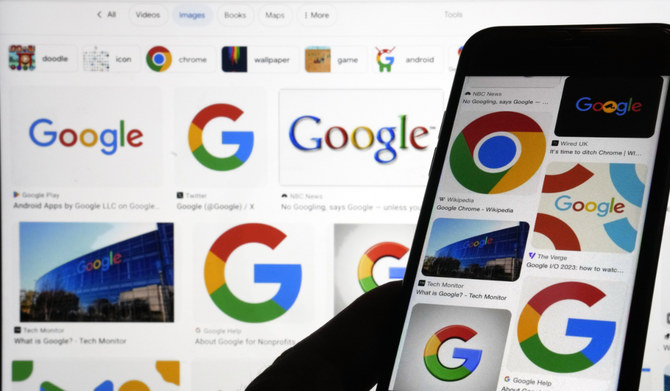
Various Google logos are displayed on a Google search, Monday, Sept. 11, 2023, in New York. (AP)
Short Url
Updated 06 August 2024
Follow

Google has an illegal monopoly on search, US judge finds

  • US Attorney General Merrick Garland called the ruling “a historic win for the American people,” adding that “no company — no matter how large or influential — is above the law”

WASHINGTON: A US judge ruled on Monday that Google violated antitrust law, spending billions of dollars to create an illegal monopoly and become the world’s default search engine, the first big win for federal authorities taking on Big Tech’s market dominance.
The ruling paves the way for a second trial to determine potential fixes, possibly including a breakup of Google parent Alphabet, which would change the landscape of the online advertising world that Google has dominated for years.
It is also a green light to aggressive US antitrust enforcers prosecuting Big Tech, a sector that has been under fire from across the political spectrum. “The court reaches the following conclusion: Google is a monopolizt, and it has acted as one to maintain its monopoly,” District Judge Amit Mehta wrote. The search engine giant controls about 90 percent of the online search market, and 95 percent on smartphones.
The “remedy” phase could be lengthy, followed by potential appeals to the District of Columbia Circuit and US Supreme Court. The legal wrangling could play out into next year, or even 2026. Shares of Google parent Alphabet fell 4.5 percent on Monday as part of a broad tech share decline. Google advertising was 77 percent of Alphabet’s total sales in 2023.
Alphabet said it plans to appeal Mehta’s ruling. “This decision recognizes that Google offers the best search engine, but concludes that we shouldn’t be allowed to make it easily available,” Google said in a statement.
US Attorney General Merrick Garland called the ruling “a historic win for the American people,” adding that “no company — no matter how large or influential — is above the law.”

BILLIONS PAID
Mehta noted that Google had paid $26.3 billion in 2021 alone to ensure that its search engine is the default on smartphones and browsers, and to keep its dominant market share.
“The default is extremely valuable real estate ... Even if a new entrant were positioned from a quality standpoint to bid for the default when an agreement expires, such a firm could compete only if it were prepared to pay partners upwards of billions of dollars in revenue share and make them whole for any revenue shortfalls resulting from the change,” Mehta wrote.
He added, “Google, of course, recognizes that losing defaults would dramatically impact its bottom line. For instance, Google has projected that losing the Safari default would result in a significant drop in queries and billions of dollars in lost revenues.” The ruling is the first major decision in a series of cases taking on alleged monopolies in Big Tech. This case, filed by the Trump administration, went before a judge from September to November of last year.
“A forced divestiture of the search business would sever Alphabet from its largest source of revenue. But even losing its capacity to strike exclusive default agreements could be detrimental for Google,” said Emarketer senior analyst Evelyn Mitchell-Wolf, who said a drawn-out legal process would delay any immediate effects for consumers.
In the past four years, federal antitrust regulators have also sued Meta Platforms, Amazon.com and Apple , claiming the companies have illegally maintained monopolies. Those cases all began under the administration of former President Donald Trump.
Amy Klobuchar, a Democratic US senator who chairs the Senate Judiciary Committee’s antitrust subcommittee, said the fact that the case spanned administrations shows strong bipartisan support for antitrust enforcement.
“It’s a huge victory for the American people that antitrust enforcement is alive and well when it comes to competition,” she said. “Google is a rampant monopolizt.”
When it was filed in 2020, the Google search case was the first time in a generation that the US government accused a major corporation of an illegal monopoly. Microsoft settled with the Justice Department in 2004 over claims that it forced its Internet Explorer Web browser on Windows users.


Saudi Media Forum urges ethical coverage as crises redefine Arab journalism

Updated 04 February 2026
Follow

Saudi Media Forum urges ethical coverage as crises redefine Arab journalism

  • Raw news without context can mislead audiences and distort credibility, experts say

RIYADH: Arab media was born in crisis and shaped by conflict rather than stability, Malik Al-Rougi, general manager of Thaqafeyah Channel, said during the Saudi Media Forum in Riyadh on Wednesday.

Al-Rougi was speaking during a panel titled “Media and Crises: The Battle for Awareness and the Challenges of Responsible Coverage,” which examined how news organizations across the region navigated credibility and professional standards amid fast-moving regional developments.

“Today, when you build a media organization and invest in it for many years, a single crisis can destroy it,” he said.

Referring to recent events, Al-Rougi said that he had witnessed news channels whose credibility “collapsed overnight.”

“In journalistic and political terms, this is not a process of news production. It is a process of propaganda production,” he said. “The damage caused by such a post … is enormous for an institution in which millions, perhaps billions, have been invested.”

When a media outlet shifts from professionalism and credibility toward “propaganda,” he added, it moves away from its core role. 

Saudi media leaders, journalists, and experts gathered at the Saudi Media Forum in Riyadh to discuss credibility, ethics, and innovation. (AN photo by Huda Bashatah/Supplied)

“A crisis can work for you or against you,” Al-Rougi added. “When, in the heart of a crisis, you demonstrate high credibility and composure, you move light-years ahead. When you fail to adhere to ethical standards, you lose light-years as well.”

Abdullah Al-Assaf, professor of political media studies at Imam Muhammad bin Saud Islamic University, said that in many crises across the Arab world, agendas and directives had often prevailed over professionalism.

“Credibility was buried,” he added.

Hasan Al-Mustafa, writer and researcher at Al-Arabiya channel, said that raw information could be subject to multiple interpretations if not placed within a proper political, security, historical or geographical context.

He added that such an approach was urgently needed during periods of political and security volatility in the Middle East. 

When, in the heart of a crisis, you demonstrate high credibility and composure, you move light-years ahead. When you fail to adhere to ethical standards, you lose light-years as well.

Malik Al-Rougi Thaqafeyah, Channel general manager

“This objectivity, or this reliability, is a great responsibility,” Al-Mustafa said. “It is reflected not only in its impact on the audience, but also on the credibility of the content creator.”

Al-Mustafa warned against populism and haste in coverage, saying that they risked deepening crises rather than providing informed public perspectives.

He also said that competition with social media influencers had pushed some traditional outlets to imitate influencer-driven models instead of strengthening their own professional standards.

“Our media has been crisis-driven for decades,” he said, describing much of the region’s coverage as reactive rather than proactive.

During a separate panel titled “The Official Voice in the Digital Age: Strategies of Influence,” speakers discussed how rapid technological and social changes were reshaping the role of institutional spokespersons.

Abdulrahman Alhusain, official spokesperson of the Saudi Ministry of Commerce, said that the role was no longer limited to delivering statements or reacting to events.

“Today, the spokesperson must be the director of the scene — the director of the media narrative,” he said.

Audiences, he added, no longer accept isolated pieces of information unless they were presented within a clear narrative and structure.

“In the past, a spokesperson was expected to deliver formal presentations. Today, what is required is dialogue. The role may once required defense, but now it must involve discussion, the exchange of views, and open, candid conversation aimed at development — regardless of how harsh the criticism may be.”

He said that spokespersons must also be guided by data, digital indicators and artificial intelligence to understand public opinion before speaking.

“You must choose the right timing, the right method and the right vocabulary. You must anticipate a crisis before it happens. That is your role.”

Abdullah Aloraij, general manager of media at the Riyadh Region Municipality, said that the most important skill for a spokesperson today was the ability to analyze and monitor public discourse.

“The challenge is not in transferring words, but in transferring understanding and impact in the right way,” he said.