

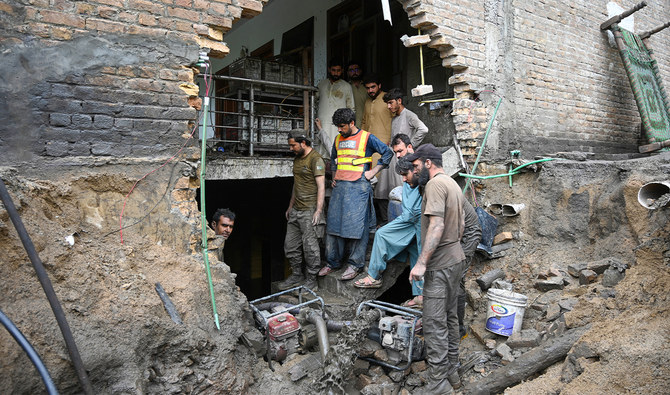

PESHAWAR: Fifteen people have been killed and 20 injured in the last two days due to heavy rains and flash floods in the northwestern Khyber Pakhtunkhwa (KP) province, the disaster management authority said in a report on Monday, as Pakistan struggles to mitigate the disastrous effects of monsoon downpours.
Torrential monsoon rains in Pakistan killed at least 38 last week in KP and Punjab provinces. Heavy to moderate rainfall in several parts of the country has triggered urban floods and landslides, prompting the NDMA to warn citizens to exercise caution during the fresh spell of rains.
“Fifteen people have been killed and 20 injured due to rains and flash floods in the last two days,” the Provincial Disaster Management Authority (PDMA) said in a report. “As per the report, the casualties include five men, four women and six children whereas the injured include five men, three women and 12 children.”
The authority said 19 houses were destroyed due to the heavy rains while 54 were damaged partially. The casualties and financial losses were reported in the northwestern districts of Chitral Upper and Lower, Malakand, Dir Lower, North and South Waziristan, Tank, Karak, Charsadda, Bajaur, Buner and Shangla.
The PDMA said its Emergency Operations Center is continuously monitoring the flow and level of water in the KP’s rivers through the flood warning system, adding that it has provided relief items to people in the affected districts of Chitral Upper and Lower.
“Relief items include blankets, tents, beds, mats, mattresses, mosquito nets, kitchen sets and other daily life items,” the PDMA said.
The authority said it was carrying out relief operations with local administrations in affected areas and was making use of small and heavy machinery to open blocked roads.
Pakistan is recognized as one of the world’s worst-affected countries due to climate change impacts. The South Asian country has experienced torrential rains, droughts and heat waves that have become more severe and erratic over the past couple of years.
Last week, the state-run Associated Press of Pakistan (APP) warned of glacial lake outburst floods (GLOF), flash floods and landslides in the country’s northern Gilgit-Baltistan (GB) and KP areas from August 3-6. It also said that high to very high-level of flash flooding is expected in Pakistan’s southwestern Balochistan province.
Unusually heavy rains in June 2022 triggered flash floods in many parts of the country, killing over 1,700 people, inflicting losses of around $30 billion, and affecting at least 30 million people.


