PARIS: Noah Lyles banished his Tokyo demons as he stormed to Olympic 100m glory in Paris in his continuing bid to fill the void left by Usain Bolt.
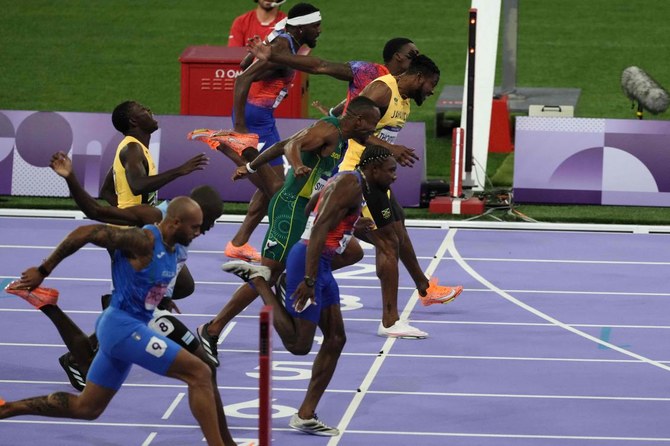
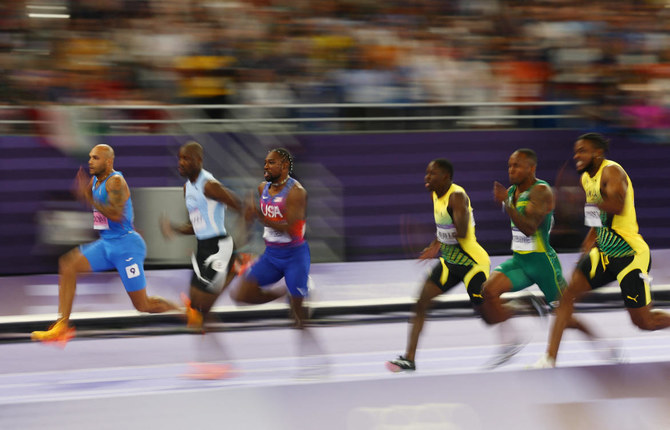
Lyles followed up on his treble gold (100m, 200m and 4x100m relay) at last year’s world championships in Budapest by winning the 100m at the Stade de France in 9.79 seconds in a dramatic photo finish.
It ended a 20-year wait for an American gold in the blue riband event. Justin Gatlin was the last sprinter, man or woman, to win Olympic 100m gold.
World Athletics president Sebastian Coe has dubbed Lyles, whose contract renewal with Adidas this season was described as the biggest since Bolt’s with Puma, an “absolute rock star.”
Dread-locked rapper more than rock star, the 27-year-old American’s efforts in the Hungarian capital were captured in Netflix’s docuseries entitled “Sprint.”
A second season is being filmed with the Paris Games as the backdrop.
The cameras firmly shine the spotlight on the self-assured Lyles, who looks more than ready to bring track back into the wider public consciousness and whose brashness was clear for all to hear in a litany of quotable soundbites in the first series.
“You have to have the mindset of a god,” Lyles said of being a top sprinter in “Sprint.”
“I’m a true believer in that the moment isn’t bigger than me, the moment was made for me.”
While many pundits insist that such an outlook is hardly rare for elite athletes, there is no doubt his brazen approach rubs many other people up the wrong way, not least legions of NBA basketball players — and their fans — after Lyles had questioned their claim to be real “world champions.”
Lyles, who has openly talked about his struggles with mental health and depression in recent years, admits that his growing fame has become a problem in the Olympic Village.
“I’ve become kind of popular in the village and unfortunately that has come with its own set of challenges in being able to find my own space within the village, whether that’s eating or training in the gym,” he said.
His gold in Paris at least atones for his disappointing Tokyo experience, where he came away with a bronze in the 200m.
“That bronze still burns a hole in my chest,” Lyles said.
“I will be carrying it around during Paris just to remind me that this is not the color we are coming back with.”
Lyles, who suffered from chronic asthma as a child, insisted he thrives under public scrutiny.
“The more eyes on me, the better I perform, or at least that’s what my therapist says. When the TV cameras are on me and people are there, I am not losing.”
The American is still hoping to complete an audacious bid for medals in four events in Paris, adding the 4x400m relay to his repertoire.
He ruffled feathers in the world indoors in Glasgow in March when, after claiming 60m silver behind teammate Christian Coleman, he was selected for the 4x400m relay squad that also won silver.
It was a call-up that left the US federation accused of favoritism.
“Let’s just say a lot of people in the US were very, very, very upset that I ran the 4x400 and to that I would say, ‘run faster, push me out!’,” Lyles said.
Bolt retired from the sport in 2017 having won 11 world and eight Olympic golds.
Lyles, whose Budapest sprint double was the first since Bolt’s at the Beijing worlds in 2015, said: “Usain Bolt has done it and him saying to me that he sees what I am doing and he respects it, it is amazing.
“I am the guy who wants to move past being track-famous. I want people to see me on the track, but in GQ and my docu-series, and realize I’m a cool guy too.
“Medals are the first step because then people pay attention to you.
“Then you can go into different directions: fashion, music. You can start collaborating with other people, artists and the world.”
Lyles arrived in Paris knowing full well that he needed to continue his fine form, simply because to continue garnering attention, he needs to keep winning medals — the Olympics are the ultimate global championships for the American spectator.
That was Bolt’s allure: his ability to dominate and win multiple gold medals at global championships.
Lyles has bagged one. More podiums beckon.


‘Rock star’ Lyles banishes Tokyo demons with Paris 100m gold
https://arab.news/j83zp
‘Rock star’ Lyles banishes Tokyo demons with Paris 100m gold

- Lyles followed up on his treble gold (100m, 200m and 4x100m relay) at last year’s world championships in Budapest


Football’s return to Syrian pitches brings fanfare — and friction
RIYADH: Just 10 days after the first anniversary of Syria’s Liberation Day, and one week after the historic performance of the country’s football team at the 2025 Arab Cup — where they reached the quarterfinals — domestic football returned as the Syrian Premier League kicked off its new season.
While league football has continued intermittently since a one-year suspension in 2011, this season represents a notable shift.
For the first time since 2017, the competition features 16 teams playing a full round-robin format — a return to structural normality after years of disrupted campaigns, withdrawals and operational challenges caused by conflict and deteriorating infrastructure.
Foreign players have also returned in significant numbers. A total of 25 overseas players are registered across the 16 clubs in what is now known as the “Prime TV” Syrian Premier League, following the broadcaster’s acquisition of domestic broadcasting rights for the season.
Yet despite the sense of renewal, the league’s reset has been far from smooth. Average attendances remain well below pre-war levels, while the season itself was delayed multiple times before eventually beginning in mid-December — a schedule that is now expected to extend deep into the summer months.
Concerns over facilities and fan safety have already sparked internal tension. The anticipated Matchday Two fixture between Tishreen and Hottin — also known as the Latakia Derby — was postponed by the Syrian Football Association until further notice. No official explanation was provided, but stadium readiness and crowd safety has been at the core of football discussion in Syria.
Supporters have also voiced their frustration over the newly announced ticket prices. Entry fees increased from 5,000 Syrian pounds ($0.45) to 15,000 SYP, a threefold rise announced by the SFA and widely cited as a factor behind subdued crowds.
Infrastructure remains a pressing issue. Historic venues such as Khalid Ibn Al-Walid Stadium in the city of Homs are still not cleared to host games due to pitch conditions and safety requirements, reinforcing the sense of uneven progress — advances made, but frequently offset by new obstacles.
Operational shortcomings were evident as early as the first game of the season. In the opening fixture between Al-Shorta and Hottin, a formal warning was issued to the former by the Disciplinary and Ethics Committee due to a breach in organizational arrangements for the match, including the failure to provide ball boys, which led to a five-minute delay to kick-off.
Political sensitivities have not been easy to navigate either. Al-Karamah were fined 1,500,000 SYP after fans directed verbal abuse at Al-Wahda player Milad Hamad, due to previous political posts made on his Facebook account.
Five days later, Al-Wahda announced Hamad’s suspension from all sporting activities pending review by the relevant committee at the SFA. “This decision comes in solidarity with all our beloved Syrian fans and as a reaffirmation of our commitment to the unity of our people and our land, and to the fact that the blood of our martyrs in the Syrian Revolution has not been shed in vain,” the club said in a statement posted via their official Facebook page.
Rebuilding a sustainable football system in Syria has proven complex. The league’s return has brought moments of excitement alongside renewed tension — a reminder that restoring domestic football is not simply about restarting competition, but about addressing the structures that support it. The Syrian Football Association was contacted for comment, but did not respond.


