Philippines, Germany commit to finalizing defense deal amid tensions in South China Sea

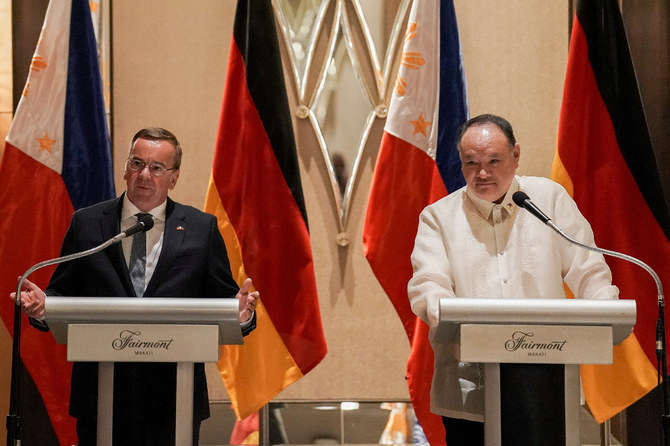
German Defense Minister Boris Pistorius speaks during a joint press conference with Philippine Defense Secretary Gilberto Teodoro Jr., at a hotel in Metro Manila, Philippines on Aug. 4, 2024. (Reuters)
Short Url
Updated 04 August 2024
Follow

Philippines, Germany commit to finalizing defense deal amid tensions in South China Sea

  • Boris Pistorius’ visit to the Philippines was the first by a German defense minister
  • Manila, Berlin are deepening ties days after US announced defense aid boost

MANILA: The Philippines and Germany committed on Sunday to finalizing a defense cooperation agreement this year, saying they strongly opposed expansive claims in the South China Sea amid continued tensions with Beijing in the disputed waters.

German Defense Minister Boris Pistorius was in Manila to meet with his Philippine counterpart Gilberto Teodoro Jr. to enhance ties between their countries, which are celebrating 70 years of diplomatic relations.

They agreed to establish long-term relations between their armed forces to expand training and bilateral exchanges, explore opportunities to expand armaments partnerships and engage in joint projects.

In a joint statement, the ministers said they “strongly opposed any unilateral attempt to advance expansive claims, especially through force or coercion,” alluding to recent incidents in the South China Sea.  

The Philippines and China have overlapping claims in the strategic waters along with a few other countries, but maritime confrontations between China Coast Guard ships and Philippine vessels have increased in recent months.

In June, Manila said the China Coast Guard rammed and boarded Philippine naval vessels during their resupply mission on the Second Thomas Shoal, part of the contested waters that has become a central flashpoint between the two countries.

“There is only one cause of conflict in the South China Sea … It is China’s illegal and unilateral attempt to appropriate most, if not all, of the South China Sea as their internal waters,” Teodoro said during a press conference.

“The Philippines is not provoking China. We do not seek war, yet we are mandated not only by our constitution but as an obligation to our countrymen to protect whatever areas, whether be jurisdiction or rights, that rightfully belong to the exclusive benefit of Filipinos.”

Manila and Berlin took measures to deepen their military ties just days after the US announced $500 million in military funding to modernize the Philippine army, an ongoing effort that will also see Manila “looking to engage Germany as a possible supplier,” Teodoro said.  

“These are in the command and control, anti-access aerial denial, maritime domain, aerial domain and in higher technologically capable equipment,” he added.

Pistorius, whose visit on Sunday was the first such trip by a German defense minister, underscored his country’s support for the 2016 ruling by the Permanent Court of Arbitration at The Hague, which said that Beijing’s claims had no legal basis.

The decision, which was based on the UN Convention of the Law of the Sea, was rejected by China.

“This ruling remains valid without any exceptions. It is our obligation to strengthen the maritime order, and we are living up to it,” Pistorius said, adding that countries must contribute to de-escalation efforts by keeping “all channels of communication open,” including with China.

“It is important that we support and protect the rules-based international order in what we’re doing here. Our commitments and engagements here are not directed against anybody but instead, we’re focusing on maintaining the rules-based international order, securing freedom of navigation and protecting trade routes.”

For Manila, stronger defense ties with Germany are “important as a symbol of the Philippines’ growing security network” at the global level, said retired US Air Force Col. Raymond Powell, a director at Sealight, a project based in Stanford University that focuses on maritime transparency.

“It carries fewer material benefits than its relationships with established Indo-Pacific powers like the US, Japan and France, but it is important (in) showing the Philippines as an integral member of a strong global community with significant economic resources and military capabilities,” Powell told Arab News.

Aaron Jed Rabena, a senior lecturer at the Asian Center of the University of the Philippines, said strengthening relations with Germany was a strategic move for Manila.

“This is part of the Philippines’ strategy to broaden its web of security partners and get as much defense and political support from them as possible,” he told Arab News.

“I wouldn’t be surprised if Germany will soon take part in military exercises and even talk of a VFA (visiting forces agreement) with the Philippines.”


Afghanistan says it thwarted Pakistani airstrike on Bagram Air Base as fighting enters fourth day

Updated 01 March 2026
Follow

Afghanistan says it thwarted Pakistani airstrike on Bagram Air Base as fighting enters fourth day

  • The fighting has been the most severe between the neighbors for years
  • Pakistan accuses Taliban government of harboring militant groups that stage attacks against it

KABUL: Afghanistan thwarted attempted airstrikes on Bagram Air Base, the former US military base north of Kabul, authorities said Sunday, while cross-border fighting between Pakistan and Afghanistan stretched into a fourth day.
The fighting has been the most severe between the neighbors for years, with Pakistan declaring that it’s in “open war” with Afghanistan.
The conflict has alarmed the international community, particularly as the area is one where other militant organizations, including Al-Qaeda and the Daesh group, still have a presence and have been trying to resurface.
Pakistan accuses Afghanistan’s Taliban government of harboring militant groups that stage attacks against it and also of allying with its archrival India.
Border clashes in October killed dozens of soldiers, civilians and suspected militants until a Qatari-mediated ceasefire ended the intense fighting. But several rounds of peace talks in Turkiye in November failed to produce a lasting agreement, and the two sides have occasionally traded fire since then.
On Sunday, the police headquarters of Parwan province, where Bagram is located, said in a statement that several Pakistani military jets had entered Afghan airspace “and attempted to bomb Bagram Air Base” at around 5 a.m.
The statement said Afghan forces responded with “anti-aircraft and missile defense systems” and had managed to thwart the attack.
There was no immediate response from Pakistan’s military or government regarding Kabul’s claim of attempted airstrikes on Bagram or the ongoing fighting.
Bagram was the United States’ largest military base in Afghanistan. It was taken over by the Taliban as they swept across the country and took control in the wake of the chaotic US withdrawal from the country in 2021. Last year, US President Donald Trump suggested he wanted to reestablish a US presence at the base.
The current fighting began when Afghanistan launched a broad cross-border attack on Thursday night, saying it was in retaliation for Pakistani airstrikes the previous Sunday.
Pakistan had said its airstrike had targeted the outlawed Pakistani Taliban, also known as Tehreek-e-Taliban Pakistan, or TTP. Afghanistan had said only civilians were killed.
The TTP militant group, which is separate but closely allied with Afghanistan’s ruling Taliban, operates inside Pakistan, where it has been blamed for hundreds of deaths in bombings and other attacks over the years.
Pakistan accuses Afghanistan’s Taliban government of providing a safe haven within Afghanistan for the TTP, an accusation that Afghanistan denies.
After Thursday’s Afghan attack, Pakistani Defense Minister Khawaja Mohammad Asif declared that “our patience has now run out. Now it is open war between us.”
In the ongoing fighting, each side claims to have killed hundreds of the other side’s forces — and both governments put their own casualties at drastically lower numbers.
Two Pakistani security officials said that Pakistani ground forces were still in control on Sunday of a key Afghan post and a 32-square-kilometer area in the southern Zhob sector near Kandahar province, after having seized it during fighting Friday. The captured post and surrounding area remain under Pakistani control, they added. The officials spoke on condition of anonymity, because they weren’t authorized to speak publicly.
In Kabul, the Afghan government rejected Pakistan’s claims. Deputy government spokesman Hamdullah Fitrat called the reports “baseless.”
Afghan officials said that fighting had continued overnight and into Sunday in the border areas.
The police command spokesman for Nangarhar province, Said Tayyeb Hammad, said that anti-aircraft missiles were used from the provincial capital, Jalalabad, and surrounding areas on Pakistani fighter jets flying overhead Sunday morning.
Defense Ministry spokesman Enayatulah Khowarazmi said that Afghan forces had launched counterattacks with snipers across the border from Nangarhar, Paktia, Khost and Kandahar provinces overnight. He said that two Pakistani drones had been shot down and dozens of Pakistani soldiers had been killed.
Fitrat said that Pakistani drone attacks hit civilian homes in Nangarhar province late Saturday, killing a woman and a child, while mortar fire killed another civilian when it hit a home in Paktia province.
There was no immediate response to the claims from Pakistani officials.