ISLAMABAD: Pakistan’s Punjab has reported its first case of the poliovirus this year, a government official confirmed on Sunday, taking the total nationwide tally of the cases reported this year to 12.
Pakistan’s National Coordinator for Polio Captain (retd) Anwar ul Haq confirmed that the latest case was reported on Saturday from Punjab’s Chakwal district.
As per local media reports, a six-year-old male child had been infected with the virus.
Previously, Pakistan has reported nine cases from the southwestern Balochistan province and two in the southern Sindh province this year.
“The first case of polio in Punjab this year has been reported in Chakwal district of the province,” Haq told Arab News. “Samples from the sewage have been taken from across the country and poliovirus has been found in more than 50 districts of Pakistan.”
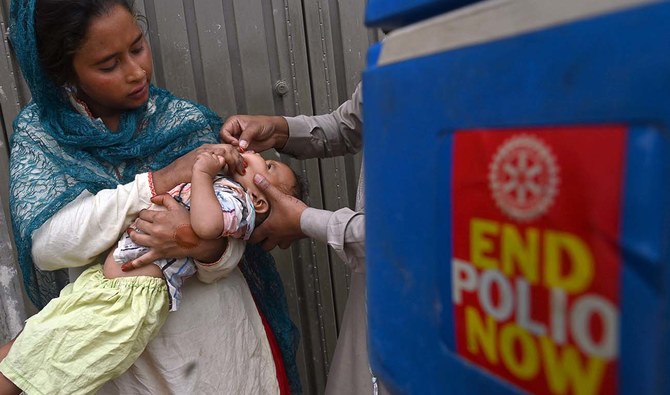
Haq said the government is launching three anti-polio campaigns in September, October and December this year to curb the infection.
“Pakistan is launching these campaigns simultaneously with Afghanistan to make it more effective,” he said. “The government has set a target to achieve 96 percent of children vaccinated by the end of 2024.”
Polio is a highly infectious disease mainly affecting children under the age of five years. It invades the nervous system and can cause paralysis or even death. While there is no cure for polio, vaccination has proven to be the most effective way to protect children from the crippling disease.
Polio vaccination efforts in Pakistan have been hampered by the belief among many Pakistanis, particularly those residing in the conservative northwestern tribal areas, that the medicine is a Western campaign aimed at sterilizing the country’s population or a cover for Western spies.
In 2012, the local Taliban ordered a ban on immunization against polio in some tribal districts. Several policemen have been killed this year while on security duty during vaccination campaigns that are frequently targeted by militants. Dozens of polio workers have also lost their lives over the decades.
The 2011 US special forces raid inside Pakistan that killed Al-Qaeda leader Osama bin Laden, architect of the September 11 attacks on the United States in 2001, also increased masses’ fears about polio vaccination.
A Pakistani doctor was accused of using a fake vaccination campaign to collect DNA samples that the CIA was believed to have been using to verify bin Laden’s identity. The doctor remains jailed in Pakistan.


Pakistan’s Punjab reports its first polio case of 2024, taking national tally to 12
https://arab.news/pgtfe
Pakistan’s Punjab reports its first polio case of 2024, taking national tally to 12

- Latest polio case detected from Pakistan’s eastern Chakwal district, confirms official
- Pakistan to launch three anti-polio campaigns in September, October and December
Pakistan reports current account surplus in Jan. owing to improved trade, remittances
- Pakistan’s exports crossed the $3 billion mark in Jan. as the country received $3.5 billion in remittances
- Last month, IMF urged Pakistan to accelerate pace of structural reforms to strengthen economic growth
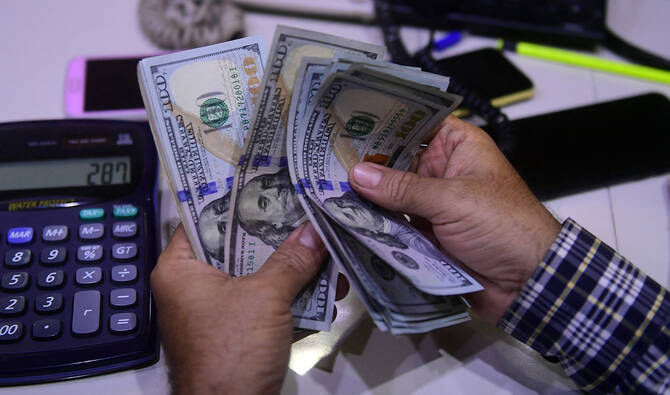
ISLAMABAD: Pakistan recorded a current account surplus of more than $120 million in January, the country’s finance adviser said on Tuesday, attributing it to improved trade balance and remittance inflows.
Pakistan’s exports rebounded in January 2026 after five months of weak performance, rising 3.73 percent year on year and surging 34.96 percent month on month, according to data released by the country’s statistics bureau.
Exports crossed the $3 billion mark for the first time in January to reach $3.061 billion, compared to $2.27 billion in Dec. 2025. The country received $3.5 billion in foreign remittances in Jan. 2026.
Khurram Schehzad, an adviser to the finance minister, said Pakistan reported a current account surplus of $121 million in Jan., compared to a current account deficit of $393 million in the same month last year.
“Improved trade balance in January 2026, strong remittance inflows, and sustained momentum in services exports (IT/Tech) continue to reinforce the country’s external account position,” he said on X.
Pakistan has undergone a difficult period of stabilization, marked by inflation, currency depreciation and financing gaps, and international rating agencies have acknowledged improvements after Islamabad began implementing reforms such as privatizing loss-making, state-owned enterprises (SOEs) and ending subsidies as part of a $7 billion International Monetary Fund (IMF) loan program.
Late last month, the IMF urged Pakistan to accelerate the pace of these structural reforms to strengthen economic growth.
Responding to questions from Arab News at a virtual media roundtable on emerging markets’ resilience, IMF’s director of the Middle East and Central Asia Jihad Azour said Islamabad’s implementation of the IMF requirements had been “strong” despite devastating floods that killed more than 1,000 people and devastated farmland, forcing the government to revise its 4.2 percent growth target to 3.9 percent.
“What is important going forward in order to strengthen growth and to maintain the level of macroeconomic stability is to accelerate the structural reforms,” he said at the meeting.
Azour underlined Pakistan’s plans to privatize some of the SOEs and improve financial management of important public entities, particularly power companies, as an important way for the country to boost its capacity to cater to the economy for additional exports.
“This comes in addition to the effort that the authorities have made in order to reform their tariffs, which will allow the private sector of Pakistan to become more competitive,” the IMF official said.


