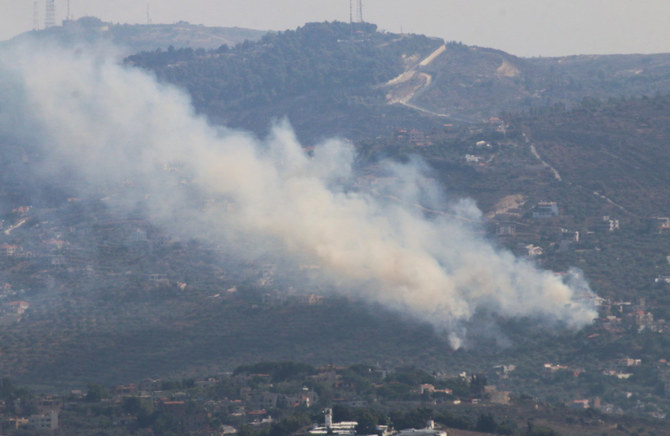
Hezbollah says it has launched ‘dozens’ of rockets at Israel

Smoke rises from Kfar Kila, amid cross-border hostilities between Hezbollah and Israeli forces, as pictured from Marjayoun, Lebanon, near the border with Israel, on August 3, 2024. (REUTERS)
Short Url
Updated 04 August 2024
Follow

Hezbollah says it has launched ‘dozens’ of rockets at Israel

  • Hezbollah says attacks in response to Israeli assaults on Kfar Kela, Deir Siriane in Lebanon
  • Attack triggers fears of sparking wider conflict in already volatile Middle East region 

BEIRUT: Hezbollah said Saturday it had launched dozens of Katyusha rockets at Israel, the latest in a series of attacks it says is in support of the Palestinian people.
The Iran-backed group said its latest attack, on Beit Hillel in northern Israel, was in response to Israel’s attacks on Kfar Kela and Deir Siriane in Lebanon which, it said, had injured civilians there.


35 have been killed and 1,200 held in Iran’s economic protests

People walk as shops are closed during protests in Tehran's centuries-old main bazaar, Iran, Tuesday, Jan. 6, 2026. (AP)
Updated 7 sec ago
Follow

35 have been killed and 1,200 held in Iran’s economic protests

  • Demonstrations show no sign of stopping
  • Govt acknowledges hardships, urges dialogue

DUBAI: The death toll in violence surrounding protests in Iran has risen to at least 35 people, activists said on Tuesday, as the demonstrations showed no signs of stopping.

The figure came from the US-based Human Rights Activists News Agency, which said more than 1,200 people have been detained in the protests, which have been ongoing for more than a week.
It said 29 protesters, four children and two members of Iran’s security forces have been killed. Demonstrations have reached over 250 locations in 27 of Iran’s 31 provinces,
The group, which relies on an activist network inside of Iran for its reporting, has been accurate in past unrest.
The semiofficial Fars news agency reported late on Monday that some 250 police officers and 45 members of the Guard’s all-volunteer Basij force have been hurt in the demonstrations.
 The authorities have acknowledged the economic hardships but accused networks linked to foreign powers of stoking the protests. 
On Tuesday, Iran’s police chief vowed to “deal with the last of these rioters.”
The shopkeepers’ protest continued on Tuesday in the bazaar, with about 150 people focusing on economic demands, Fars reported.
The protests have spread to some cities in western and southern Iran but do not match the scale of unrest that swept the nation in 2022-23 over the death of Mahsa Amini, who died in police custody for violating Iran’s dress code.
However, even though smaller, these protests have quickly expanded ‌from an economic ‌focus to broader frustrations, with some protesters chanting against the country’s clerical rulers.
The police chief, Ahmadreza Radan, was quoted on Tuesday by state media as saying they had drawn a distinction between protesters and rioters, the latter facing arrests on site or following identification by intelligence units.
“I pledge that we will deal with the last of these rioters. It is still time for those who were deceived by foreign services to identify themselves and draw on the Islamic Republic’s greatness,” Radan said.
Fars said ​Tuesday’s gathering of shopkeepers on Saadi street in Tehran ended without “expanding the police’s presence.”
Mohammad, 63, a jewelry shop owner in the bazaar, said there was a heavy presence of riot police and plainclothes security forces inside and around the area.
“They were forcing shopkeepers who were on strike to open their shops. I did not see it myself, but I heard there were clashes outside the bazaar and police fired tear gas,” he said by phone. 
Footage shared on Telegram on Tuesday appeared to show dozens of security forces on motorbikes patrolling the street and the unidentified person who took the clip can be heard saying the security forces had fired tear gas.
President Masoud Pezeshkian has promised reforms to help stabilize the monetary and banking systems and protect purchasing power.
The government has announced a subsidy reform, removing preferential currency exchange rates for importers in favor of direct transfers to Iranians to boost their purchasing ‌power for essential goods. The measure will come into force on Jan. 10.
The central bank chief was also replaced on Dec. 29.
The rial fell further to 1,489,500 on Tuesday, representing a 4 percent fall since the protests started.