

Northern Pakistan, Balochistan on flood alert as nearly 40 killed in rain disasters this week 

People watch water gushing down river next to destroyed bridge in Chitral, Pakistan on August 4, 2024. (Photo courtesy: Screengrab/Reuters)
Short Url
Updated 04 August 2024
Follow

Northern Pakistan, Balochistan on flood alert as nearly 40 killed in rain disasters this week 

  • Glacial lake outburst floods, landslides and flash floods expected in KP, GB from Aug. 3-6, disaster authority says
  • Nullahs in Zhob, Kalat, Nasirabad and Sibbi divisions in Balochistan to experience “high to very high” flooding

ISLAMABAD: Pakistan on Sunday warned of glacial lake outbursts, flash floods and landslides in the country’s northern regions as well as the southwestern Balochistan province amid continuing monsoon downpours, with nearly 40 people killed across the country this week in rain-related disasters.
According to figures from the Provincial Disaster Management Authorities (PDMA) in the Punjab and Balochistan provinces, 32 people were killed in rain-related incidents this week in the northwestern Khyber Pakhtunkhwa province while six died in Punjab. 
Pakistan is recognized as one of the world’s worst-affected countries from climate change impacts. The South Asian country has experienced torrential rains, droughts and heat waves that have become more severe and erratic over the past couple of years. 
“NDMA [National Disaster Management Authority] National Emergencies Operation Center anticipated that the latest hydrometeorological conditions suggest that high to very high-level flash flooding is likely in Balochistan,” the authority said in a statement. 
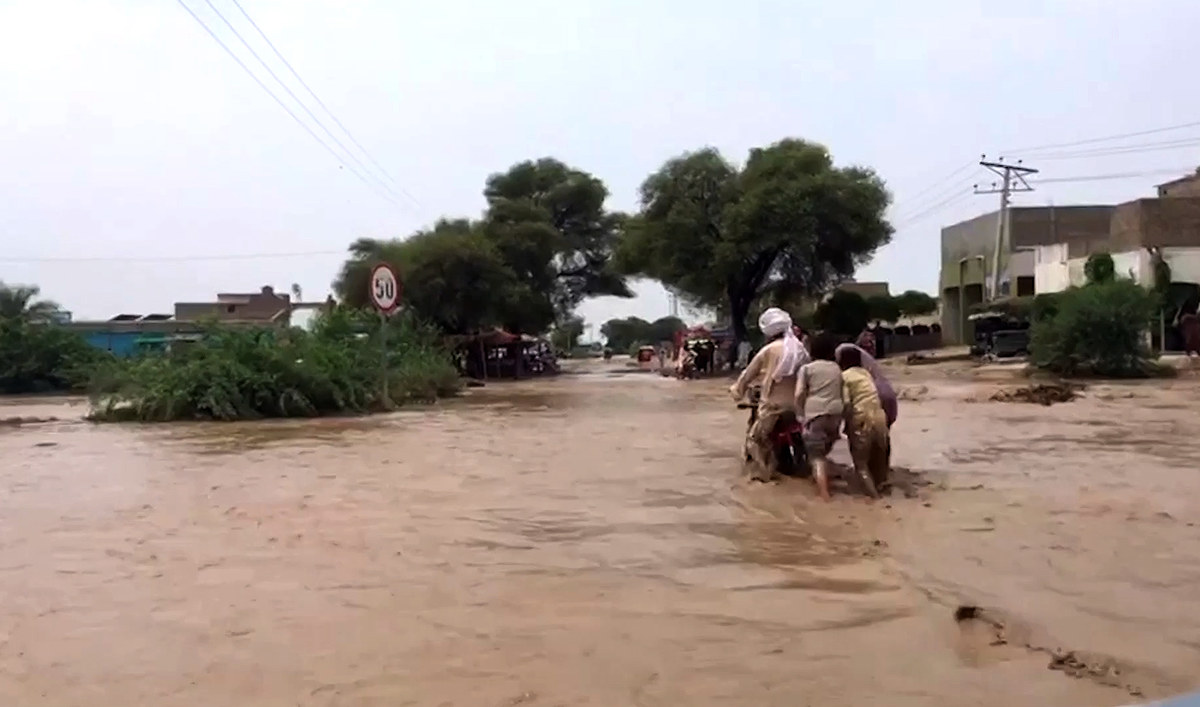


People push motorcycle across muddy water in Chitral, Pakistan on August 4, 2024. (Photo courtesy: Screengrab/Reuters)

It warned that hill torrents of the local nullahs of Zhob, Kalat, Nasirabad and Sibbi divisions in Balochistan wre likely to experience “high to very high level” of flash flooding, saying it could damage infrastructure. 
“Similarly, The hill torrents of and local nullahs of Dera Ghazi Khan are likely to experience high to very high level of flash flooding which may result in damage to infrastructure,” it added. 
The authority warned populations at risk to avoid flood waters and find safe locations away from flood-prone areas. 
Separately, Pakistani state-run media, the Associated Press of Pakistan (APP), warned of glacial lake outbursts (GLOF), flash floods and landslides in Pakistan’s northern Gilgit-Baltistan (GB) and Khyber Pakhtunkhwa areas from Aug. 3-6.
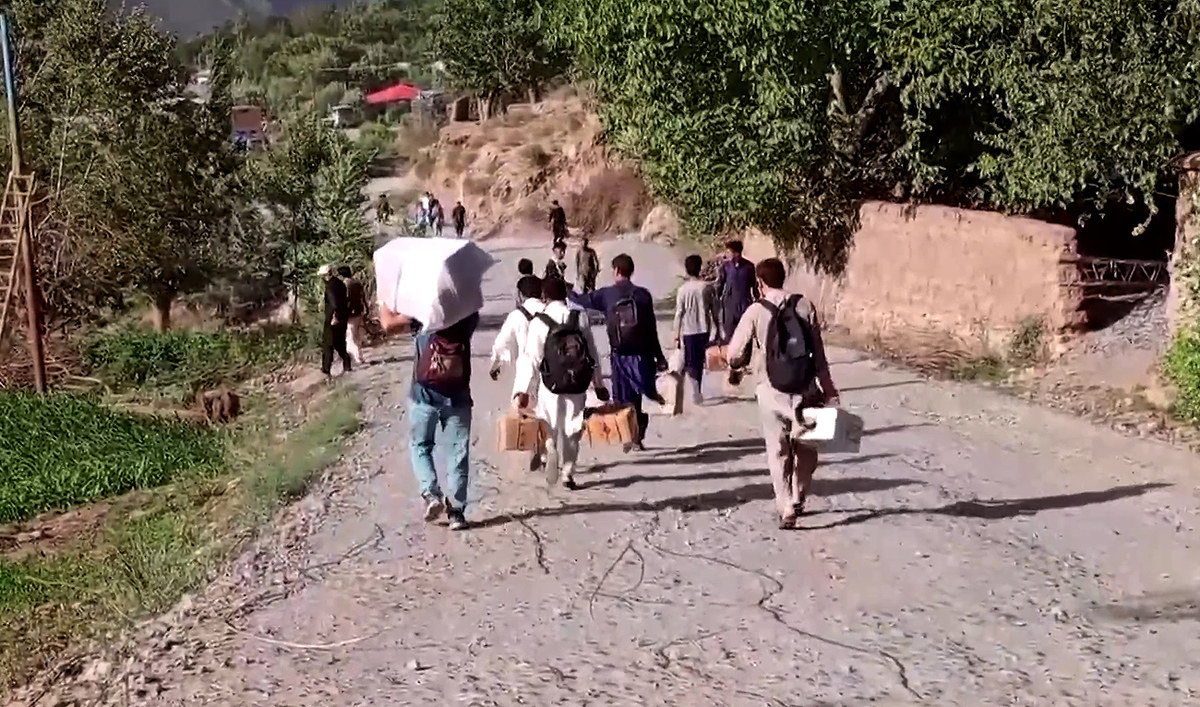


Residents move carrying belonging from the flooded areas in Chitral, Pakistan on August 4, 2024. (Photo courtesy: Screengrab/Reuters)

“The National Disaster Management Authority (NDMA) Emergencies Operation Center anticipated that a glacial lake outburst flood (GLOF), Landslides and Flash Flood is expected in Khyber Pakhtunkhwa and Gilgit Baltistan due to increasing glacier melt, persistent high temperatures and weather system bringing intermittent rains from today till Tuesday,” APP said on Saturday. 
The NDMA has said intermittent rains and high temperatures are expected to trigger low-level/localized flash floods in KP and GB, which in turn could impact temporary bridge and road connections for upstream areas.
The authority has advised the provincial disaster management authorities and local administrations in KP and GB to closely monitor the situation, identify at-risk populations, and evacuate them to safer zones in case of medium to high flows, APP reported. 
Unusually heavy rains in June 2022 triggered flash floods in many parts of the country, killing over 1,700 people, inflicting losses of around $30 billion, and affecting at least 30 million people.
In June, a UN official warned that an estimated 200,000 people in Pakistan could be affected by the upcoming monsoon season, which has brought heavier rains than usual.


Pakistan’s defense chief accuses ‘Indian-sponsored proxies’ of fueling violence in Balochistan

Updated 4 sec ago
Follow

Pakistan’s defense chief accuses ‘Indian-sponsored proxies’ of fueling violence in Balochistan

  • Field Marshal Syed Asim Munir speaks to participants of 18th National Workshop on Balochistan
  • Warns violation of Pakistan’s territorial integrity will be met with a “firm and decisive response”

ISLAMABAD: Pakistan’s Chief of Defense Forces (CFD) Field Marshal Syed Asim Munir on Wednesday blamed militant groups allegedly sponsored by India for fueling violence and disrupting development in the province, warning the military will foil their designs. 

Munir was speaking to participants of the 18th National Workshop on Balochistan (NWB) at the General Headquarters of the military in Rawalpindi. The NWB features discussions on Pakistan’s policies on security, development and other challenges related to Balochistan by officials, leaders and citizens. 

Pakistan accuses India of sponsoring militant groups in its southwestern Balochistan province, who demand independence from Islamabad. India rejects the allegations. These ethnic Baloch militant groups accuse Pakistan’s government and military of denying locals a share in the province’s mineral wealth, charges that both deny. 

“Highlighting the security challenges, the COAS & CDF remarked that Indian-sponsored proxies continue to propagate violence and disrupt development in Balochistan,” the Inter-Services Public Relations (ISPR), the military’s media wing, said in a statement.

“He reaffirmed that such inimical designs will be thwarted through stern actions by security forces to rid the province of terrorism and unrest.”

The Pakistani army chief lauded the federal and provincial governments’ initiatives for Balochistan’s development, underscoring a people-centric approach to unlock the province’s “vast economic potential.”

Munir appreciated the civil society for its constructive role in debunking propaganda, the military’s media wing said. 

“He stressed the importance of rejecting vested political agendas to ensure that Balochistan’s future is shaped by long-term prosperity for all its residents,” the ISPR said. 

The CDF reaffirmed Pakistan’s commitment to regional peace but stressed that any violation of the country’s territorial integrity will be met with a decisive response. 

Pakistan suffered a surge in militant attacks in its northwestern and Balochistan provinces this year. As per the Pakistan Institute for Conflict and Security Studies (PICSS) think tank, combat-related deaths in 2025 rose by 73 percent to 3,387, compared with 1,950 in 2024. 

These deaths included 2,115 militants, 664 security forces personnel, 580 civilians and 28 members of pro-government peace committees (combatants), the think tank said in a press release. 

“PICSS noted that most violence remained concentrated in Pashtun-majority districts of Khyber Pakhtunkhwa, including the tribal districts (erstwhile FATA), and in Balochistan,” the think tank said in its report on Sunday. 

Islamabad also accuses Afghanistan of sheltering militants who launch attacks on Pakistan soil. Kabul rejects these allegations and says it cannot be held responsible for Pakistan’s security lapses.