Pakistan offers Iraq police training, urges halt to withholding pilgrims’ passports

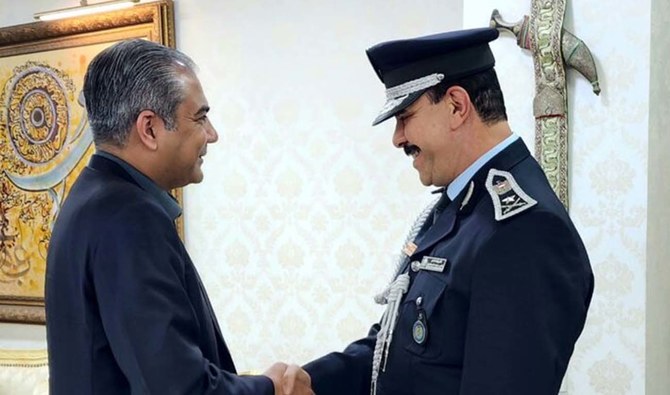
Commander of Iraq’s Rapid Response Unit Lieutenant General Dr. Tahmeir Ismail (R) shakes hands with Pakistan Interior Minister Mohsin Naqvi in Islamabad, Pakistan on August 3, 2024. (Photo courtesy: Radio Pakistan)
Short Url
Updated 04 August 2024
Follow

Pakistan offers Iraq police training, urges halt to withholding pilgrims’ passports

  • Both countries have tried to enhance law enforcement cooperation, focusing on counterterrorism, counternarcotics
  • A senior Iraqi official says he will discuss the issue of pilgrims’ travel documents with director general of passports

ISLAMABAD: Federal Interior Minister Mohsin Naqvi on Saturday discussed the possibility of training Iraqi police in Pakistan during a meeting with a delegation from the Arab state, where he also raised the issue of not withholding the passports of Pakistani pilgrims.
Pakistan and Iraq have discussed law enforcement cooperation in recent years, focusing on enhancing collaboration in counterterrorism, counternarcotics and intelligence-sharing.
The two sides also focused on several bilateral issues as Naqvi welcomed Commander of Iraq’s Rapid Response Unit, Lt. Gen. Dr. Tahamir Ismail, at his office in Islamabad.
“The conversation included training Iraqi police in Pakistan and collaboration on the Safe City Project,” said a statement released by the ministry after the meeting. “They discussed enhancing mutual cooperation to prevent illegal immigration and human trafficking.”
The interior minister also requested the Iraqi authorities not to withhold Pakistani pilgrims’ passports visiting their country.
“They discussed matters of mutual interest, including providing more facilities to Pakistani pilgrims in Iraq and eliminating the requirement of keeping their passports,” the statement added.
Pakistani pilgrims frequently travel to Iraq, particularly to visit the holy cities of Karbala and Najaf, which are significant religious sites for Shia Muslims. The journeys of these pilgrims are often organized by tour operators who arrange their visas, travel and accommodation.
In recent years, the Iraqi government has implemented stricter controls, including the practice of temporarily keeping passports to prevent pilgrims from overstaying their visas, which has been a particular concern for pilgrims from economically struggling regions like Pakistan.
The Iraqi commander said that pilgrims coming from Pakistan were highly respected and added he would discuss the issue with the director general of passports in his country.


Pakistan sets expectations for Trump-backed Gaza Board of Peace at UN

Updated 4 sec ago
Follow

Pakistan sets expectations for Trump-backed Gaza Board of Peace at UN

  • The country calls for ceasefire enforcement and reconstruction of the war-ravaged territory
  • Pakistani diplomat warns Gaza recovery must proceed without annexation or forced displacement

ISLAMABAD: Pakistan on Wednesday highlighted its expectations of US President Donald Trump’s Board of Peace (BoP) in Gaza, saying it joined the United Nations-backed body alongside other Muslim nations since it expected concrete steps toward a permanent ceasefire, reconstruction of Gaza and a lasting and just peace grounded in the Palestinian right to statehood.

Prime Minister Shehbaz Sharif signed the Gaza Board of Peace charter earlier this week along with other world leaders on the sidelines of the 56th Annual Meeting of the World Economic Forum in Davos.

Pakistan’s Permanent Representative to the UN, Ambassador Asim Iftikhar Ahmad, told an open Security Council debate on the Middle East that the decision was driven by the need to address the “unresolved Palestinian question,” which he described as “the core of the instability” in the region.

“We hope that the BoP under the framework of resolution 2803 will lead to concrete steps toward the implementation of a permanent ceasefire, further scaling up of humanitarian aid, reconstruction of Gaza, and realization of the right to self-determination of the people of

Palestine through a credible, time-bound political process, consistent with international legitimacy and relevant UN resolutions resulting in an independent, sovereign and contiguous state of Palestine based on pre-1967 borders with Al-Quds Al-Sharif as its capital,” Ahmad said while addressing the council.

“That is the ultimate goal supported by the international community,” he added. “Palestinian-led governance and institutional strengthening, with a central role of the Palestinian Authority, are indispensable in this regard.”

Ahmad maintained Pakistan was deeply concerned about the fragile situation in Gaza, pointing to Israel’s continued ceasefire violations that he said were putting civilian lives at risk. He stressed that the ceasefire must be fully respected with a view to a permanent cessation of hostilities.

The Pakistani diplomat said recovery and reconstruction should begin without delay and must proceed without annexation, forced displacement or any alteration of the territorial unity of the Occupied Palestinian Territory.

“The contiguity of Gaza and the West Bank is indispensable for the viability of the Palestinian state,” he said.

Ahmad also called for a credible, irreversible and time-bound political process culminating in the realization of Palestinian statehood in accordance with international legitimacy.

“The international community, particularly this council, bears the responsibility to translate renewed engagement into measurable change on the ground for the betterment of the Palestinian people,” he said, adding that Pakistan was ready to work with “members of the council, regional and international partners, and the United States to advance a just and lasting solution to the Palestinian question, and comprehensive peace in the Middle East.”