CARACAS: A half-dozen masked assailants ransacked the headquarters of Venezuelan opposition leader Maria Corina Machado on Friday in the latest escalation of violence against opponents of Nicolás Maduro following the country’s disputed presidential election.
The raid occurred at around 3 a.m., Machado’s party said, adding that the assailants broke down doors and hauled away valuable documents and equipment. Images published by Machado’s party on social media show several walls covered in black spray paint.
The assault comes as top officials, including Maduro himself, have threatened to arrest the opposition leader, who has gone into hiding as she seeks to rally Venezuelans and the international community to challenge last Sunday’s election results.
The Biden administration has thrown its support firmly behind the opposition, recognizing last minute candidate Edmundo González as the victor, discrediting the official results of the vote proclaiming Maduro the winner.
The US announcement late Thursday followed calls from multiple governments, including close allies of Maduro, for Venezuela’s electoral authorities to release precinct-level vote counts, as it has done during previous elections.
The electoral body declared Maduro the winner Monday, but the main opposition coalition revealed hours later that it had collected copies of 80 percent of the country’s 30,000 voting tallies and that they show González prevailed by a more than 2-to-1 margin.
“Given the overwhelming evidence, it is clear to the United States and, most importantly, to the Venezuelan people that Edmundo González Urrutia won the most votes in Venezuela’s July 28 presidential election,” US Secretary of State Antony Blinken said in a statement.
Maduro responded with a quick admonishment: “The United States needs to keep its nose out of Venezuela!”
González, whose location is also unknown, posted a message on X Friday thanking the United States “for recognizing the will of the Venezuelan people reflected in our electoral victory and for supporting the process of restoring democratic norms in Venezuela.”
The US government announcement came amid a flurry of diplomatic efforts by Brazil, Colombia and Mexico to convince their fellow leftist to allow an impartial audit of the vote. On Thursday, the governments of the three countries issued a joint statement calling on Venezuela’s electoral authorities “to move forward expeditiously and publicly release” detailed voting data.
But it’s unclear what leverage the countries have over Maduro, who has shown little inkling to rethink his entrenched position.
While no ally or anyone in the armed forces has yet to break with Maduro over the contested elections, he faces huge obstacles righting Venezuela’s economy without the legitimacy that can only come from a credible election result.
Venezuela sits atop world’s largest proven crude reserves and once boasted Latin America’s most advanced economy, but it entered into freefall marked by 130,000 percent hyperinflation and widespread shortages after Maduro took the helm in 2013. More than 7.7 million Venezuelans have left the country since 2014, the largest exodus in Latin America’s recent history.
US oil sanctions have only deepened the misery and the Biden administration — which had been easing those restrictions — is now likely to ramp them up again unless Maduro backs down and agrees to some sort of transition.
“He’s counting on being able to wait this out and people will get tired of demonstrating,” said Cynthia Arnson, a distinguished fellow at the Wilson Center, a Washington think tank. “The problem is the country is in a death spiral and there’s no chance the economy will be able to recover without the legitimacy that comes from a fair election.”
On Monday, after the National Electoral Council declared Maduro the winner of the election, thousands of opposition supporters took to the streets. The government said it arrested hundreds of protesters and Venezuela-based human rights organization Foro Penal said 11 people were killed. Dozens more were arrested the following day, including a former opposition candidate, Freddy Superlano.
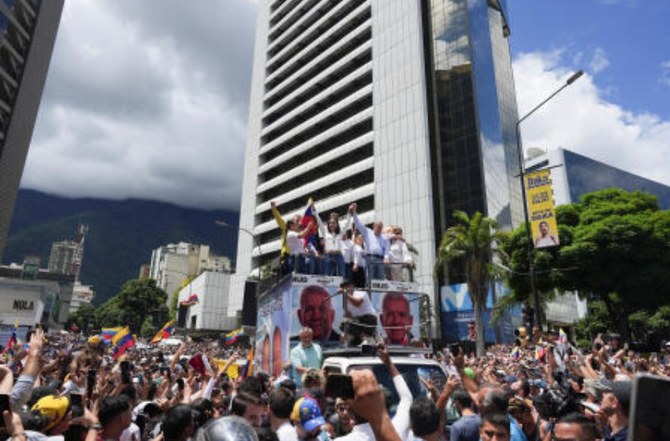
Machado — who was barred from running for president — and González addressed a huge rally of their supporters in the capital, Caracas, on Tuesday, but they have not been seen in public since. Later that day, the president of the National Assembly, Jorge Rodriguez, called for their arrest, describing them as criminals and fascists.
On Wednesday, Maduro asked Venezuela’s highest court to conduct an audit of the election, but that request drew almost immediate criticism from foreign observers who said the court, which like most institutions is controlled by the government, lacks the independence to perform a credible review.
Asked why electoral authorities have not released detailed vote counts, Maduro said the National Electoral Council has come under attack, including cyberattacks, without elaborating.
In an op-ed published Thursday in the Wall Street Journal, Machado said she is “hiding, fearing for my life, my freedom, and that of my fellow countrymen.” She reasserted that the opposition has physical evidence that Maduro lost the election and urged the international community to intervene.
“We have voted Mr. Maduro out,” she wrote. “Now it is up to the international community to decide whether to tolerate a demonstrably illegitimate government.”
Machado later posted a video on social media calling on supporters to gather Saturday across the country.


![]()

Masked assailants ransack Venezuela opposition leader’s headquarters as post-election tensions mount
Short Url
https://arab.news/zynbs
Masked assailants ransack Venezuela opposition leader’s headquarters as post-election tensions mount
- The raid occurred at around 3 a.m., Machado’s party said, adding that the assailants broke down doors and hauled away valuable documents and equipment
- Images published by Machado’s party on social media show several walls covered in black spray paint


Latest updates


© 2026 SAUDI RESEARCH & PUBLISHING COMPANY, All Rights Reserved And subject to Terms of Use Agreement.