

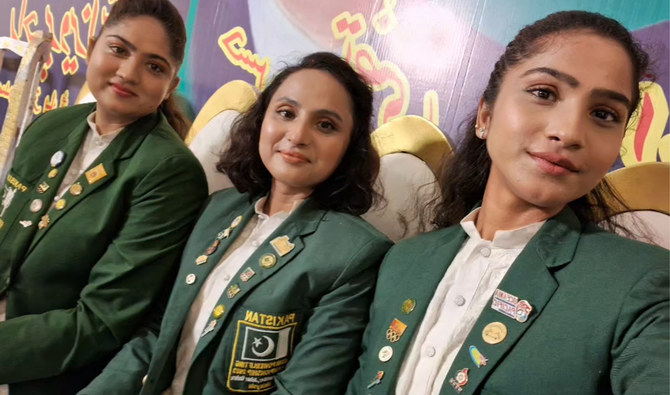

LAHORE: On a busy road in the eastern Pakistani city of Lahore, a training academy for female weightlifters has been inspiring women to reach the top of the male-dominated sport and smash taboos in the process.
The tiny one-room facility is run by four sisters — popularly called the “Sohail Sisters” or “Power Girls” — three of whom won big this month at the Asian Pacific African Compound Powerlifting Championship held in South Africa. Twinkle, Sybil and Veronica won 15 gold medals between them, while the fourth sister, Maryam, could not make it to the championship due to funding constraints.
The success of the Sohails has put the spotlight on weightlifting among women and girls, and now they want to encourage more to follow their dreams — even if that means challenging gender stereotypes in socially conservative countries like Pakistan.
“[Because of weightlifting] People used to say a lot of negative things about me in school, in college, and even among my relatives,” Twinkle, 26, told Arab News. “They don’t say anything now, not with all these medals on my jacket.”
Twinkle became the first Pakistani female powerlifter to win a gold medal in 2015 when she achieved the feat at a competition in Muscat, Oman, at the age of 17. Two years later, she lifted an impressive 240 kg at the Oceania Pacific powerlifting tournament in Singapore, bringing home four gold medals.
Twinkle started out by playing kabaddi, a fast-paced, combative, and contact team sport, and in 2013 participated in the Kabaddi World Cup in India. Later, she switched to powerlifting and her sisters followed suit.
“Now in the Asian Pacific African Compound Powerlifting Championship that just concluded, I was in the sub-80 kg category and lifted 370 kgs to win five gold medals,” Twinkle said. “Four in the classic format, one in equipped.”
Veronica, 18, won gold in all junior categories of the Asian Championship held in Dubai in 2018, a contest in which the sisters made history by each winning a medal. In no other competition before had four sisters won together.
“This record is unique to Pakistan, and in 2021 this record was officially approved by the IPF [International Powerlifting Federation],” Veronica said. “And in the same year, the ISPR [Inter-Services Public Relations] gave us a Pride of Performance award.”

The picture shared by the Sohail sisters on June 27, 2024, shows the Sohail sisters wearing medals after getting the Pride of Performance award in 2021. (Sohail Sisters)
Sybil, 24, competes in the 52 kg category.
“I started powerlifting after watching Twinkle,” she told Arab News. “But it wasn’t an easy journey.”
The Lahore-based sisters are used to training with rusted barbells and weights.
“If you look internationally, you look at those players and you look at our academy,” she said. “There’s a huge difference [in equipment].”
Funding is another obstacle.
Maryam, the eldest of the sisters at 28, couldn’t make it to this month’s championship in South Africa due to financial issues. While the country’s sports board paid for the women’s plane tickets, other expenses such as accommodation, doping tests, entry fees and equipment had to be arranged by the sisters themselves, Sybil said.
Where the sisters do get support is from their father, Sohail Khokhar, whose own dreams of becoming a professional cricketer were not supported by his parents but who wanted his daughters to have the illustrious sports career he never had.
He pushed them to pursue powerlifting.
“So they could make a name for themselves,” Khokhar explained.
“Even my grandfather tried stopping me, [saying] that weightlifting is not for women,” Twinkle added. “But my father and mother were always supportive.”
The girls also had a good coach, Rashid Malik, a UK resident, who has been working with them since 2013. Twinkle was his first disciple.
“My coach, Rashid Malik, had this aim that us four sisters would make a world record,” Twinkle said.
But while the sisters have had the freedom to pursue weightlifting, the family is also big on education and both Twinkle and Sybil have degrees in Sports Science.
“We four sisters buck each other up a lot, from an education point of view, study point of view and even the activities at home,” Twinkly said. “We push each other that ‘No, you can do this’.”
The sisters are also on a mission to unearth more talent like themselves at the small academy they run, the “Twinkle Sohail Academy,” on a busy road near Lahore’s busy Mozang Chungi area.
“Any new talent who wants to train and learn weightlifting, powerlifting, they’re more than welcome,” Twinkle said. “We will train them.”


