ISLAMABAD: Pakistan’s Prime Minister Shehbaz Sharif on Thursday strongly criticized Israel for committing acts of barbarity in Palestine and flagrantly violating international laws in the “extra-territorial killing” of Hamas’ political chief Ismail Haniyeh.
Haniyeh’s death was announced on Wednesday by Iran’s Revolutionary Guards, who said he and his bodyguard were killed in a strike on their accommodation in the Iranian capital at 2:00 a.m. (2230 GMT). Haniyeh was in Tehran to attend the swearing-in ceremony of the new Iranian president.
It came just hours after Israel targeted and killed top Hezbollah commander Fuad Shukr in a retaliatory strike on the Lebanese capital Beirut, sending fears of a wider regional war soaring in fallout from the Israel-Hamas war in Gaza.
While Israel has refrained from commenting on the Tehran strike, Iran has vowed retaliation against the Jewish state for carrying out an assassination on its soil.
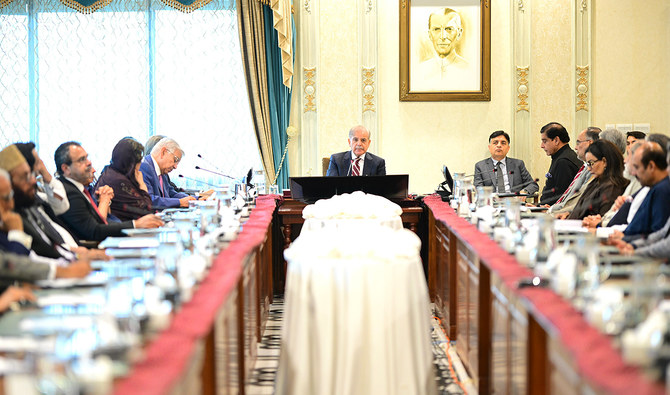
“I believe the entire world has condemned it [Haniyeh’s killing] in the strongest words,” Sharif said while chairing a meeting of the parliamentary members of his ruling coalition government.
“An extra-territorial killing was conducted in which Ismail Haniyeh was martyred through a rocket,” he said, regretting that international laws were violated in the act.
The prime minister regretted the world’s “silence” over the incident, saying that it was a time for reflection for the international community.
He noted that Israel had violated United Nations Security Council resolutions repeatedly since last year, lamenting that the Jewish state was not stopping its military offensive in Palestine despite the International Court of Justice describing its actions as “genocide.”
He thanked Ireland and Spain for recognizing the state of Palestine and supporting the two-state solution in the Middle East.
‘ACT OF DANGEROUS ESCALATION’
Separately, Pakistan’s foreign office on Thursday denounced Israel’s act of assassinating Haniyeh, saying that it was an act of “dangerous escalation.”
“Yesterday’s assassination of Ismail Haniyeh, the chief of the political bureau of Hamas in Tehran, was an act of dangerous escalation in an already volatile region and undermines efforts for peace,” Foreign Office Spokesperson Mumtaz Zahra Baloch told reporters at a news conference.
“We express our condolences to his family and the Palestinian people. His killers must be held to account.”
Baloch said Israel had unleashed a “campaign of terror” against the Palestinian people since October 2023.
“Its war on Gaza and the inhumane siege in violation of international human rights and humanitarian law have resulted in misery, death and destruction,” she added.
“These acts constitute war crimes and crimes against humanity. We call upon the United Nations to uphold international law and to bring an end to the genocide of the people of Gaza.”
She reiterated Pakistan’s support for Palestinians’ right to self-determination, their right of return to their homeland and the establishment of an independent state for them “with Al-Quds Al-Sharif as its capital.”


![]()

Pakistan PM condemns Israel for Hamas leader’s ‘extra-territorial killing’ in Tehran
Short Url
https://arab.news/6qvrp
Pakistan PM condemns Israel for Hamas leader’s ‘extra-territorial killing’ in Tehran
- Ismail Haniyeh and bodyguard were killed in Tehran on Wednesday when a rocket struck his accommodation
- Shehbaz Sharif says Israel flagrantly violated international laws in Haniyeh’s assassination, regrets world’s “silence”
Latest updates


© 2026 SAUDI RESEARCH & PUBLISHING COMPANY, All Rights Reserved And subject to Terms of Use Agreement.