

Olympic gold medal or major? Golf still trying to figure out where 5 rings fit among 4 majors

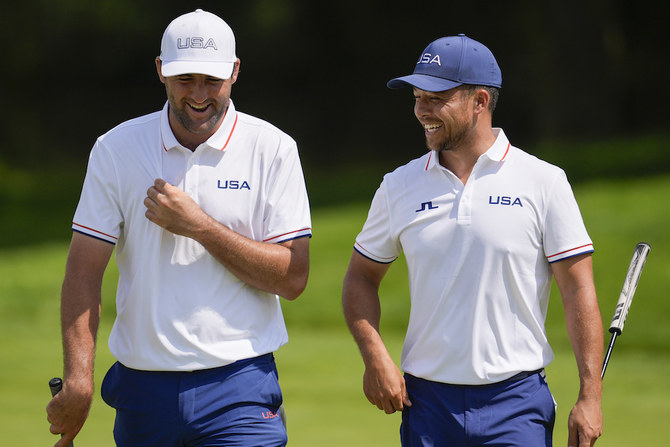
Scottie Scheffler, left, and Xander Schauffele, both of the US, during a practice round for the men’s golf event at the 2024 Summer Olympics Wednesday at Le Golf National in Saint-Quentin-en-Yvelines, France. (AP)
Short Url
Updated 01 August 2024
Follow

Olympic gold medal or major? Golf still trying to figure out where 5 rings fit among 4 majors

  • The men’s competition starts Thursday on sunbaked Le Golf National, site of the French Open and more famously the 2018 Ryder Cup
  • Golf was on the Olympic program for the St. Louis Games in 1904, and then it was gone until being resurrected in 2016

SAINT-QUENTIN-EN-YVELINES, France: Perhaps one way to measure when golf has truly arrived as an Olympic sport is when players stopped getting asked how a gold medal would stack up against winning a major.

No one is entirely sure, including the one player at Le Golf National who would know.

“That’s a great question for Xander Schauffele since he’s the only man recently to have done both,” said Jon Rahm, a two-time major champion from Spain playing in his first Olympics.

“It’s a good question, but it’s tricky,” Schauffele said.

He won the gold medal in the Tokyo Games, at the time the pinnacle of his young career and extra meaningful because of his family. His father, Stefan, was invited to take part in Germany’s decathlon training and was hit by a drunken driver on the way there, losing an eye.

Schauffele now has two very important silver trophies to go with that gold medal — the Wanamaker Trophy from winning the PGA Championship in May, the claret jug from his British Open title two weeks ago.

“Golf was in the Olympics, and then it was out of the Olympics,” Schauffele said. “So I think a lot of the kids were watching Tiger — or if you’re a little older, you were watching Jack or Arnie, the older legends of the game. You’re watching them win majors.

“For me, it’s very personal,” he said. “The relationship my dad and I have with golf, a lot of it surrounds his teachings of when he was trying to be an Olympian. Then the majors are what I grew up watching. They are two very different things to me.”

Schauffele also said, “The gold medal, it’s been marinating nicely.”

The general consensus is to give it time. The men’s competition starts Thursday on sunbaked Le Golf National, site of the French Open and more famously the 2018 Ryder Cup. It’s the third Olympic golf competition since the sport was put back on the program in Rio de Janeiro.

One little known fact: Paris is the only host city to stage two Olympic golf competitions.

The first gold medal in golf went to Charles Sands in the 1900 Olympics, and odds are he didn’t care all that much. Sands also competed in tennis, his primary sport, in those Paris Games without reaching the medal rounds. He beat 12 amateurs in golf, a sport he had taken up just five years earlier at St. Andrews Golf Club in New York.

Golf was on the Olympic program for the St. Louis Games in 1904, and then it was gone until being resurrected in 2016.

Justin Rose and Inbee Park won in Rio. Schauffele and Nelly Korda won in Tokyo. Gold medalists in golf have not lacked for star power, just meaning.

“I think as golf is in the Olympics for a longer period of time ... I don’t know if anything will be able to sit alongside the majors. We have our four events a year that are the gold standard,” Rory McIlroy said. “But think this in time is going to be right up there among that.”

Golf is gaining traction, best measured by attendance. The top seven players in the world, starting with Scottie Scheffler and Schauffele at Nos. 1 and 2, are part of the 60-man field at Le Golf National.

Collin Morikawa and Wyndham Clark, who have three majors between them over the last five years, were at the opening ceremony on Friday and have spent time at other events. It is not lost of them that so many Olympic athletes have worked four years for their biggest moment. Golf gets four big moments a year, plus the Olympics.

For Morikawa, seeing the other athletes compete this week gives him an even deeper appreciation. He was in the seven-man playoff for the bronze in Tokyo. There’s that other small matter of being in the same group with Schauffele at seven tournaments since Tokyo.

“We hear Xander get announced on the tee as the reigning gold medalist. As a major champion, you hear it for a year. But this, you hear it for four. It’s a pretty cool thing to have.”

Scheffler and Schauffele are the leading two favorites — one with a Masters green jacket to go along with six PGA Tour titles this year and the No. 1 ranking, the other a double major winner in 2024.

McIlroy has gone 10 years since winning his fourth major championship. He skirted around the issue by saying a gold medal would be his biggest feat in the last 10 years.

But it also depends on the country. Hideki Matsuyama was under enormous pressure in the Tokyo Games, held in 2021 without spectators because of the COVID-19 pandemic. He also was part of the seven-man playoff for the bronze. Matsuyama was the Masters champion that year.

Green jacket or gold medal?

“I think every single golf fan knows what the green jacket is,” he said. “But the gold medal, I think every single fan in Japan would know what the gold medal is in the Olympics. I think both are important, but I think the gold medal would have a big impact in Japan.”

The home pressure — and support — this year falls to Matthieu Pavon of France. He wants to win a major, just like any golfer. But a week among other Olympians changed his mind.

“I always felt like major for golf is more important because we have not really grown up with the Olympics,” he said. “After a few days in the Olympic Village, the opening ceremony in Paris with all this crowd in front of the Eiffel Tower and all the great moments we spent the last few days, it really feels like a gold medal would be now ranked higher than a major for me.”


Round-arm bowling challenges cricket’s norm

Updated 9 sec ago
Follow

Round-arm bowling challenges cricket’s norm

  • The action is defined as the hand being between shoulder and waist height and is different to the delivery mode adopted by most bowlers

Following last week’s consideration of the most significant of the 73 recently announced changes to the Laws of Cricket, a new challenge to an old law has surfaced.

This focuses on what constitutes a fair delivery and the spotlight has fallen on Pakistan’s spinner, Usman Tariq. At first sight, one might assume Tariq’s 1.93-meter height would make it likely he would be a fast bowler. He used to be, but an injury restricted his movement and he turned to spin. After some success he decided to stick with it, although now aged 28, it has taken him at least six years to hit the heights.

There is little doubt Tariq has a distinctive action. He starts with a shuffle, takes a skip, then three short steps to arrive alongside the crease. He enters with a sideways step on one foot, pausing in his delivery stride, knee raised, looking at the batter, before delivering the ball in a slinging, round-arm action. This is defined as the hand being between shoulder and waist height and is different to the delivery mode long adopted by most bowlers, who have a high arm action.

Attempts to introduce round-arm bowling in the first quarter of the 19th century met with fierce resistance to the point where the Marylebone Cricket Club introduced a law in 1816 to prohibit its practice. Gradually, however, attitudes changed and by 1835 its use was legitimized. It was not long before bowlers raised their hands above the shoulder during delivery. This led to years of confrontation between bowlers, umpires and law makers, which ended when the MCC changed Law 10 in 1864. Bowlers were allowed to bring their arm through at any height providing it was straight and the ball was not thrown.

Under the current code, Law 21, No Ball, defines a fair delivery. It states that “a ball is fairly delivered in respect of the arm if, once the bowler’s arm has reached the level of the shoulder in the delivery swing, the elbow joint is not straightened partially or completely from that instant until the ball has left the hand.”

The International Cricket Council has underpinned this definition by stating: “An illegal bowling action is a bowling action where the player's elbow extension exceeds 15 degrees between their arm reaching the horizontal and the ball being released.” The precision of this specification cannot be measured accurately by the human eye. If an umpire has a suspicion that the action is illegal, the bowler can be reported and sent for testing at an ICC bowling action testing center.

In March 2024, Tariq was reported by the umpires when bowling for Quetta Gladiators in the Pakistan Super League. Five days later, his action was cleared by the ICC-accredited biomechanics laboratory at the National Cricket Academy in Lahore.

In April 2025, he was reported again when playing in the PSL and was cleared for a second time. Most observers support this judgement, agreeing that Tariq’s arm does not straighten anywhere near the 15-degree threshold required for an action to be ruled illegal.

Buoyed by this second clearance, Tariq played with distinction in the Caribbean Premier League in September 2025, claiming 20 wickets, forming close bonds with senior West Indian players. A month later, Tariq made his T20 debut for Pakistan against South Africa in Lahore.

My first sighting of Tariq was during the latter stages of the DP World ILT20 in December 2025/January 2026, when he played a key role in the Desert Vipers’ success. In the first qualifier against the MI Emirates, one batter, Tom Banton of England, made a throwing motion when Tariq dismissed him. This served to further raise Tariq’s profile and gain the attention of a wider cricket world.

In franchise leagues, he has claimed 37 wickets in 22 matches, conceding around seven runs per over. When Pakistan hosted Australia in January prior to the T20 World Cup, more controversy erupted. In the second of three T20Is, Tariq dismissed Cameron Green, who made a throwing gesture as he walked off the field. Green later apologized, but his action fueled social media hysteria in the build up to the World Cup and Pakistan’s match against India, with exaggerated imitations appearing on-line.

Several ex-players have been outspoken in condemning Tariq’s action. One suggested that his act of stopping in his delivery swing was in breach of the laws, claiming it is not allowed to stop and look at the position of the batter before delivering the ball. In practice, it is not unusual for finger spinners to pause slightly at the crease, as their braced front leg is important in the act of imparting spin to the ball. There appears to be nothing in the laws which prohibits this pause.

The fallback position for those who do not approve of it is Law 41, Unfair Play, and clause 41.5, which covers the “deliberate distraction or deception of the batter.” It states: “It is unfair for any fielder willfully to attempt, by word or action, to distract, deceive or obstruct either batter after the striker has received the ball.” Clearly, this discounts before the striker receives the ball, although this should be considered equally important.

There is another part of Law 41 that gives umpires power. In 41.2.1, the umpires “shall be the sole judges of fair and unfair play. If an umpire considers that any action by a player, not covered in the Laws, is unfair, he/she shall call and signal Dead ball.”

In this T20 World Cup, another bowler has adopted a round-arm action. Gerhard Erasmus, the captain of Namibia, fell foul of umpire Rod Tucker in a match against India. As part of his bowling repertoire, Erasmus has developed a delivery from behind the crease. Tucker objected to this, calling “dead ball,” presumably invoking Law 41.2.1. An altercation ensued, after which Erasmus was allowed to continue bowling in the same way. He claimed four key wickets, conceding only 20 runs. It may be assumed that the Indian batters were not best pleased.

In an era of T20 cricket where everyone agrees that the balance of power lies with batters, it is understandable that bowlers will try and introduce ways to alter the balance. Tariq and Erasmus are attempting to do this with actions out of the norm.

Batters and their supporters are seeking to negate their impact by questioning their legitimacy. Reasoned voices within the game point out that Tariq’s pause is a part of his regular action, delivered consistently. He does not throw the ball, and his action should be considered legal.

In a fascinating interview with Brain Murgatroyd for the Desert Vipers, Tariq revealed that he has “two corners” in his elbow, whilst the pause came about because one coach told him his run up was too fast.

Batters may feel that the pause is off-putting, but they cannot say they do not have an opportunity to prepare, since Tariq is now a known quantity. On Wednesday, Pakistan played Namibia in Colombo, where both Erasmus and Tariq were on show. I watched Tariq’s bowling very closely in the warm-ups and the match, in which he claimed four wickets. His action never varied, but his speed and type of delivery did in a guileful manner. This is where his real deception exists. It is up to batters to deal with it rather than question the legalities.