

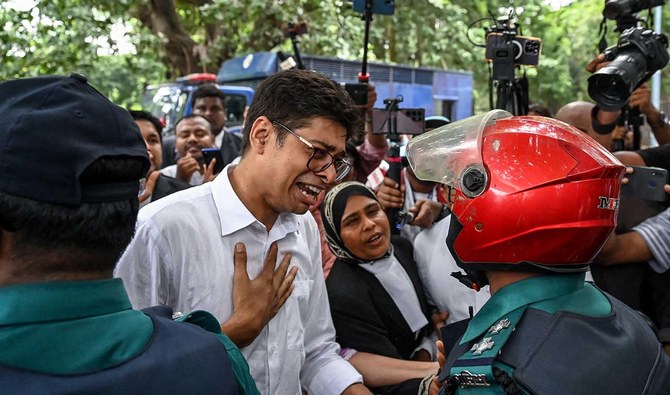

DHAKA, Bangladesh: Bangladesh observed a day of mourning Tuesday in memory of more than 200 people killed in recent weeks during violence that evolved from student protests over the South Asian country’s quota system for government jobs.
After weeks of peaceful protests by students looking to change the system — which reserves 30 percent of government jobs for families of veterans and freedom fighters during the war of independence against Pakistan in 1971 — violence erupted on July 15 when activists of a student wing of the ruling party attacked demonstrators. Security officials opened fire, using tear gas and rubber bullets to try to quell the violence.
The quota protests posed the most serious challenge to Bangladesh’s government since Prime Minister Sheikh Hasina won a fourth consecutive term in January elections that the main opposition groups boycotted.
The ruling Awami League party and opposition Bangladesh Nationalist Party have often accused each other of fueling political chaos and violence, most recently ahead of the election, which was marred by a crackdown on several opposition figures.
Government officials — including those at the Bangladesh Secretariat, the top office containing most of the country’s ministers and bureaucrats — wore black badges Tuesday to mourn those killed in the violence.
Bangladesh is slowly crawling back to normalcy with the strict curfew being relaxed in recent days. Authorities also asked all mosques, temples and other religious installations to organize special prayers Tuesday for the dead.
Later Tuesday, Hasina visited a state-run hospital in the capital of Dhaka, where many of the injured were being treated. She asked hospital authorities to ensure the best possible care.
Also on Tuesday, members of 31 cultural groups tried to hold a procession in downtown Dhaka, condemning the deaths in the violence but police blocked it. No violence was reported as singers and other activists sat down on the street and continued the protests peacefully amid a tight police cordon.
Home Minister Asaduzzaman Khan put the overall death toll at 150, while the country’s leading Bengali-language daily, Prothom Alo, said 211 people have been killed since the violence erupted on July 15 while thousands of others have been injured.
Media reports said about 10,000 people have been arrested over the past two weeks in relation to clashes at protests and other attacks on state properties. Rights groups have called for an end to arbitrary arrests, and critics accused the government of using excessive force to tamp down the violence.
“The mass arrest and arbitrary detention of student protesters is a witch hunt by the authorities to silence anyone who dares to challenge the government and is a tool to further perpetuate a climate of fear,” Smriti Singh, regional director for South Asia at Amnesty International, said in a statement Monday.
“Reports suggest that these arrests are entirely politically motivated, in retaliation for the exercise of human rights,” Singh said.
The government has defended its position, saying that the arrests were being made on specific charges, and reviewing CCTV footage and on the basis of evidence.
Six of the protest coordinators being held in custody by the Detective Branch of the Dhaka Metropolitan Police released a statement calling off the protests, but other demonstrators rejected the video statement, claiming it was coerced.
They say they will protest until all their demands are met, including a public apology from Hasina, the prime minister.
Police said the six coordinators were taken into custody for their safety, and their families met them on Monday. A video was posted showing the six having a meal with the head of the Detective Branch in Dhaka, Harun-or-Rashid.
Rights activists have demanded the six be released so that they can return to their families.
The protesters have no single leader, though the movement has a number of coordinators across the country. A news release attributed to one coordinator, Abdul Hannan Masooud, called for protests Wednesday at educational institutions, courts and major roads. The release could not be verified independently.
Also Tuesday, Bangladesh’s Law Minister Anisul Huq said that the government would ban the right wing Jamaat-e-Islami party and its student wing Islami Chhatra Shibir. Hasina and several other Cabinet ministers have accused the party and its student wing of playing a role in the violence during the student protests.
Huq said the ruling Awami League-led 14-party alliance had decided that the Jamaat-e-Islami party and its student wing should be officially banned on Wednesday. Details of the ban were not immediately clarified.
The party was a governing partner of the Bangladesh Nationalist Party under former Prime Minister Khaleda Zia, Hasina’s arch rival, in 2001-2006. The party had actively campaigned in favor of Pakistan’s military and against the creation of independent Bangladesh in 1971.
Protesters have said the 30 percent quota was discriminatory and benefited supporters of Hasina, whose Awami League party led the independence movement, and urging that it be replaced by a merit-based system.
On July 21, the Supreme Court ordered that the 1971 war veterans’ quota be cut to 5 percent. Of the remainder, 93 percent of civil service jobs would be merit-based, while the remaining 2 percent would be reserved for members of ethnic minorities, transgender people and those with disabilities. Two days later, the government accepted the ruling and pledged to execute the decision.
The status of the 1971 war veterans remains a charged issue in Bangladesh as the quota had also applied to women raped by Pakistani soldiers and their collaborators during the war for independence — and their children. These women have been recognized as “freedom fighters” for the ordeal they suffered. Sheikh Mujibur Rahman, Hasina’s father, is the independence leader of Bangladesh.
Both broadband and mobile data services were restored Tuesday after a dayslong Internet blackout, but social media platforms including Facebook remained blocked. Banks and offices opened under a relaxed curfew. Schools and other educational institutions were closed with no opening date yet set as police continued to grapple with protesters.


