

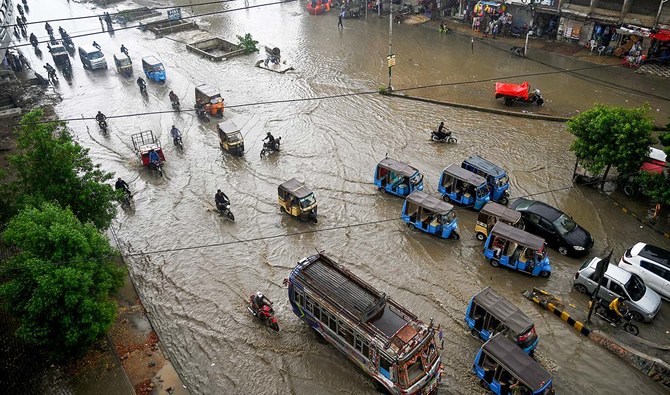

ISLAMABAD: Pakistan’s top disaster management authority on Wednesday warned that torrential rains and thundershowers were expected to hit the country from August 1-6, as nearly 20 people were killed this week in the northwestern Khyber Pakhtunkhwa (KP) and eastern Punjab province.
Pakistan is recognized as one of the most vulnerable countries to climate change impacts and this year recorded its “wettest April since 1961,” with 59.3 millimeters of rainfall and at least 144 deaths in thunderstorms and house collapses, mostly in the northwestern Khyber Pakhtunkhwa provinces, according to official data. The monsoon season is crucial for the region, providing essential water for agriculture, which is the backbone of Pakistan’s economy.
“More monsoon rains and thundershowers from August 1-6,” the National Disaster Management Authority (NDMA) said on Wednesday. “Monsoon currents from the Arabian Sea and Bay of Bengal are likely to penetrate in the upper part by July 31 and then in central and southern parts of the country from Aug 2 onwards.”
The statement highlighted that torrential rains may generate flash floods in local streams flowing through Murree, Galliyat, Mansehra, Kohistan, Chitral, Dir, Shangla, Bunner, Bannu, Kurram, Waziristan, D.I Khan, Orakzai, Khyber, Mohmand, Nowshera and Swabi in Khyber Pakhtunkhwa province. Islamabad, Rawalpindi and northeast Punjab might also be affected.
Hill torrents may be triggered in D.G Khan, Rajanpur, Sulaiman and Kirthar Ranges, the authority said, adding that heavy downpours may result in urban flooding in Islamabad, Rawalpindi and northeast Punjab including Gujranwala, Lahore, Sheikhupura, Kasur, Sialkot, Sargodha, Faisalabad, Multan, Sahiwal, Nowshera and Peshawar from Aug 2-5.
The NDMA warned that rain events might lead to a surge in water levels of streams with a possibility of landslides in upper KP, Murree, Galliyat, Kashmir and Gilgit Baltistan. The weather conditions could also pose a threat to life and property in vulnerable areas.
According to the report, NDMA advised all the provincial disaster management authorities to remain prepared to respond to untoward situations: ” Departments must ensure the pre-placement of machinery and the availability of relevant staff in vulnerable areas.”
It urged local departments to sensitize residents living along riverbanks and facilitate their timely evacuation of at-risk populations from low-lying areas. The citizens were advised to undertake precautionary measures like staying clear of electric poles and weak infrastructure. Tourists and travelers were advised to remain cautious.
Last month, a UN official warned that an estimated 200,000 people in Pakistan could be affected by the upcoming monsoon season.
Unusually heavy rains in June 2022 triggered flash floods in many parts of the country, killing over 1,700 people, inflicting losses of around $30 billion on the economy, and affecting at least 30 million people.


