

Torrential rains to continue in Pakistan from Aug 1-6 as at least 20 killed this week

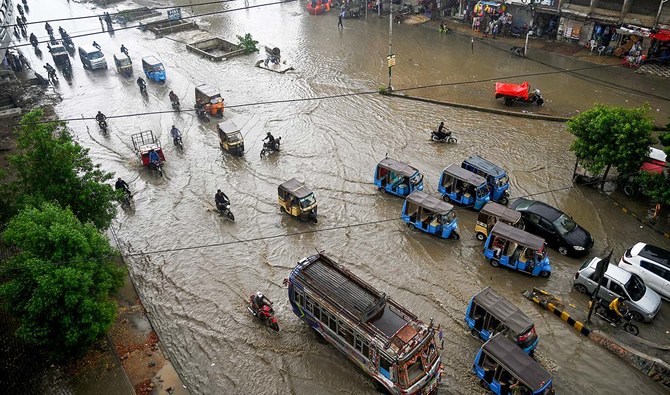
People wade through a flooded street amid rainfall in Karachi on July 30, 2024. (AFP)
Short Url
Updated 31 July 2024
Follow

Torrential rains to continue in Pakistan from Aug 1-6 as at least 20 killed this week

  • NDMA warns of flash floods in country’s northwestern KP province
  • Authorities advise precautionary measures for citizens during monsoons

ISLAMABAD: Pakistan’s top disaster management authority on Wednesday warned that torrential rains and thundershowers were expected to hit the country from August 1-6, as nearly 20 people were killed this week in the northwestern Khyber Pakhtunkhwa (KP) and eastern Punjab province. 

Pakistan is recognized as one of the most vulnerable countries to climate change impacts and this year recorded its “wettest April since 1961,” with 59.3 millimeters of rainfall and at least 144 deaths in thunderstorms and house collapses, mostly in the northwestern Khyber Pakhtunkhwa provinces, according to official data. The monsoon season is crucial for the region, providing essential water for agriculture, which is the backbone of Pakistan’s economy. 

“More monsoon rains and thundershowers from August 1-6,” the National Disaster Management Authority (NDMA) said on Wednesday. “Monsoon currents from the Arabian Sea and Bay of Bengal are likely to penetrate in the upper part by July 31 and then in central and southern parts of the country from Aug 2 onwards.”

The statement highlighted that torrential rains may generate flash floods in local streams flowing through Murree, Galliyat, Mansehra, Kohistan, Chitral, Dir, Shangla, Bunner, Bannu, Kurram, Waziristan, D.I Khan, Orakzai, Khyber, Mohmand, Nowshera and Swabi in Khyber Pakhtunkhwa province. Islamabad, Rawalpindi and northeast Punjab might also be affected.

Hill torrents may be triggered in D.G Khan, Rajanpur, Sulaiman and Kirthar Ranges, the authority said, adding that heavy downpours may result in urban flooding in Islamabad, Rawalpindi and northeast Punjab including Gujranwala, Lahore, Sheikhupura, Kasur, Sialkot, Sargodha, Faisalabad, Multan, Sahiwal, Nowshera and Peshawar from Aug 2-5.

The NDMA warned that rain events might lead to a surge in water levels of streams with a possibility of landslides in upper KP, Murree, Galliyat, Kashmir and Gilgit Baltistan. The weather conditions could also pose a threat to life and property in vulnerable areas.

According to the report, NDMA advised all the provincial disaster management authorities to remain prepared to respond to untoward situations: ” Departments must ensure the pre-placement of machinery and the availability of relevant staff in vulnerable areas.”

It urged local departments to sensitize residents living along riverbanks and facilitate their timely evacuation of at-risk populations from low-lying areas. The citizens were advised to undertake precautionary measures like staying clear of electric poles and weak infrastructure. Tourists and travelers were advised to remain cautious. 

Last month, a UN official warned that an estimated 200,000 people in Pakistan could be affected by the upcoming monsoon season. 

Unusually heavy rains in June 2022 triggered flash floods in many parts of the country, killing over 1,700 people, inflicting losses of around $30 billion on the economy, and affecting at least 30 million people.


World Bank approves $400 million to expand water, sanitation services in Pakistan’s Punjab

Updated 4 sec ago
Follow

World Bank approves $400 million to expand water, sanitation services in Pakistan’s Punjab

  • Project aims to improve access for 4.5 million people and curb waterborne diseases
  • Program to prioritize women’s participation and climate-resilient urban infrastructure

ISLAMABAD: The World Bank this week approved $400 million for a new project to expand access to safe water, sanitation and hygiene services for around 4.5 million people in Pakistan’s most populous Punjab province, aiming to curb waterborne diseases and reduce long-term public health costs.

The project, known as the Punjab Inclusive Cities Program (PICP), is the second phase of the World Bank-supported Pakistan Urban Water, Sanitation and Hygiene Services Multiphase Programmatic Approach. It will focus on rehabilitating water supply networks, sewerage systems and wastewater treatment plants, while expanding stormwater drainage infrastructure across 16 secondary cities in Punjab.

Punjab faces persistent challenges in providing safe drinking water and adequate sanitation, with many urban households relying on contaminated sources. Weak infrastructure and limited hygiene services contribute to high rates of waterborne diseases such as diarrhea, typhoid and hepatitis, which disproportionately affect children and low-income communities.

“Reducing child stunting is essential for Pakistan’s future. Through the Punjab Inclusive Cities Program, we are investing in safe water, sanitation, and hygiene services to break the cycle of malnutrition and disease that holds back so many children from reaching their full potential,” the World Bank quoted its Country Director for Pakistan, Bolormaa Amgaabazar, as saying in a statement.

“In collaboration with the Punjab Government, the program represents a significant step forward in improving urban infrastructure and strengthening local institutions, thereby laying the foundation for healthier communities and a more prosperous Pakistan.”

Child stunting, a form of chronic malnutrition that leaves children too short for their age, is often linked to repeated infections, poor sanitation and unsafe drinking water, and remains a major public health concern in Pakistan.

Beyond water and sanitation, the project will also support solid waste management systems to improve sanitary waste disposal, extending services to an additional two million people in Punjab’s urban areas. The program will strengthen the capacity of local governments, including efforts to improve revenue generation and long-term service sustainability.

“The program complements infrastructure investments with capacity building and revenue generation, helping to ensure that service delivery is well sustained,” the statement quoted Amena Raja, Senior Urban Specialist at the World Bank, as saying.

“It will also help Punjab’s cities better withstand floods and droughts, ensuring urban development is both environmentally responsible and resilient to climate change.”

The program includes a gender-focused component, prioritizing the hiring of women in decision-making roles, establishing gender-compliant service desks and supporting skills development. It also aims to mobilize private capital to support water and sanitation services in Punjab’s secondary cities.

Pakistan has been a member of the World Bank since 1950 and has received more than $48 billion in assistance since. The Bank’s current portfolio in the country comprises 54 projects with total commitments of $15.7 billion, while its private-sector arm, the International Finance Corporation, has invested about $13 billion since 1956.

Earlier this year, Pakistan and the World Bank signed a first-of-its-kind agreement for a plan to focus $20 billion in lending to the cash-strapped nation over the coming decade on development issues like the impact of climate change as well as boosting private-sector growth.