KARACHI: A Chinese diplomat in Pakistan on Tuesday urged political parties and rights groups in the restive Balochistan province to “set aside” their differences and focus on construction and economic development of the region, which has seen violent protests since last week.
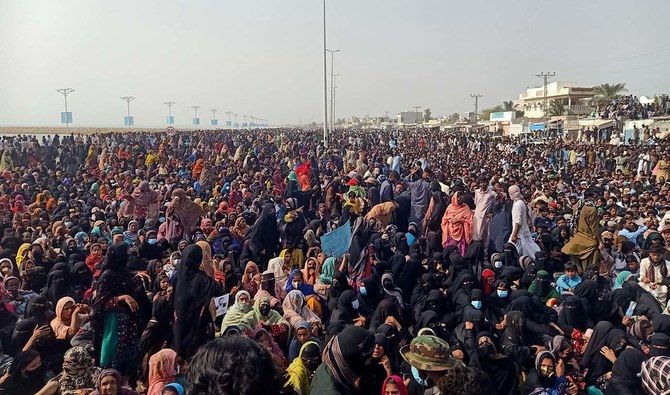
Thousands of people have gathered in Gwadar, home to a key Chinese-built deep seaport central to the multi-billion-dollar China-Pakistan Economic Corridor (CPEC), since last week to participate in a Baloch rights movement, organized by the Baloch Yakjehti Committee (BYC) group led by 31-year-old human rights activist Dr. Mahrang Baloch, on Sunday.
Tensions soared in the province on Saturday when more than a dozen protesters, enroute to Gwadar for Sunday’s public gathering, were injured in clashes with security forces in the Mastung district, officials and protesters said. The clashes took place amid a shutdown of Internet, mobile phone and broadband services in parts of Balochistan.
Gulzar Dost Baloch, a BYC member who was leading a caravan in Quetta, said supporters were leaving Mastung for Gwadar when “security forces attacked the buses with straight gun fire.” The BYC later said one protester was killed in the clashes, while the Pakistani army said on Monday that a Pakistani sepoy was killed and 16 others, including an officer, were injured in “unprovoked assaults.”
“Some people said that ‘without the stability of Balochistan, there’s no stability of Pakistan.’ So, I agree with this and this view,” Chinese Consul General Yang Yundong told reporters in Karachi, when asked about Beijing’s view on the protests in Balochistan.
“We hope that all the political parties and social organizations take their overall national interest into account and to set aside that difference and focus on construction and economic development and to take the people’s interest as a top priority.”
Gwadar, situated along the Arabian Sea, lies at the heart of China-Pakistan Economic Corridor (CEPC), under which Beijing has funneled tens of billions of dollars into massive transport, energy and infrastructure projects in Pakistan.
But the undertaking has been hit by Islamabad struggling to keep up its financial obligations as well as attacks on Chinese targets by militants in Balochistan and elsewhere in the country.
Yang said Gwadar was central to CPEC and noted the completion of several projects, including the new Gwadar International Airport, in the southwestern Pakistani city. He emphasized that China was committed “to develop Gwadar into a transshipment harbor.”
“Under Gwadar, Balochistan has great potential,” he said, highlighting the province’s mine and mineral wealth. “We will put that and the cooperation in the mining sectors as a breakthrough of our industry corporations. So hopefully and with the stabilization of the situations and with the consented efforts from both sides, from China, Pakistan, the CPEC will bring more tangible benefit to local peoples.”
Pakistan’s Balochistan province, which borders Iran and Afghanistan, is the site of a low-level insurgency for the last two decades by separatists who say they are fighting what they see as the unfair exploitation of the province’s wealth by the federation.
The Pakistani state denies the allegation and says it works for the uplift of the impoverished province. The government and army have often blamed neighbors India, Afghanistan and Iran of stoking tensions in Balochistan and funding the insurgency, which they deny.
The Chinese diplomat said the world was facing a new “period of turmoil and transformation,” with regional conflicts dragging on, and instability, uncertainty and unpredictability spreading globally.
“We want to build Balochistan into a more stable and prosperous province,” he said. “As all-weather strategic cooperative partners, China and Pakistan’s relationship has withstood the test of international changes and remains rock-solid and stable as Mount Himalayas.”
A month ago, Yang said, Pakistan Prime Minister Shehbaz Sharif had visited China where leaders of the two countries had reached a broad consensus on further deepening the strategic cooperative partnership between China and Pakistan.
“Our two countries maintain close communication and exchanges at all levels and our relationship is very unique,” he added.
The Chinese consul general said the two sides would build on the achievements of CPEC and jointly develop five major corridors for growth, better life, innovation, green development and openness, creating an upgraded version of CPEC and aligning it with Pakistan’s ‘5Es’ framework that focuses on economy, energy, education, environment and equality in order to benefit the two countries and peoples.
“Without security, there is no guarantee for development,” he said, adding that during his meeting with PM Sharif, President Xi Jinping had clearly stated that China supported Pakistan’s fight against militancy and hoped Islamabad would continue to create a “safe, stable and predictable business environment,” ensuring the safety of Chinese people, projects and institutions in Pakistan.
“We firmly believe that with strong guidance from the high-level consensus of the two countries and joint efforts of relevant departments, security cooperation between the two countries will surely reach a higher level, creating a safe environment and providing reliable guarantees for the development of China-Pakistan relations,” Yang added.


![]()

Chinese envoy urges government, rights groups to ‘set aside’ differences amid Balochistan protests
Short Url
https://arab.news/9vy2n
Chinese envoy urges government, rights groups to ‘set aside’ differences amid Balochistan protests
- Gwadar has been site of days-long protests against alleged rights abuses in Balochistan
- Province is at the heart of Beijing's investments in China-Pakistan Economic Corridor
Latest updates


© 2026 SAUDI RESEARCH & PUBLISHING COMPANY, All Rights Reserved And subject to Terms of Use Agreement.