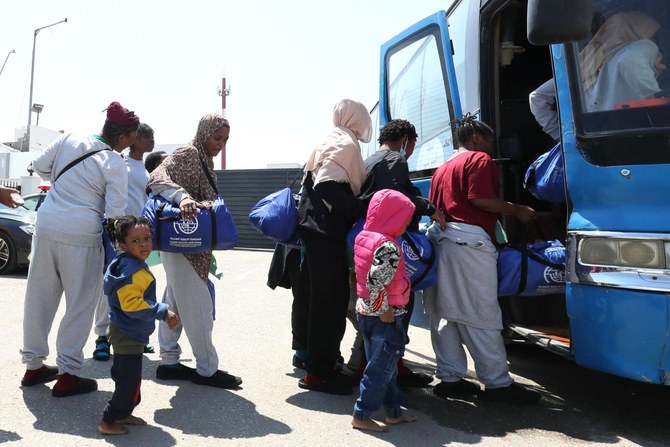
TRIPOLI: Libya repatriated Tuesday 369 irregular migrants to their home countries Nigeria and Mali, including more than one hundred women and children, an official told AFP.
Mohammed Baredaa, head of the Libyan interior ministry organization tasked with halting irregular migration, said two repatriations flights took place transporting 204 Nigerians and 165 Malians.
Nine babies, 18 minors, and 108 women were among the Nigerian irregular migrants, said Baredaa.
He said that the flights were carried out “in coordination with the International Organization for Migration (IOM).”
The UN agency provides free return flights to migrants and help reintegrating them into their home countries with its “voluntary humanitarian return program.”
But some migrants told AFP on Tuesday that they were being forcibly deported.
Libyan authorities “came at night and broke down the door,” said Hakim, 59, a Nigerian who has lived in Libya for 25 years who declined to give his surname.
He said they confiscated his passport before detaining him and his wife prior to repatriation.
Libya is still struggling to recover from years of war and chaos after the 2011 NATO-backed overthrow of longtime dictator Muammar Qaddafi.
Smugglers and human traffickers have taken advantage of the climate of instability that has dominated the vast country since.
Libya has been criticized over the treatment of migrant and refugees, with accusations from rights groups ranging from extortion to slavery.
Situated about 300 kilometers (186 miles) from Italy, it is a key departure point for migrants, primarily from sub-Saharan African countries, risking perilous Mediterranean Sea journeys to seek better lives in Europe.
But with mounting efforts by Libya and the European Union to curb irregular migration, many have found themselves stranded in Libya.
Earlier this month, Libyan authorities said up to four in five foreigners in the North African country were undocumented.
“It’s time to resolve this problem,” Interior Minister Imad Trabelsi had said at the time, adding that Libya has turned from a “transit country to a country of settlement” — something he deemed “unacceptable.”


![]()
![]()

Libya repatriates 369 Nigeria and Mali migrants

Short Url
https://arab.news/yqquq
Libya repatriates 369 Nigeria and Mali migrants
- Nine babies, 18 minors, and 108 women were among the Nigerian irregular migrants, said Baredaa
- Libya has been criticized over the treatment of migrant and refugees, with accusations from rights groups ranging from extortion to slavery


Latest updates


© 2026 SAUDI RESEARCH & PUBLISHING COMPANY, All Rights Reserved And subject to Terms of Use Agreement.