ISLAMABAD: Pakistan’s Petroleum Minister Dr. Musadik Malik said on Tuesday the government was providing relief to 86 percent of electricity consumers who were using less than 200 units a month, adding the impact of a Rs50 billion ($179.5 million) subsidy would likely be visible next month.
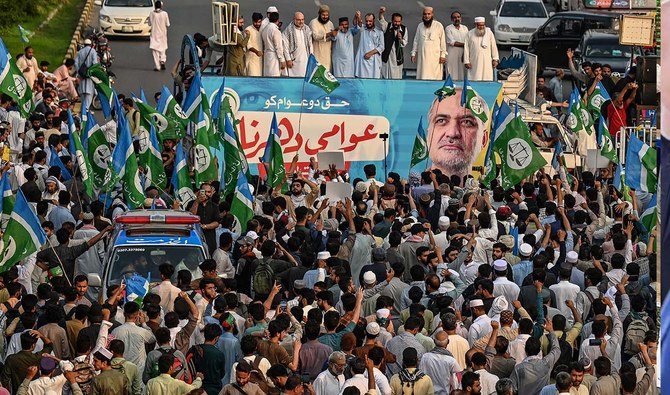
Malik’s statement came amid a protest by thousands of Jamaat-e-Islami (JI) supporters in the garrison city of Rawalpindi for the fifth consecutive day on Tuesday, demanding a reduction in power tariffs, petroleum levy and prices of essential products. The party has announced plans to widen its protests to other cities as well.
Prime Minister Shehbaz Sharif this month approved a three-month, Rs50 billion subsidy for electricity consumers using up to 200 units a month. This decision came in response to backlash from the salaried class over the tax-heavy federal budget, which intensified debates about the escalating costs of living in Pakistan.
The announcement followed the Pakistani government’s approval of a roughly 51 percent increase in electricity costs for low-income consumers to meet requirements set by the International Monetary Fuund (IMF) as part of a recently agreed $7 billion loan deal with Islamabad.
“Pakistan’s 86 percent of households use less electricity than 200 units and the government will pay for it,” Malik told reporters at a media briefing in Islamabad. “The Prime Minister has ordered the treasury to withdraw Rs50 billion from the development fund to provide subsidies to these 86 percent consumers [and] the impact of this will be visible from next month.”
The minister said there had been a lot of “noise” about electricity bills and the government was concerned about the masses.
“But this is not enough because the price of electricity is high. That’s why three, four committees have been formed,” he said. “I have even been made head of a committee and every week, we are reporting to the Prime Minister. They will find a solution that will benefit all.”
Analysts believe while a short-term relief will not impact the IMF program, but extending it beyond September could pose problems, stressing the need for a long-term solution to the issue.
Shehbaz Rana, a journalist who closely covered the IMF program, said since the government withdrew this Rs50 billion amount from the Public Sector Development Programme (PSDP) to provide temporary relief to electricity consumers, there would be no negative impact on the IMF program in the short term.
“If the government tried to further extend this temporarily beyond the end of September, then there might be issues for the IMF program,” he told Arab News.
Rana pointed out the government’s decision to temporarily freeze electricity rates for consumers using up to 200 units a month was only a “partial solution.”
He said the government had postponed planned increases of “14 percent to 51 percent” in electricity prices, and this deferral, effective from July 1 to September 30, was not a permanent fix.
“From the 1st of October, the new rates, which means up to 51 percent increase for the residential consumers, will take effect for all classifications of the residential consumers whether these are the users of 200 units or above 200 units,” Rana said.
Dr. Khaqan Najeeb, an economist and a former spokesperson of the finance ministry, said the IMF would likely agree with this measure as this money was being taken out of the PSDP and did not disturb the overall fiscal framework.
“At the general level, there must be a realization that the electricity sector in particular and the energy sector overall need a restructuring effort in terms of reorganizing the sector, which mainly is a governance issue, and reorganizing is now a necessity in the next three to five years,” he told Arab News.
Dr. Ali Salman, executive director of an Islamabad-based Policy Research Institute of Market Economy (PRIME) think tank, stated that while the IMF might not have had an issue with the measure, it was merely a “temporary fix” and would not address the underlying problem.
“Obviously the cost of electricity is too high for low-income households and instead of showing this relief in an unsustainable manner, the government can cut the costs of the electricity bill by reducing the tax collection on these bills by about 25 percent of the bill which we pay,” he said.
Every time, he noted, the government reallocated the budget from something to provide temporary relief, describing it as a practice that was “neither advisable nor sustainable.”


Pakistan says providing power subsidy to 86 percent consumers amid cost-of-living protests
https://arab.news/yvq3b
Pakistan says providing power subsidy to 86 percent consumers amid cost-of-living protests

- Pakistan this month approved $179.5 million subsidy for electricity consumers using up to 200 units a month
- Analysts believe short-term relief won’t affect country’s IMF program, but extending it could cause problems

Ramadan tests Pakistan’s daily wage workers but faith endures
- Reduced work hours during fasting month cut already fragile incomes
- Charities, local businesses step in as laborers try to support families back home
ISLAMABAD: Abdul Waqif grips a worn-out shovel and digs into the earth beneath the harsh midday sun, his body bent with age but still moving steadily. Moments later, the 70-year-old hoists a heavy bag of cement onto his shoulders and carries it toward an under-construction house, all while fasting.
For Waqif and thousands of daily wage laborers across Pakistan, Ramadan is not just a month of spiritual devotion. It is also a month of shrinking incomes.
Waqif migrated from Mohmand tribal district in northwestern Pakistan to Islamabad two decades ago in search of work. Like many laborers from rural and former tribal areas, he left behind limited local opportunities to earn a living in larger cities such as Islamabad, Lahore and Karachi.
In Pakistan, daily wage workers, particularly in construction and manual labor, are among the most economically vulnerable. They are paid only for days worked, receive no job security or benefits, and often rely on informal arrangements. Any slowdown in economic activity directly affects their ability to feed their families.
Economic activity typically slows during Ramadan, when Muslims fast from dawn to sunset. Employers often reduce work hours or postpone physically demanding projects to ease the burden on fasting workers. While intended as a gesture of consideration, it means fewer working hours and fewer earnings.
For laborers such as Waqif, who earns between Rs1,000-1,200 [$3.59-4.31] per day, even a slight reduction in work can be devastating.
His suhoor, the pre-dawn meal before fasting begins, usually consists of a few chapatis from a nearby hotel. The hunger and thirst that follow him through the day are constant companions as he lifts bricks and mixes cement in the heat.
But so is his faith.
“Allah gives me courage. I am hungry and thirsty, but I keep working,” Waqif said while wiping the sweat off his brow.
Back in Mohmand district, his wife, four daughters and two sons depend on the money he sends home. Every rupee matters.
“I support them with this work,” Waqif said. “I eat three meals a day here and I also have to save money for my children and send it to them.”
The reduction in work during Ramadan weighs heavily on him.
“I don’t find much work in Ramadan, and I’m worried for my family,” Waqif said.
‘HONEST LIVING’
Finding food for suhoor is sometimes a challenge. On some mornings, someone offers him a piece of flatbread. Other times, he buys what little he can afford from a nearby eatery.
Muhammad Sajid, owner of Al-Hadi restaurant in Islamabad’s G-15 sector, says he tries to ease that burden by offering meals to laborers at half price.
“We don’t let anyone go hungry,” Sajid told Arab News. “We offer sehri and iftar as much as anyone can afford.”
The restaurant serves tea, yogurt, several types of curries and parathas.
Charity groups also expand operations during Ramadan, when community support traditionally increases. The Junaid Welfare Foundation runs a roadside dastarkhwan, or communal meal spread, serving hundreds daily.
Haq Rawan Shareefi, a manager at the foundation, said around 500 people are provided iftar meals each day. The cost of one person’s iftar is Rs200 [$0.72].
“That means, on iftar and sehri, our expenses range from Rs150,000 [$538.97] to Rs200,000 [$718.63],” Shareefi said.
For Waqif, breaking his fast at sunset brings temporary relief from the physical strain of the day. But the financial uncertainty remains.
“I ask Allah for this,” he said. “May Allah give me strength to earn honest living for my children.”


