ISLAMABAD: Pakistan’s Petroleum Minister Dr. Musadik Malik said on Tuesday the government was providing relief to 86 percent of electricity consumers who were using less than 200 units a month, adding the impact of a Rs50 billion ($179.5 million) subsidy would likely be visible next month.
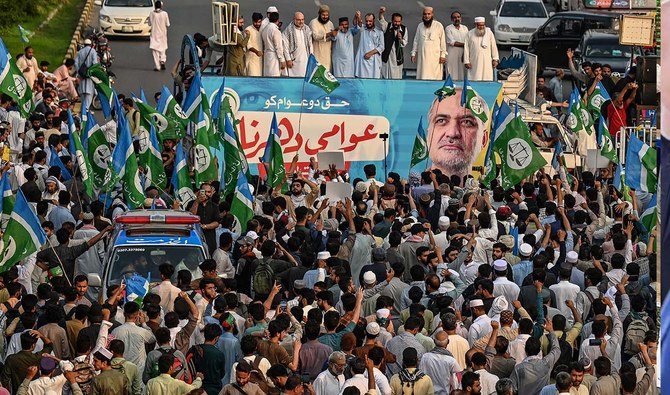
Malik’s statement came amid a protest by thousands of Jamaat-e-Islami (JI) supporters in the garrison city of Rawalpindi for the fifth consecutive day on Tuesday, demanding a reduction in power tariffs, petroleum levy and prices of essential products. The party has announced plans to widen its protests to other cities as well.
Prime Minister Shehbaz Sharif this month approved a three-month, Rs50 billion subsidy for electricity consumers using up to 200 units a month. This decision came in response to backlash from the salaried class over the tax-heavy federal budget, which intensified debates about the escalating costs of living in Pakistan.
The announcement followed the Pakistani government’s approval of a roughly 51 percent increase in electricity costs for low-income consumers to meet requirements set by the International Monetary Fuund (IMF) as part of a recently agreed $7 billion loan deal with Islamabad.
“Pakistan’s 86 percent of households use less electricity than 200 units and the government will pay for it,” Malik told reporters at a media briefing in Islamabad. “The Prime Minister has ordered the treasury to withdraw Rs50 billion from the development fund to provide subsidies to these 86 percent consumers [and] the impact of this will be visible from next month.”
The minister said there had been a lot of “noise” about electricity bills and the government was concerned about the masses.
“But this is not enough because the price of electricity is high. That’s why three, four committees have been formed,” he said. “I have even been made head of a committee and every week, we are reporting to the Prime Minister. They will find a solution that will benefit all.”
Analysts believe while a short-term relief will not impact the IMF program, but extending it beyond September could pose problems, stressing the need for a long-term solution to the issue.
Shehbaz Rana, a journalist who closely covered the IMF program, said since the government withdrew this Rs50 billion amount from the Public Sector Development Programme (PSDP) to provide temporary relief to electricity consumers, there would be no negative impact on the IMF program in the short term.
“If the government tried to further extend this temporarily beyond the end of September, then there might be issues for the IMF program,” he told Arab News.
Rana pointed out the government’s decision to temporarily freeze electricity rates for consumers using up to 200 units a month was only a “partial solution.”
He said the government had postponed planned increases of “14 percent to 51 percent” in electricity prices, and this deferral, effective from July 1 to September 30, was not a permanent fix.
“From the 1st of October, the new rates, which means up to 51 percent increase for the residential consumers, will take effect for all classifications of the residential consumers whether these are the users of 200 units or above 200 units,” Rana said.
Dr. Khaqan Najeeb, an economist and a former spokesperson of the finance ministry, said the IMF would likely agree with this measure as this money was being taken out of the PSDP and did not disturb the overall fiscal framework.
“At the general level, there must be a realization that the electricity sector in particular and the energy sector overall need a restructuring effort in terms of reorganizing the sector, which mainly is a governance issue, and reorganizing is now a necessity in the next three to five years,” he told Arab News.
Dr. Ali Salman, executive director of an Islamabad-based Policy Research Institute of Market Economy (PRIME) think tank, stated that while the IMF might not have had an issue with the measure, it was merely a “temporary fix” and would not address the underlying problem.
“Obviously the cost of electricity is too high for low-income households and instead of showing this relief in an unsustainable manner, the government can cut the costs of the electricity bill by reducing the tax collection on these bills by about 25 percent of the bill which we pay,” he said.
Every time, he noted, the government reallocated the budget from something to provide temporary relief, describing it as a practice that was “neither advisable nor sustainable.”


Pakistan says providing power subsidy to 86 percent consumers amid cost-of-living protests
https://arab.news/yvq3b
Pakistan says providing power subsidy to 86 percent consumers amid cost-of-living protests

- Pakistan this month approved $179.5 million subsidy for electricity consumers using up to 200 units a month
- Analysts believe short-term relief won’t affect country’s IMF program, but extending it could cause problems

International Cricket Council in talks to revive India-Pakistan T20 World Cup clash
- Pakistan face two-point loss and net run-rate hit if they forfeit Feb. 15 match
- ICC seeks dialogue after Pakistan boycott clash citing government directive
NEW DELHI, India: The International Cricket Council is in talks with the Pakistan Cricket Board to resolve the boycott of its T20 World Cup match against India on February 15, AFP learnt Saturday.
Any clash between arch-rivals India and Pakistan is one of the most lucrative in cricket, worth millions of dollars in broadcast, sponsor and advertising revenue.
But the fixture was thrown into doubt after Pakistan’s government ordered the team not to play the match in Colombo.
The Pakistan Cricket Board reached out to the ICC after a formal communication from the cricket’s world body, a source close to the developments told AFP.
The ICC was seeking a resolution through dialogue and not confrontation, the source added.
The 20-team tournament has been overshadowed by an acrimonious political build-up after Bangladesh, who refused to play in India citing security concerns, were replaced by Scotland.
As a protest, Pakistan refused to face co-hosts India in their Group A fixture.
Pakistan, who edged out Netherlands in the tournament opener on Saturday, will lose two points if they forfeit the match and also suffer a significant blow to their net run rate.
India skipper Suryakumar Yadav said this week that his team would travel to Colombo for the clash.
Pakistan and India have not played bilateral cricket for more than a decade, and meet only in global or regional tournaments.


