Pakistan army gives retired officer 14 years jail for ‘inciting sedition’ among personnel

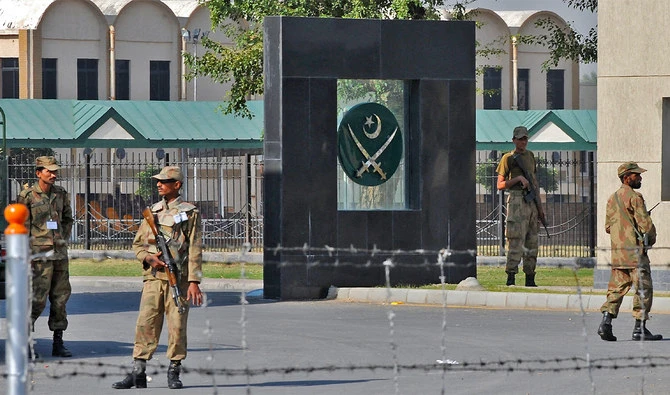
Pakistani soldiers guard the main entrance to army headquarters in Rawalpindi, Pakistan, on October 11, 2009. (AFP/File)
Short Url
Updated 30 July 2024
Follow

Pakistan army gives retired officer 14 years jail for ‘inciting sedition’ among personnel

  • Lt. Col. Akbar Hussain convicted after military trial on May 10 and stripped of rank on July 26
  • Retired Major Adil Raja, Captain Haider Raza Mehdi got 14 and 12 years respectively last year for sedition and espionage 

KARACHI: A retired military officer, Lt. Col. Akbar Hussain, was convicted and sentenced to 14 years in prison for “inciting sedition among army personnel,” the Pakistan army’s media wing said in a statement on Tuesday. 

Hussain was convicted in May after a military court trial under the Pakistan Army Act, 1952, and he was stripped of his rank on July 26, the military added. 

“The court of competent jurisdiction adjudged him ‘guilty’ of the offense charged, through due judicial process and awarded the punishment of 14 years rigorous imprisonment on 10th May 2024,” the army said in a statement. 

The statement said two other retired officers, Major Adil Farooq Raja and Captain Haider Raza Mehdi, were convicted and sentenced last year through the Field General Court Martial on “charges of inciting sedition among army personnel from discharge of duties and violation of the provisions of Official Secrets Act, 1923 related to espionage and acts prejudicial to the safety and interest of the State.”

“The court of competent jurisdiction had convicted and adjudged both Adil Farooq Raja and Haider Raza Mehdi on the date of 7th and 9th October 2023, through due judicial process, with the punishments awarded as 14 and 12 years of rigorous imprisonment respectively and forfeiture of rank of both individuals with effect from 21 November 2023,” the statement concluded. 

The Pakistan army rarely shares details of military court trials. 

In 2019, the military said it was conducting court-martial proceedings against two senior officers on charges of espionage but gave no details on the identity or rank of the officers nor what country or organization they were alleged to be spying for.

In 2012, a Pakistan military court sentenced five army officers to prison for having ties with the Hizb-ut-Tahrir fundamentalist group.
Pakistan urges Afghan rulers to ‘rid their soil of terrorists’ at regional meeting in Tehran

Updated 14 December 2025
Follow

Pakistan urges Afghan rulers to ‘rid their soil of terrorists’ at regional meeting in Tehran

  • Iran hosts meeting of special representatives on Afghanistan from Pakistan, China, Russia, Central Asian countries
  • Pakistan alleges militants use Afghan soil to launch attacks against it, charges the Afghan Taliban deny repeatedly

ISLAMABAD: Pakistan’s special envoy on Afghanistan Mohammad Sadiq urged rulers in Kabul on Sunday to rid their soil of “terrorists,” saying the move would inspire confidence in its neighbors to engage with the country.

Sadiq, who is Pakistan’s special representative to Afghanistan, was part of a high-level meeting hosted by Iran in Tehran to discuss issues related to Afghanistan. The meeting featured Afghan affairs representatives from Pakistan, Tajikistan, Uzbekistan, Turkmenistan, China and Russia, Iranian state news agency IRNA said. 

Pakistan blames a surge in attacks on its soil on militants it says are based in Afghanistan, a charge Kabul denies. The allegations have caused tensions between the neighbors to rise, resulting in deadly border clashes in October that saw dozens of soldiers killed on both sides. 

“It is imperative that the current de facto rulers [in Afghanistan] take steps to ameliorate their suffering,” Sadiq wrote on social media platform X. 

“And the foremost step in this regard would be to rid their soil indiscriminately of all types of terrorists.”

Sadiq said he agreed with other participating countries during the meeting that the “threat of terrorism” originating from Afghanistan’s soil is a “big challenge” for the region. 

“Also made this point that only an Afghanistan that does not harbor terrorists will inspire confidence in the neighboring and regional countries to meaningfully engage with Afghanistan, helping to realize the country’s immense economic and connectivity potential,” he concluded. 

Officials from Pakistan and Afghanistan engaged in three rounds of peace talks in Türkiye, Qatar and Saudi Arabia since the October clashes but were unable to reach an agreement. 

While Pakistan has vowed it would go after militants in Afghanistan that threaten it, Kabul has said it would retaliate to any act of aggression from Islamabad.