
CARACAS: Fresh demonstrations were expected in Venezuela Tuesday after one person died when security forces tried to break up protests triggered by a hotly disputed election result that gave Venezuelan President Nicolas Maduro a third term in power.
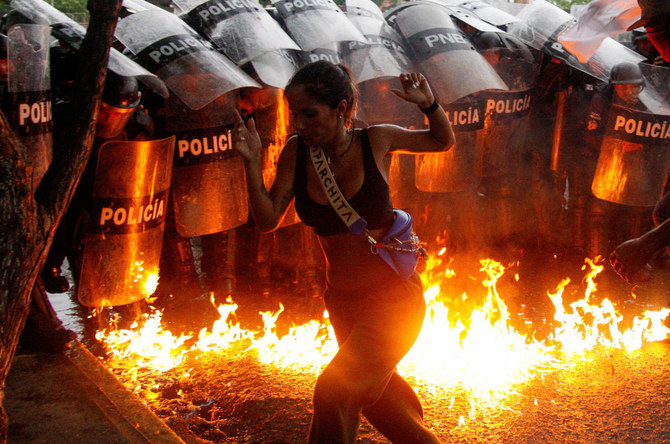
Security forces fired tear gas and rubber bullets Monday at angry protesters challenging the reelection victory claimed by Maduro but disputed by the opposition and questioned by many other countries.
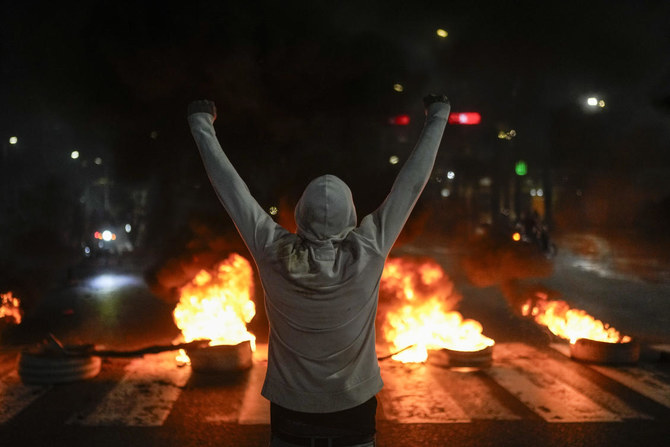
Thousands of people flooded the streets of several neighborhoods in the capital, chanting “Freedom, freedom!” and “This government is going to fall!“
Some ripped Maduro campaign posters from street posts and burned them.
At least two statues of Hugo Chavez, the late socialist revolutionary who led Venezuela for more than a decade and handpicked Maduro as his successor, were knocked down by protesters.
One person died in northwest Yaracuy state and 46 were arrested in post-election demonstrations, Alfredo Romero, head of the Foro Penal rights group that specializes in political prisoner issues, said on social media platform X. He did not say what caused the death.
The National Electoral Council (CNE) certified the reelection of Maduro, 61, to another six-year term until 2031.
Maduro dismissed international criticism and doubts about the result of Sunday’s voting, claiming Venezuela was the target of an attempted “coup d’etat” of a “fascist and counter-revolutionary” nature.
Opposition leader Maria Corina Machado told reporters that a review of available voting records clearly showed that the next president “will be Edmundo Gonzalez Urrutia,” who replaced her on the ballot after she was barred by Maduro-aligned courts.
The records showed a “mathematically irreversible” lead for Gonzalez Urrutia, she said, with 6.27 million votes to Maduro’s 2.75 million.
She called for families to turn out Tuesday for “popular assemblies” nationwide to show support for a peaceful transition of power.
“There are millions of citizens in Venezuela... who want to see that their vote counts,” she posted later on X.
Maduro’s campaign manager Jorge Rodriguez, also called on X for “large marches starting this Tuesday to celebrate the victory.”
In Caracas on Monday, AFP observed members of the national guard firing tear gas and rubber bullets at protesters, some wearing motorbike helmets and bandanas tied over their faces. Some responded by throwing rocks.
Protests were reported even in poor areas of Caracas that had been bastions of support for Maduro. Shots were heard in some areas.
“We want freedom. We want Maduro to go. Maduro, leave!,” Marina Sugey, a 42-year-old resident of Petare, a poor area of Caracas, told AFP.
The elections were held amid widespread fears of fraud by the government and a campaign tainted by accusations of political intimidation.
The CNE said on Monday Maduro had won 51.2 percent of votes cast compared to 44.2 percent for Gonzalez Urrutia.
When the opposition cried foul, Attorney General Tarek William Saab linked Machado to an alleged cyber “attack” seeking to “adulterate” the results.
International reactions
The United Nations, United States, European Union and several Latin American countries called for a “transparent” process, while allies including China, Russia and Cuba congratulated Maduro.
Gonzalez Urrutia, a 74-year-old former diplomat, acknowledged on Monday the deep discontent with the CNE results and vowed that “we will fight for our liberty.”
Nine Latin American countries called in a joint statement for a “complete review of the results with the presence of independent electoral observers.”
The US-based Carter Center, one of few organizations that had observers in Venezuela, urged the CNE to immediately publish detailed polling station-level results.
Brazil and Colombia also urged a review of the numbers, while Chile’s president said the outcome was “hard to believe.”
Peru recalled its ambassador and Panama said it was suspending relations with Venezuela.
The Washington-based Organization of American States called an emergency meeting for Wednesday at the request of Argentina and other countries that challenged the CNE tally.
Caracas hit back, saying it was withdrawing diplomatic staff from Argentina, Chile, Costa Rica, Panama, Peru, the Dominican Republic and Uruguay.
It also suspended flights to and from Panama and the Dominican Republic.
Criticism
Independent polls had predicted Sunday’s vote would end 25 years of “Chavismo,” the populist movement founded by Chavez.
Maduro has been at the helm of the once-wealthy oil-rich country since 2013. The past decade has seen GDP drop by 80 percent, pushing more than seven million of Venezuela’s 30 million citizens to emigrate.
He is accused of locking up critics and harassing the opposition in a climate of rising authoritarianism.
In the run-up to the election, he warned of a “bloodbath” if he lost.
Sunday’s election was the product of a deal reached last year between the government and opposition.
That agreement led the United States to temporarily ease sanctions imposed after Maduro’s 2018 reelection, rejected as a sham by dozens of Latin American and other countries.
Sanctions were snapped back after Maduro reneged on agreed conditions.
Venezuela boasts the world’s largest oil reserves but production capacity has been severely diminished in recent years.
Most Venezuelans live on just a few dollars a month and endure biting shortages of electricity and fuel.
Economic misery in the South American nation has been a major source of migration pressure on the southern border of the United States, where immigration is a major presidential election issue.