

As fighting rages, displaced Gazans struggle with disease and lack of shelter

1 / 5
A Palestinian man carries a body following an Israeli strike, amid the Israel-Hamas conflict, at Al-Aqsa Martyrs Hospital in Deir Al-Balah in the central Gaza Strip, July 27, 2024. (REUTERS)
2 / 5
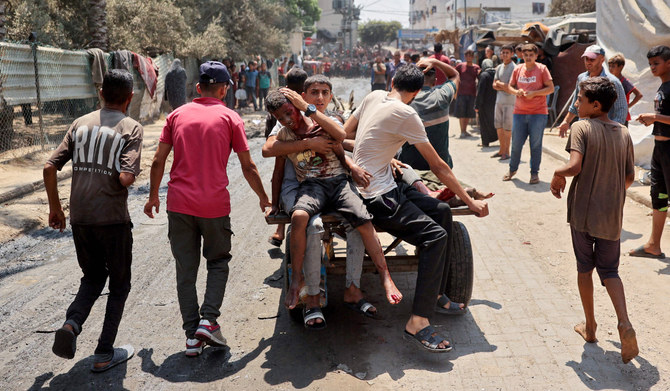
Palestinians injured during an Israeli strike on the Khadija school housing displaced people, ride on the back of a cart in Deir al-Balah, in the central Gaza Strip on July 27, 2024, amid the ongoing conflict between Israel and the militant Hamas group. (AFP)
3 / 5
A Palestinian couple with their belongings react following an Israeli strike on the Khadija school housing displaced people in Deir al-Balah, in the central Gaza Strip on July 27, 2024, amid the ongoing conflict between Israel and the militant Hamas group. (AFP)
4 / 5
An injured Palestinian woman is carried to an ambulance following an Israeli strike on the Khadija school housing displaced people in Deir al-Balah, in the central Gaza Strip on July 27, 2024, amid the ongoing conflict between Israel and the militant Hamas group. (AFP)
5 / 5
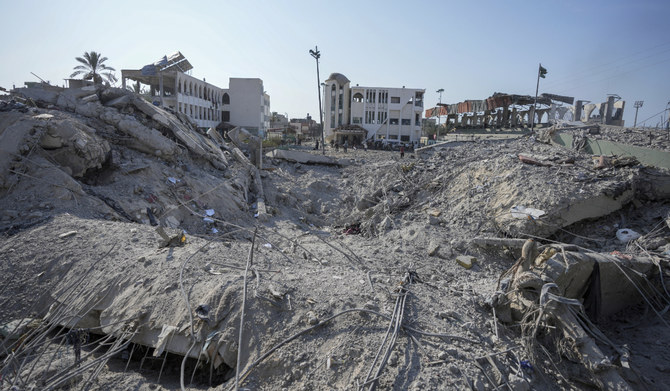
Palestinians inspect the rubble of a school destroyed in an Israeli airstrike on Deir al-Balah, central Gaza Strip, Saturday, July 27, 2024. (AP)
Short Url
Updated 30 July 2024
Follow

As fighting rages, displaced Gazans struggle with disease and lack of shelter

  • Israel has killed more than 39,000 Palestinians in the Gaza Strip, according to health authorities
  • People have been forced to evacuate repeatedly, often with only a few hours notice

CAIRO/DEIR AL-BALAH, Gaza Strip: Thousands of Palestinians fled a community in the central Gaza Strip on Monday in the face of new Israeli evacuation orders, worsening the humanitarian plight in an area already inundated with displaced people fleeing an assault in the south.
Israeli forces, which have now captured nearly the entire Gaza Strip in nearly 10 months of war, have spent the last several weeks launching major operations in areas where they had previously claimed to have uprooted Hamas fighters.
Hundreds of thousands of people have converged on Deir Al-Balah, a small city in the center of the enclave that is the only major area yet to be stormed, many forced there by fighting in the ruins of Khan Younis further south since last week.
In its latest assault, Israel ordered residents on Sunday to flee Al-Bureij, just northeast of Deir.
“What is left? Deir? Deir is full of people. Everyone is in Deir. All of Gaza. Where should people go?” Aya Mansour told Reuters in Deir after fleeing from Bureij.
The Israeli military said fighter jets hit 35 targets across the Gaza Strip over the past day as troops battled fighters in Khan Younis and Rafah, close to the border with Egypt. The armed wings of Hamas and the Islamic Jihad said fierce gunbattles have been ongoing in those two areas as well as in the suburb of Tel Al-Hawa in Gaza City further north.
Palestinian medical officials said at least eight Palestinians were killed in an Israeli air strike earlier in Khan Younis.
On Sunday, the military issued new evacuation orders to some districts in Bureij, forcing thousands to leave before the army blew up several houses.
Some families used donkey carts and rickshaws to carry whatever belongings remained. Many walked for several km on foot to reach Deir or Al-Zawayda town to the west.
Philippe Lazzarini, head of UNRWA, the United Nations relief agency for Palestinians, said only 14 percent of the Gaza Strip had not been placed under evacuation orders by the Israeli military. People have been forced to evacuate repeatedly, often with only a few hours notice.
Aid worker Tamer Al-Burai in Deir said water in Deir was becoming more difficult to get as more and more displaced people arrived, both from Khan Younis to the south and Bureij to the north.
“The situation is catastrophic, people are sleeping in the streets,” he said.

CEASEFIRE TALKS
Although Prime Minister Benjamin Netanyahu has faced weekly demonstrations from Israelis demanding a ceasefire to bring back more than 100 hostages still held in Gaza, there has been little visible progress in talks brokered by Qatar and Egypt.
Negotiations are set to continue after Israeli officials returned from the latest round in Rome on Sunday. Washington, which sponsors the talks, has repeatedly said a deal is close; the latest talks are over a proposal President Joe Biden unveiled back in May.
“People here live on the hope there will be a ceasefire, but it is all lies. I think I will die here. No one knows who is going to die first here,” said Aya Mohammad, 30, a Gaza City resident sheltering in Deir.
The limited access to water has worsened health complications from poor sanitation. Many displaced people were suffering from skin diseases, and children are afflicted by fevers, continuous weeping, and declining to eat or be breastfed, said Hussam Abu Safiyah, the director of the Kamal Adwan Hospital in northern Gaza.
The war began with an assault on southern Israel by Hamas-led fighters who killed 1,200 people and captured around 250 hostages, according to Israeli tallies.
Since then Israeli forces have killed more than 39,000 Palestinians in the Gaza Strip, according to health authorities there who do not distinguish between combatants and civilians but say more than half of the dead are women or children. Israel, which has lost around 330 soldiers in Gaza, says a third of those it has killed are fighters.
Hamas has demanded a path to an end to the war in Gaza as a condition for its agreement to a ceasefire. Israeli Prime Minister Benjamin Netanyahu has said repeatedly the conflict will stop only once Hamas is defeated.


Tunisia’s famed blue-and-white village threatened after record rains

Updated 57 min 37 sec ago
Follow

Tunisia’s famed blue-and-white village threatened after record rains

  • The one-time home of French philosopher Michel Foucault and writer Andre Gide, the village is protected under Tunisian preservation law, pending a UNESCO decision on its bid for World Heritage status

SIDI BOU SAID, Tunisia: Perched on a hill overlooking Carthage, Tunisia’s famed blue-and-white village of Sidi Bou Said now faces the threat of landslides, after record rainfall tore through parts of its slopes.
Last week, Tunisia saw its heaviest downpour in more than 70 years. The storm killed at least five people, with others still missing.
Narrow streets of this village north of Tunis — famed for its pink bougainvillea and studded wooden doors — were cut off by fallen trees, rocks and thick clay. Even more worryingly for residents, parts of the hillside have broken loose.
“The situation is delicate” and “requires urgent intervention,” Mounir Riabi, the regional director of civil defense in Tunis, recently told AFP.
“Some homes are threatened by imminent danger,” he said.
Authorities have banned heavy vehicles from driving into the village and ordered some businesses and institutions to close, such as the Ennejma Ezzahra museum.

- Scared -

Fifty-year-old Maya, who did not give her full name, said she was forced to leave her century-old family villa after the storm.
“Everything happened very fast,” she recalled. “I was with my mother and, suddenly, extremely violent torrents poured down.”
“I saw a mass of mud rushing toward the house, then the electricity cut off. I was really scared.”
Her Moorish-style villa sustained significant damage.
One worker on site, Said Ben Farhat, said waterlogged earth sliding from the hillside destroyed part of a kitchen wall.
“Another rainstorm and it will be a catastrophe,” he said.
Shop owners said the ban on heavy vehicles was another blow to their businesses, as they usually rely on tourist buses to bring in traffic.
When President Kais Saied visited the village on Wednesday, vendors were heard shouting: “We want to work.”
One trader, Mohamed Fedi, told AFP afterwards there were “no more customers.”
“We have closed shop,” he said, adding that the shops provide a livelihood to some 200 families.

- Highly unstable -

Beyond its famous architecture, the village also bears historical and spiritual significance.
The village was named after a 12th-century Sufi saint, Abu Said Al-Baji, who had established a religious center there. His shrine still sits atop the hill.
The one-time home of French philosopher Michel Foucault and writer Andre Gide, the village is protected under Tunisian preservation law, pending a UNESCO decision on its bid for World Heritage status.
Experts say solutions to help preserve Sidi Bou Said could include restricting new development, building more retaining walls and improving drainage to prevent runoff from accumulating.
Chokri Yaich, a geologist speaking to Tunisian radio Mosaique FM, said climate change has made protecting the hill increasingly urgent, warning of more storms like last week’s.
The hill’s clay-rich soil loses up to two thirds of its cohesion when saturated with water, making it highly unstable, Yaich explained.
He also pointed to marine erosion and the growing weight of urbanization, saying that construction had increased by about 40 percent over the past three decades.
For now, authorities have yet to announce a protection plan, leaving home and shop owners anxious, as the weather remains unpredictable.