

Druze in shock as war between Israel and Hezbollah strikes home

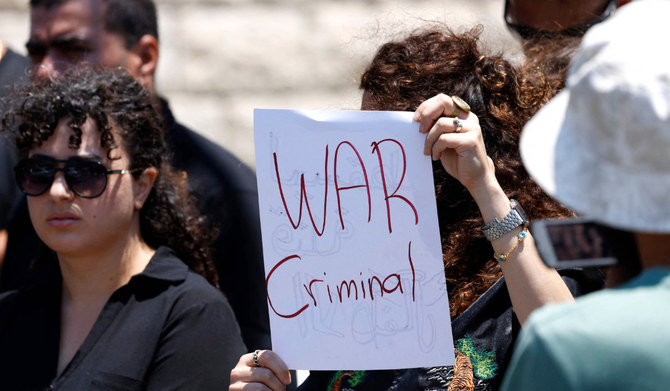
Citizens demonstrated against the Israeli Prime Minister during his visit to the Druze village of Majdal Shams in the Israel annexed Golan Heights on July 29, 2024, amid ongoing cross-border clashes between Israeli troops and Hezbollah fighters. (AFP)
Short Url
Updated 30 July 2024
Follow

Druze in shock as war between Israel and Hezbollah strikes home

  • But in the Golan Heights, an area seized from Syria in the 1967 Middle East war and later annexed by Israel in a move not generally recognized internationally, many still identify as Syrians and refuse Israeli citizenship

MAJDAL SHAMS, Golan Heights: For many of the Druze community in the Golan Heights mourning 12 youngsters killed in a missile strike at the weekend, the carnage came as a shock despite the months of daily rocket fire and air strikes between Israel and southern Lebanon.
Even when the rockets were flying elsewhere, the community felt largely safe, said Raya Fakher Aldeen, a resident of Majdal Shams, the Druze village where children and teenagers were playing football when the missile landed on Saturday.
“It was a shock because not once in the last nine months, even when the sirens were sounding, did we feel we were being targeted,” she said.
Israel has accused the Iranian-backed Lebanese group Hezbollah of carrying out the strike and on Monday, during a visit to Majdal Shams, Prime Minister Benjamin Netanyahu promised a “harsh response.”
Hezbollah denies killing the youngsters but said it had launched strikes on what it said were military targets in nearby areas of the Israeli-occupied Golan Heights.
As members of an Arab minority straddling Israel, Lebanon, Jordan, Syria and the Golan Heights, the Druze, who practice a form of Islam, occupy a special niche in the complicated politics of the region.
Unlike most Israeli Palestinians, many Druze in Israel serve in the military and police, including during the war in Gaza, and some have reached high rank.
But in the Golan Heights, an area seized from Syria in the 1967 Middle East war and later annexed by Israel in a move not generally recognized internationally, many still identify as Syrians and refuse Israeli citizenship.
The ambiguity of the Druze position was reflected in the resolutely non-political funeral. Thousands mourned in Majdal Shams on Sunday but there was no sign of either Israeli or Syrian flags and political talk was largely absent.
“Many Druze feel angry and do not want to be fuel in this war for any side,” said Fakher Aldeen.
The standoff between Israel and Hezbollah, which began soon after the Hamas-led attack on Israel on Oct. 7, has forced the evacuation of tens of thousands of people on both sides of the Israeli-Lebanese border, but has so far stopped short of the full-scale war that many now fear.
Sultan Abu Jabal, a 62-year-old who works and lives in Majdal and who lost a granddaughter in the attack, denounced what he said was a “crazy war.”
“They are all innocent people. Why is it my problem if there are troubles between Hezbollah and Israel?“

NO ESCAPING REGIONAL POLITICS
However the politics of the region is inescapable and though the youngsters killed in the strike do not appear to have held Israeli citizenship, Israeli officials including Prime Minister Benjamin Netanyahu and Defense Minister Yoav Gallant have embraced them as their own.
“A Jewish child murdered on the Gaza border on Oct. 7 and a Druze child murdered on the Golan Heights are the same. These are our children,” Gallant said during a visit to Majdal Shams.
On the other side of the dividing line, Lebanese Druze leader Walid Jumblatt, a former Hezbollah opponent who has since reconciled with the movement, told Al Jazeera television the Israeli claim that Hezbollah fired the rocket was a fabrication.
On the Syrian side, Druze Sheikh Yousef Al-Jarbou offered prayers for the dead and accused Israel of “committing daily massacres” in a speech published by Syrian state media, accompanied by a photo showing Syrian and Druze flags behind him and a photo of President Bashar Assad, a Hezbollah ally.
“The incident is being exploited by all sides,” said Lubna Al Bassit, an anti-Assad activist in Sweida, the Druze capital of Syria, who reflects the views of Druze who blame Iran and Hezbollah.
“There’s rivalry. Who is the real voice of the Druze community — is it the Israeli Druze who are integrated in Israel and serve in the army, or is it the Lebanese who have been taking a stance against Israel, specifically Jumblatt who is a historic leader of the Druze,” said Mohanad Hage Ali of the Carnegie Middle East Center.
As Lebanon braces for Israeli strikes that are expected to be much heavier than those seen so far in the war, the Druze of Majdal Shams are left to wait.
“We hope this war will end and this massacre will be the last one in this devastating war,” said Sheikh Salim Abu Jabal. “We call for peace. We don’t attack anyone and we don’t accept being attacked by anyone.”


Geoeconomic confrontation tops global risks in 2026: WEF report

Updated 4 sec ago
Follow

Geoeconomic confrontation tops global risks in 2026: WEF report

  • Also armed conflict, extreme climate, public polarization, AI
  • None ‘a foregone conclusion,’ says WEF’s MD Saadia Zahidi

DUBAI: Geoeconomic confrontation has emerged as the top global risk this year, followed by state-based armed conflict, according to a new World Economic Forum report.

The Global Risks Report 2026, released on Wednesday, found that both risks climbed eight places year-on-year, underscoring a sharp deterioration in the global outlook amid increased international competition.

The top five risks are geoeconomic confrontation (18 percent of respondents), state-based armed conflict (14 percent), extreme weather events (8 percent), societal polarization (7 percent) and misinformation and disinformation (7 percent).

The WEF’s Managing Director Saadia Zahidi said the report “offers an early warning system as the age of competition compounds global risks — from geoeconomic confrontation to unchecked technology to rising debt — and changes our collective capacity to address them.

“But none of these risks are a foregone conclusion.”

The report assesses risks across three timeframes: immediate (2026); short-to-medium term (next two years); and long term (next 10 years).

Economic risks show the largest overall increase in the two-year outlook, with both economic downturn and inflation jumping eight positions.

Misinformation and disinformation rank fifth this year but rise to second place in the two-year outlook and fourth over the 10-year horizon.

The report suggests this reflects growing anxiety around the rapid adoption of artificial intelligence, with adverse outcomes linked to AI surging from 30th place in the two-year timeframe to fifth in the 10-year outlook.

Uncertainty dominates the global risk outlook, according to the report.

Surveyed leaders and experts view both the short- and long-term outlook negatively, with 50 percent expecting a turbulent or stormy global environment over the next two years, rising to 57 percent over the next decade.

A further 40 percent and 32 percent, respectively, describe the outlook as unsettled across the two- and 10-year timeframes, while just 1 percent anticipate a calm global outlook in either period.

Environmental risks ease slightly in the short-term rankings. Extreme weather fell from second to fourth place and pollution from sixth to ninth. Meanwhile, critical changes to Earth systems and biodiversity loss dropped seven and five positions, respectively.

However, over the next decade, environmental threats re-emerge as the most severe, with extreme weather, biodiversity loss, and critical changes to Earth systems topping the global risk rankings.

Looking ahead over the next decade, around 75 percent of respondents anticipate a turbulent or stormy environmental outlook, making it the most pessimistic assessment across all risk categories.

Zahidi said that “the challenges highlighted in the report underscore both the scale of the potential perils we face and our shared responsibility to shape what comes next.”

Despite the gloomy outlook, Zahidi signaled a positive shift in global cooperation.

 “It is also clear that new forms of global cooperation are already unfolding even amid competition, and the global economy is demonstrating resilience in the face of uncertainty.”

Now in its 21st year, the Global Risks Report highlights a core message: global risks cannot be managed without cooperation.

As competition intensifies, rebuilding trust and new forms of collaboration will be critical, with the report stressing that today’s decisions will shape future outcomes.

The report was released ahead of WEF’s annual meeting, which will be held in Davos from Jan. 19 to 23.