

UK welcomes Lebanese government’s call for cessation of violence

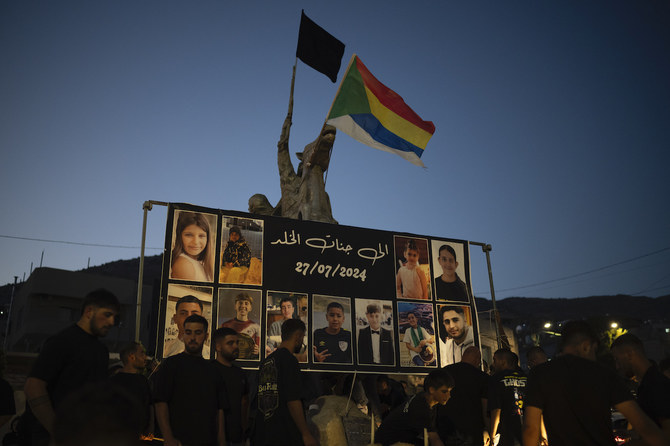
hotos of the children and teens killed in a rocket strike at a football field, are displayed at a roundabout as people light candles in their memories, at the village of Majdal Shams, in the Israeli-annexed Golan Heights, Sunday, July 28, 2024. (AP)
Short Url
Updated 29 July 2024
Follow

UK welcomes Lebanese government’s call for cessation of violence

LONDON: Britain welcomes the Lebanese government’s call for a cessation of all violence after an attack on the Israeli-occupied Golan Heights blamed on Lebanon’s Hezbollah, Britain’s foreign minister said following a call with Lebanon’s prime minister.
“I spoke to (Lebanon’s) Prime Minister @Najib_Mikati today to express my concern at escalating tension and welcomed the Government of Lebanon’s statement urging for cessation of all violence,” David Lammy wrote on X on Monday.
“We both agreed that widening of conflict in the region is in nobody’s interest.”

A flurry of diplomatic activity is underway to contain an expected Israeli response against Hezbollah, Lebanese Foreign Minister Abdallah Bou Habib said.
On Sunday, Israeli Defense Minister Yoav Gallant had vowed to “hit the enemy hard” after rocket fire from Lebanon killed 12 minors, raisings fears the war in Gaza could spread.
Israel has accused Lebanon’s Hezbollah movement of firing a Falaq-1 Iranian rocket, but the Iran-backed group — which has regularly targeted Israeli military positions — said it had “no connection” to the incident.
Bou Habib said the United States, France and others were trying to contain the escalation, in an interview late Sunday with local broadcaster Al-Jadeed.
“Israel will escalate in a limited way and Hezbollah will respond in a limited way... These are the assurances we’ve received,” Bou Habib said.
Lebanese Prime Minister Najib Mikati had also said that “talks are ongoing with international, European and Arab sides to protect Lebanon and ward off dangers,” in a statement Sunday.
The rocket fire in Majdal Shams, whose population is Arabic-speaking Druze, prompted Israeli Prime Minister Benjamin Netanyahu to return early from the United States.
On Sunday, the White House said the deadly rocket fire was “conducted by Lebanese Hezbollah.”


Algeria inaugurates strategic railway to giant Sahara mine

President Tebboune attended an inauguration ceremony in Bechar. (AFP file photo)
Updated 39 min 54 sec ago
Follow

Algeria inaugurates strategic railway to giant Sahara mine

  • The mine is expected to produce 4 million tons per year during the initial phase, with production projected to triple to 12 million tons per year by 2030
  • The project is financed by the Algerian state and partly built by a Chinese consortium

ALGEIRS: Algerian President Abdelmadjid Tebboune on Sunday inaugurated a nearly 1,000-kilometer (621-mile) desert railway to transport iron ore from a giant mine, a project he called one of the biggest in the country’s history.
The line will bring iron ore from the Gara Djebilet deposit in the south to the city of Bechar located 950 kilometers north, to be taken to a steel production plant near Oran further north.
The project is financed by the Algerian state and partly built by a Chinese consortium.
During the inauguration, Tebboune described it as “one of the largest strategic projects in the history of independent Algeria.”
This project aims to increase Algeria’s iron ore extraction capacity, as the country aspires to become one of Africa’s leading steel producers.
The iron ore deposit is also seen as a key driver of Algeria’s economic diversification as it seeks to reduce its reliance on hydrocarbons, according to experts.
President Tebboune attended an inauguration ceremony in Bechar, welcoming the first passenger train from Tindouf in southern Algeria and sending toward the north a first charge of iron ore, according to footage broadcast on national television.
The mine is expected to produce 4 million tons per year during the initial phase, with production projected to triple to 12 million tons per year by 2030, according to estimates by the state-owned Feraal Group, which manages the site.
It is then expected to reach 50 million tons per year in the long term, it said.
The start of operations at the mine will allow Algeria to drastically reduce its iron ore imports and save $1.2 billion per year, according to Algerian media.