

Pakistan PM condoles death of Saudi Prince Abdullah bin Khalid bin Turki

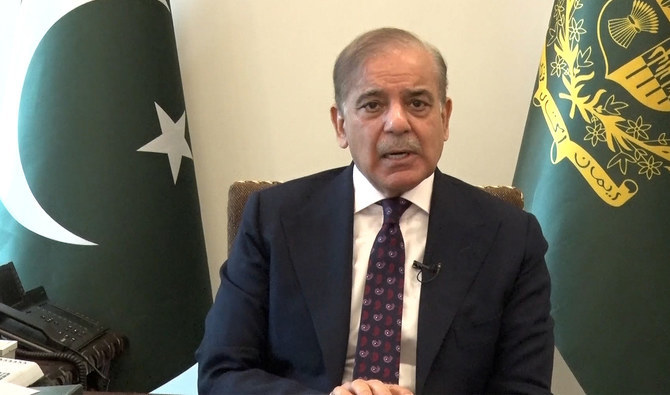
Pakistan Prime Minister Shehbaz Sharif addresses the nation in Islamabad, Pakistan on May 30, 2024. (PID/File)
Short Url
Updated 29 July 2024
Follow

Pakistan PM condoles death of Saudi Prince Abdullah bin Khalid bin Turki

  • Saudi Arabia's Royal Court announced Prince Abdullah bin Khalid's death on Sunday 
  • Sharif offers condolences to Saudi king, crown prince in social media post 

ISLAMABAD: Pakistan's Prime Minister Shehbaz Sharif on Monday offered his condolences to Saudi Arabia's leadership for the passing of Prince Abdullah bin Khalid bin Turki bin Abdulaziz bin Turki Al-Saud. 

Saudi Arabia's Royal Court announced Prince Abdullah bin Khalid's passing in a statement on Sunday. Funeral prayers for the Saudi prince were offered at the Grand Mosque in Makkah on Sunday after the Isha prayer. 

In a message on social media platform X, Sharif offered his condolences to Saudi Arabia's King Salman bin Abdulaziz Al-Saud and Crown Prince Mohammed bin Salman bin Abdulaziz Al Saud. 

"My heart goes out to the Royal Family and the people of Saudi Arabia in this moment of grief," he wrote. "May the departed soul rest in eternal peace. Ameen!"

Pakistan and Saudi Arabia enjoy strong trade, defense and cultural ties. The kingdom is home to over two million Pakistani expatriates and the top source of remittances to the cash-strapped South Asian country.

Islamabad and Riyadh have recently sought to bolster trade and economic ties with one another, with Pakistan seeing a flurry of high-level visits from Saudi Arabia's senior officials and businesspersons in recent months. The kingdom this year reaffirmed its commitment to expedite an investment package worth $5 billion for Pakistan.


Pakistan, China to sign multiple MoUs at major agriculture investment conference today

Updated 18 January 2026
Follow

Pakistan, China to sign multiple MoUs at major agriculture investment conference today

  • Hundreds of Chinese and Pakistani firms to attend Islamabad event
  • Conference seen as part of expanding CPEC ties into agriculture, trade

KARACHI: Islamabad and Beijing are set to sign multiple memorandums of understanding (MoUs) to boost agricultural investment and cooperation at a major conference taking place in the capital today, Monday, with hundreds of Chinese and Pakistani companies expected to participate.

The conference is being billed by Pakistan’s Ministry of National Food Security and Research as a platform for deepening bilateral agricultural ties and supporting broader economic engagement between the two countries.

“Multiple memorandums of understanding will be signed at the Pakistan–China Agricultural Conference,” the Ministry of National Food Security said in a statement. “115 Chinese and 165 Pakistani companies will participate.”

The conference reflects a growing emphasis on expanding Pakistan-China economic cooperation beyond the transport and energy foundations of the flagship China-Pakistan Economic Corridor (CPEC) into agriculture, industry and technology.

Under its first phase launched in 2015, CPEC, a core component of China’s Belt and Road Initiative, focused primarily on transportation infrastructure, energy generation and connectivity projects linking western China to the Arabian Sea via Pakistan. That phase included motorways, power plants and the development of the Gwadar Port in the country's southwest, aimed at helping Pakistan address chronic power shortages and enhance transport connectivity.

In recent years, both governments have formally moved toward a “CPEC 2.0” phase aimed at diversifying the corridor’s impact into areas such as special economic zones, innovation, digital cooperation and agriculture. Second-phase discussions have highlighted Pakistan’s goal of modernizing its agricultural sector, attracting Chinese technology and investment, and boosting export potential, with high-level talks taking place between planning officials and investors in Beijing.

Agri-sector cooperation has also seen practical collaboration, with joint initiatives examining technology transfer, export protocols and value-chain development, including partnerships in livestock, mechanization and horticulture.

Organizers say the Islamabad conference will bring together government policymakers, private sector investors, industry associations and multinational agribusiness firms from both nations. Discussions will center on investment opportunities, technology adoption, export expansion and building linkages with global buyers within the framework of Pakistan-China economic cooperation.