

Oil Updates – crude gains on fears of wider Middle East conflict after rocket strike in Golan Heights

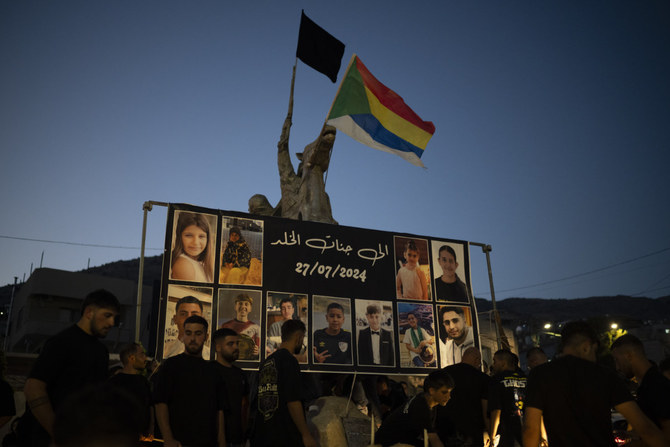
Photos of the children and teens killed in a rocket strike at a soccer field, are displayed at a roundabout as people light candles in their memories, at the village of Majdal Shams, in the Israeli-annexed Golan Heights, on July 28, 2024. (AP)
Short Url
Updated 30 July 2024
Follow

Oil Updates – crude gains on fears of wider Middle East conflict after rocket strike in Golan Heights

  • Israel has vowed retaliation against Hezbollah in Lebanon, and Israeli jets hit targets in southern Lebanon on Sunday
  • The Iran-backed Hezbollah militia denied any role in the rocket strike, which hit a Druze village in Israel-occupied Golan

SINGAPORE: Oil prices rose on Monday, paring last week’s loss, on fears of a widening conflict in the Middle East following a rocket strike in the Israeli-occupied Golan Heights, which Israel and the US blamed on Lebanese armed group Hezbollah.

Brent crude futures gained 40 cents, or 0.5 percent, to $81.53 a barrel at 8:50 a.m. Saudi time. US West Texas Intermediate crude futures climbed 34 cents, or 0.4 percent, to $77.50 a barrel.

Last week, Brent lost 1.8 percent while WTI fell 3.7 percent on sagging Chinese demand and hopes of a Gaza ceasefire agreement.

On Sunday, Israel’s security cabinet authorized Prime Minister Benjamin Netanyahu’s government to decide on the “manner and timing” of a response to the Saturday’s rocket strike in the Golan Heights that killed 12 teenagers and children.

Iran-backed Hezbollah denied responsibility for the attack, the deadliest in Israel or Israeli-annexed territory since Palestinian militant group Hamas’ Oct. 7 assault sparked the war in Gaza. That conflict has spread to several fronts and risks spilling into a wider regional conflict.

Israel has vowed retaliation against Hezbollah in Lebanon, and Israeli jets hit targets in southern Lebanon on Sunday.

“Worries over escalating tensions in the Middle East prompted fresh buying, but gains were limited by lingering concerns of weakening demand in China,” said Toshitaka Tazawa, an analyst at Fujitomi Securities.

Over the past few weeks, hopes of a ceasefire in Gaza have been gaining momentum.

But Israel wants changes in a plan for a Gaza truce and the release of hostages by Hamas, complicating a deal to halt nine months of combat that have devastated the enclave, according to a Western official, a Palestinian and two Egyptian sources.

On the demand side, data released earlier this month showing that China’s total fuel oil imports dropped 11 percent in the first half of 2024 have raised concern about the wider demand outlook in the Asian giant, the world’s biggest crude importer.

“Demand concerns remain a key factor that presses on crude oil prices. The economic growth slowed in China in the second quarter, while domestic consumer demand was sluggish,” said independent market analyst Tina Teng.

She added that the US Federal Reserve’s rate decision and China’s manufacturing PMI are the next key events for markets as they try to gauge the oil market trajectory.

Meanwhile, US energy firms last week added oil and natural gas rigs for a second week in a row, boosting the monthly count by the most since November 2022, energy services firm Baker Hughes said in its closely followed report on Friday.

Markets are also keeping a watch on oil producer Venezuela, after the country’s electoral authority said President Nicolas Maduro had won a third term with 51 percent of the vote despite multiple exit polls pointing to an opposition win.

US Secretary of State Antony Blinken said the US has serious concerns that the results do not reflect the votes of the people.

The US had previously said it would “calibrate” its sanctions policy toward Venezuela depending on how the high-stakes election unfolds in the OPEC nation. 


G7 countries to release oil reserves as IEA agrees to largest ever market intervention

Updated 11 March 2026
Follow

G7 countries to release oil reserves as IEA agrees to largest ever market intervention

  • IEA recommends release of 400 million barrels

RIYADH: Germany, Japan and Austria will release part of their oil reserves after the International Energy Agency recommended the release of 400 million barrels of oil ‌from stockpiles, the largest ‌such move in IEA ​history.

In a statement, IEA Executive Director Fatih Birol said the flow of oil, gas and other commodities through the Strait of Hormuz have all but stopped, leading global energy supply to fall by around 20 percent.

Ahead of the confirmation of the move — a larger intervention than the 182.7 million barrels that were released in 2022 by in response to Russia’s invasion of Ukraine — several countries began setting out plans to bring their reserves into play as countries grapple with ​soaring crude prices amid ​the US-Israeli war with Iran. 

Birol said: “I can now announce that IEA countries have decided to launch the largest ever release of emergency oil stocks in our agency's history. 

“IEA countries will be making 400 million barrels of oil available to the market to offset the supply lost through the effective closure of the strait.

“This is a major action aiming to alleviate the immediate impacts of the disruption in markets.”

Germany’s Economy ⁠Minister ​Katherina Reiche ⁠confirmed on Wednesday her government plans to limit petrol price increases at filling stations to once a day and to introduce more stringent antitrust regulation of the sector.

She did not ⁠give an exact timing for ‌those measures, but added that ‌the US and ​Japan would be the ‌largest contributors to the release of the ‌oil reserves.

The US has not confirmed it would do so, but its Interior Secretary Doug Burgum told Fox News on Wednesday that “these are the kinds of moments that these reserves are used for.”

The announcements did not stop oil prices rising, with Brent crude up 3.26 percent to $90.66 a barrel at 4:29 p.m Saudi time, and West Texas Intermediate up 3.12 percent to $86.05. Both were some way below the $119 a barrel seen earlier in the week.

“The situation regarding oil supplies is tense, as the Strait of Hormuz is currently virtually impassable,” Germany’s Reiche said.

“We will comply with this request and ‌contribute our share, because Germany stands behind the IEA’s most important principle: mutual ⁠solidarity,” Reiche ⁠said about the IEA’s request.

According to a statement by Reiche’s ministry, Germany will contribute 2.64 million tonnes of oil. This corresponds to 19.51 million barrels.

Reiche stressed there was no supply shortage in the country, which has a legally mandated reserve of oil and oil products intended to cover 90 days’ demand.

South Korea will release 22.46 million ​barrels of oil, which represents 5.6 percent of the total IEA ask, the ⁠country's industry ministry said.

“The government will consult with the IEA ⁠secretariat on details, such ‌as ‌the ​timing ‌and amount, from ‌the perspective of national interests in accordance with domestic conditions,” ‌the ministry said in a statement.

The ⁠ministry ⁠said it would continue to coordinate closely with major countries in responding to high oil prices to minimise any domestic ​impact.

Austrian Economy Minister Wolfgang Hattmannsdorfer said his country was releasing part of the emergency oil reserve and extending the national strategic gas reserve, adding: “One thing is clear: in a crisis, there must be no crisis winners at the expense of commuters and businesses.”

Acting ahead of the IEA move, G7 ​member Japan announced plans to release 15 days' worth of ‌private-sector oil reserves and one month's worth of state oil reserves.

“Rather than wait for formal IEA approval ‌of a coordinated international reserve release, Japan will act first to ease global energy market supply and demand, releasing reserves as early as the 16th of this month,” Prime Minister Sanae Takaichi said in a broadcast statement.

Following a meeting with the IEA on Wednesday, G7 energy ministers said: “In principle, we support the implementation of proactive measures to address the situation, including the use of strategic reserves.”

All IEA member countries are required to keep 90 days’ worth of their nation’s oil use in reserve in case of global disruption.