

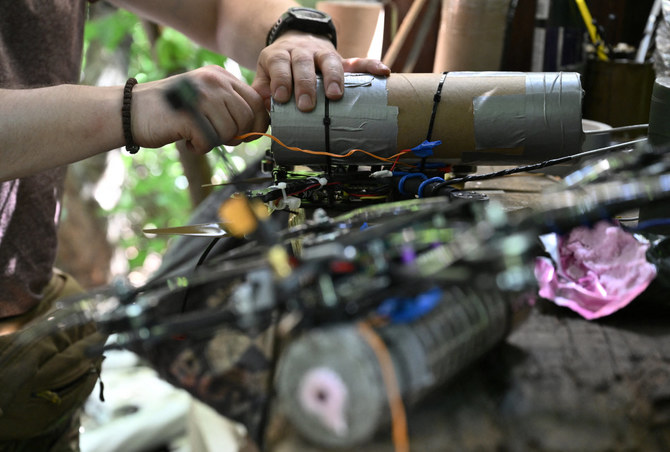

KYIV: Ukraine on Sunday said it struck an oil depot in southern Russia that supplies the Kremlin’s troops as Russian strikes in Ukraine’s eastern Donetsk region, where Moscow claimed further gains, left five civilians dead and 15 others wounded.
Ukraine’s General Staff said in a statement Kyiv’s security services were responsible for a drone strike in Russia’s southern Kursk region that morning on an oil depot used to meet the needs of the Russian military, and contains 11 tanks with a total volume of 7,000 cubic meters (about 247,202 cubic feet), adding the attack prompted “powerful explosions and a fire … probably involving containers with oil products.”
“The defense forces continue to take all measures to undermine the military and economic potential of the Russian occupiers and force the Russian Federation to stop its armed aggression against Ukraine,” the statement said.
Earlier Sunday, Russia’s Defense Ministry said seven Ukrainian drones were shot down overnight over Russian territory, while a regional official said a drone strike set fire to the oil depot in the Kursk province. Firefighters were battling the blaze on Sunday morning after three fuel tanks went up in flames, according to acting regional Gov. Alexey Smirnov. Smirnov said nobody was hurt.
The Kursk region lies on the border with Ukraine’s Sumy province where Ukraine has in recent months repeatedly targeted various sites, including oil depots and other military infrastructure, inside Russian territory, with drones and other weapons. Ukrainian officials have been pressuring Western allies to be able to use their modern and more sophisticated weapons to strike more valuable targets inside Russian territory.
Ukraine has been systematically targeting Russian transport, energy and military infrastructure to disrupt the Kremlin’s economy and its ability to fund the war, which Russia launched with a full-scale invasion on its smaller neighbor in 2022.
Also on Sunday, Russian troops continued to eke out gains in Ukraine’s war-torn eastern Donetsk province as they pushed westward toward the towns of Pokrovsk and Kurakhove. Russia’s Defense Ministry on Sunday said that its forces had taken control of two neighboring villages some 30 kilometers (19 miles) east of Pokrovsk, Prohres and Yevhenivka. The day before, Moscow claimed the nearby village of Lozuvatske, one of nearly a dozen it says it has captured in the province this month.
Taking control of all of Donetsk, part of the country’s industrial heartland that now bears the scars of years of fighting, is one of the Kremlin’s main war goals.
Five civilians died and 15 more suffered wounds following Russian strikes in the Donetsk region on Saturday and overnight, local Gov. Vadym Filashkin reported on Telegram Sunday. Shortly later, other Ukrainian officials said Russian shelling wounded more civilians, including children, in the east and south.
At least eight people suffered wounds after Moscow’s forces on Sunday struck the eastern Ukrainian city of Nikopol, local Gov. Serhii Lysak reported that same day. Lysak said a toddler and a 10-year-old girl were among the victims, six of whom had to be hospitalized.
Russian shelling on Sunday also wounded eight further civilians, including a 10-year-old and two teenagers, in a village in Ukraine’s southern Kherson province, local official Roman Mrochko reported.


