



RIYADH: Saudi banks will see their client base expand and earnings increase thanks to government-backed economic diversification efforts that are driving innovation and boosting productivity, according to a new report.
According to Moody’s analysis of banks in the Gulf Cooperation Council and Commonwealth of Independent States, Saudi Arabia and Oman were the top two GCC countries with the lowest volatility in non-oil sector expansion from 2020 to 2023.
The Kingdom also ranked among the top three for cumulative non-oil growth during this period, along with the UAE and Qatar.
Vladlen Kuznetsov, assistant vice president at Moody’s Ratings said: “Oil-dependent economies in the Gulf, Iraq, Kazakhstan and Azerbaijan are broadening as governments provide funding for diversification initiatives.”
He added: “Barring external shocks, growth in non-oil sectors is poised to exceed 3 percent or 4 percent over the coming years, accelerating from an average of around 1 percent or 2 percent in 2016-2021. This will outpace growth in oil sectors in most cases.”
Moody’s noted Saudi Arabia’s Vision 2030 aims to cut oil dependence by boosting real estate and tourism with projects like NEOM. Banks, though small relative to the economy, are increasingly funding non-oil ventures and have high-quality loans.
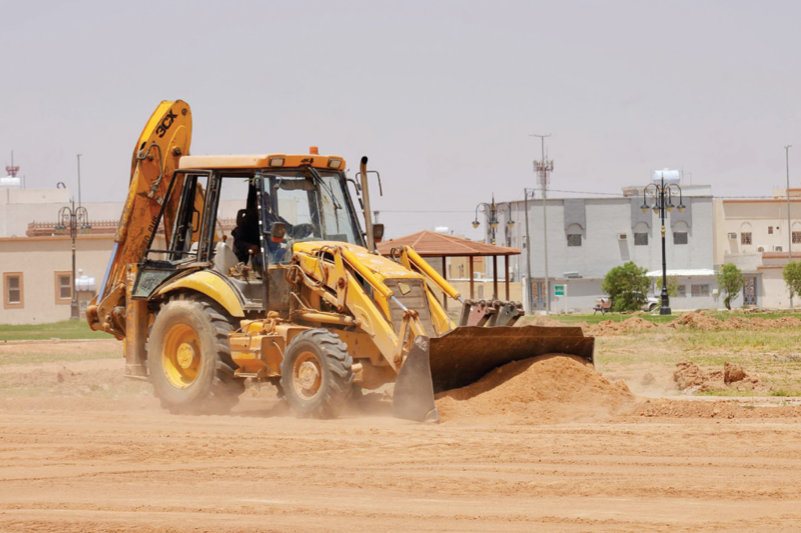
State financing is fueling large infrastructure projects. (SPA)
Slower deposit growth might push them toward unstable market funding. Nonetheless, strong government creditworthiness and ongoing diversification are expected to improve support for banks during economic stress.
The Kingdom has actively utilized the debt market to finance its ambitious projects, leading the GCC bond market in the first half of 2024.
According to a report from Kuwait-based Markaz, the Kingdom raised $37 billion through 44 issuances over this period. Despite these substantial funding needs, Saudi banks maintain healthy balance sheets, with S&P Global Ratings assigning investment-grade ratings and stable outlooks to most major lenders.
The economies of the Gulf states, Iraq, and parts of the CIS remain heavily reliant on oil and gas. However, climate concerns are driving a shift toward new sectors, supported by government diversification efforts.
State financing is fueling large infrastructure projects and offering subsidies to small and medium-sized enterprises in non-oil sectors.
GCC governments, including Saudi Arabia, Kuwait, and Oman, as well as Qatar, UAE, and Bahrain, are working to reduce their dependence on hydrocarbons through ambitious diversification initiatives – along with CIS countries including Kazakhstan and Azerbaijan.
According to Moody’s, these projects aim to mitigate economic vulnerability to oil price fluctuations and enhance resilience to the global carbon transition, benefiting local banks. However, the full impact of these diversification efforts may take years to realize.
Benefits and challenges of diversification
In oil-dependent economies, domestic banks often focus on narrower non-oil sectors like real estate, construction, trade, and services, as well as some manufacturing, according to Moody’s.
Large oil and gas companies in these economies, being financially robust, typically borrow from global banks rather than domestic ones, limiting the lending opportunities for local banks.
Consequently, domestic banks’ loan portfolios are dominated by a few large entities, and their deposit bases are similarly concentrated.
Most large-scale diversification projects are financed by governments and state-owned enterprises, rather than local banks, which contrasts with more developed economies where such efforts are often bank-funded, the report added.
In GCC countries, the presence of wealthy governments and state-owned firms further reduces the demand for domestic bank loans.
The report mentioned that as these economies diversify, banks will benefit from several factors. They will expand their franchises and improve financial inclusion, as non-oil sectors tend to be more stable than oil sectors, leading to steadier economic growth and increased public wealth.
This wealth boost enhances the creditworthiness of retail borrowers and offers banks more lending opportunities. New companies will emerge, profits will rise as firms innovate, and household incomes will increase.
More lending options will help banks manage risks better and stabilize credit cycles in volatile sectors like retail and construction. With reduced economic volatility, banks will find it easier and cheaper to obtain long-term funding.
Increased monetary and economic stability will attract long-term deposits and foreign investment, improving banks’ funding sources and supporting their growth.
Stable government finances will also enhance their ability to assist banks during difficult times, although these benefits may take years to fully materialize.
The benefits of economic diversification vary across banks and economies due to factors like legal frameworks, rule of law, and corruption according to Moody’s.
Larger banks, especially in developed economies, can leverage diversification more effectively due to their financial strength, supporting growth in sectors like manufacturing and construction.
Banks in Qatar, UAE, and Kuwait are already significant in financing economic development. However, the impact on banks’ loan quality, funding, and government support will depend on their current conditions.
For example, banks in Saudi Arabia with low problem loans may see less impact compared to those with higher problem loans, like in Kazakhstan.
Banks in the CIS and Iraq, where banking sectors are smaller relative to the economy, have the most potential for growth.
Overall, banks in Kazakhstan, Azerbaijan, and Qatar, as well as Oman, the UAE, and Saudi Arabia are well-positioned to benefit from diversification according to Moody’s. They either experience strong economic momentum or have opportunities to tackle key credit challenges, such as franchise growth, loan quality, funding, and government support.
Government role
According to Moody’s, diversification relies heavily on government initiatives and can be hindered by unfavorable commodity price changes or geopolitical shocks.
Countries like Saudi Arabia, UAE, and Kuwait, as well as Qatar, Azerbaijan, and Kazakhstan, have substantial resources for infrastructure and sectoral subsidies, though not all invest significantly.
Saudi Arabia’s government budget expenditures amounted to $344 billion in 2023, reflecting an 11 percent increase from the previous fiscal year. In an announcement in December 2023, the Ministry of Finance projected expenditures of 2024 to total $333 billion.
This translates into 27.5 percent of government debt to GDP ratio according to IMF World Economic Outlook in April.
This is in comparison to the UAE’s 2024 budgeted expenditures of $17.44 billion and Kuwait’s projected government expenditures of $80 billion, according to announcements by their respective ministries of finance.
According to the IMF, Kuwait’s debt-to-GDP ratio is projected to be 7.1 percent, and the UAE’s is expected to be 30.3 percent
Saudi Arabia boasts one of the highest reserve coverage ratios among Fitch-rated sovereigns, equivalent to 16.5 months of current external payments.
This budget will focus on accelerating the implementation of critical programs essential to achieving the goals of Saudi Vision 2030 according to the Ministry.
It also highlighted the importance of fostering stronger partnerships with the private sector to advance economic diversification and enhance job opportunities for the Saudi workforce.


