

Negotiations to begin today between Pakistani religious party, government amid protests over inflation, taxes

1 / 2
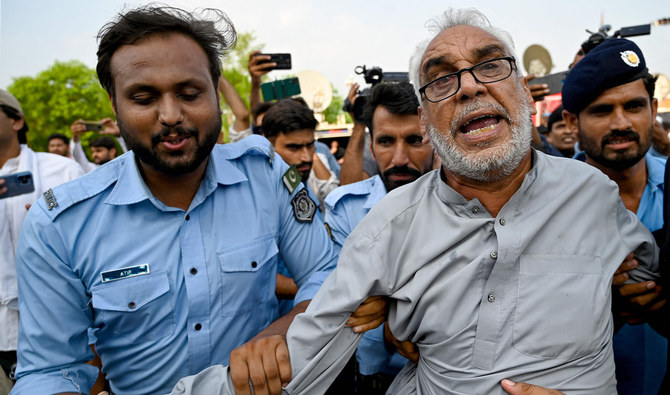
Security personnel detain an activist of Jamaat-e-Islami (JI) party as they protest against inflation in Islamabad on July 26, 2024. (AFP)
2 / 2
Supporters of the Pakistani religious party, Jamaat-e-Islami, stage a sit-in protest in the city of Rawalpindi, Pakistan, on July 27, 2024. (AP)
Short Url
Updated 27 July 2024
Follow

Negotiations to begin today between Pakistani religious party, government amid protests over inflation, taxes

  • Talks to begin after protest leaders met delegation of ruling administration that agreed to release its detained supporters
  • JI party had threatened to expand its sit-in to other cities if its demands to provide economic relief to people were not met

ISLAMABAD: A Pakistani religious party protesting against the rising cost of living in the country will hold negotiations with the government today, Sunday, after meeting a delegation of the ruling administration that agreed to release its detained party workers.

Thousands of Jamaat-e-Islami (JI) supporters have camped in Rawalpindi’s historic Liaqat Bagh ground, demanding the government remove additional taxes imposed in the latest budget presented last month.

JI chief Hafiz Naeem-ur-Rehman has also called for a reduction in power tariffs recommended by the International Monetary Fund (IMF) amid soaring inflation, along with a review of Pakistan’s loss-making agreements with independent power producers (IPPs).

The government formed a three-member negotiating committee to engage with the JI leadership a day earlier when the party said hundreds of its workers had been arrested by law enforcement agencies.

“The negotiations between the government and Jamaat-e-Islami will begin on July 28,” the party said in a brief statement after meeting the visiting delegation at the site of the sit-in. “The time and place [for the talks] will be announced later.”

Earlier, the JI said there could be no negotiations with the government before the release of its workers.

“We have rejected the government’s three-member negotiation committee as it comprises irrelevant people,” Aamir Baloch, the party spokesperson, told Arab News. “We will negotiate with the government only when all of our arrested workers are released.”

“Our 300 out of 1,100 workers were arrested by Islamabad and Punjab police,” he continued. “They are still in custody, so there is no point in starting negotiations at this stage.”

Pakistan’s Information Minister Attaullah Tarar announced the formation of the government’s negotiating team on Friday, saying it included him and two senior members of the ruling Pakistan Muslim League-Nawaz (PML-N) party.

“We are ready for negotiations, but don’t disrupt public life,” he said during a news conference. “The government’s three-member committee will talk to you. Amir Muqam, Tariq Fazal Chaudhry and I will negotiate with you. Whenever you express willingness, we are ready for the negotiations.”

The JI decided to form a four-member committee to negotiate with the government after Tarar and his delegation went to meet the party leaders and held a conversation in an amicable environment.

The JI said the information minister had assured its leadership of releasing the detained party workers.

Prior to that, the Rawalpindi district administration closed Murree Road, a main thoroughfare in the city, with shipping containers and deployed heavy contingents of security personnel around the sit-in site to avoid any untoward incident.

The JI chief had also addressed his supporters at Liaqat Bagh, expressing his resolve to make the government accept the party’s demands.

“If the government believes our sit-in will remain confined to Murree Road, this is its wishful thinking,” Naeem-ur-Rehman said. “If they do not reduce electricity bills, address the IPP issue and revoke tax slabs imposed on the salaried classes, then this sit-in will not remain limited here. It will spread to the entire country.”


World Bank president in Pakistan to discuss development projects, policy issues

Updated 01 February 2026
Follow

World Bank president in Pakistan to discuss development projects, policy issues

  • Pakistan, World Bank are currently gearing up to implement a 10-year partnership framework to grant $20 billion loans to the cash-strapped nation
  • World Bank President Ajay Banga will hold meetings with Pakistan Prime Minister Shehbaz Sharif and other senior officials during the high-level visit

ISLAMABAD: World Bank President Ajay Banga has arrived in Pakistan to hold talks with senior government officials on development projects and key policy issues, Pakistani state media reported on Sunday, as Islamabad seeks multilateral support to stabilize economy and accelerate growth.

The visit comes at a time when Pakistan and the World Bank are gearing up to implement a 10-year Country Partnership Framework (CPF) to grant $20 billion in loans to the cash-strapped nation.

The World Bank’s lending for Pakistan, due to start this year, will focus on education quality, child stunting, climate resilience, energy efficiency, inclusive development and private investment.

"World Bank President Ajay Banga arrives in Pakistan for a high-level visit," the state-run Pakistan TV Digital reported on Sunday. "During his stay, he will meet Prime Minister Shehbaz Sharif and other senior officials to discuss economic reforms, development projects, and key policy issues."

Pakistan, which nearly defaulted on its foreign debt obligations in 2023, is currently making efforts to stabilize its economy under a $7 billion International Monetary Fund (IMF) program.

Besides efforts to boost trade and foreign investment, Islamabad has been seeking support from multilateral financial institutions to ensure economic recovery.

“This partnership fosters a unified and focused vision for your county around six outcomes with clear, tangible and ambitious 10-year targets,” Martin Raiser, the World Bank vice president for South Asia, had said at the launch of the CPF in Jan. last year.

“We hope that the CPF will serve as an anchor for this engagement to keep us on the right track. Partnerships will equally be critical. More resources will be needed to have the impact at the scale that we wish to achieve and this will require close collaboration with all the development partners.”

In Dec., the World Bank said it had approved $700 million in ​financing for Pakistan under a multi-year initiative aimed at supporting the country's macroeconomic stability and service delivery.

It ‍followed a $47.9 ‍million World Bank grant ‍in August last year to improve primary education in Pakistan's most populous Punjab province.