BEIJING: In consecutive days this week, China brokered a deal between rival Palestinian factions and hosted Ukraine’s foreign minister at a moment when pressure is mounting on the country to negotiate an end to the grinding war there.
While it’s unclear if the agreement between Hamas and Fatah will succeed where others have failed and there is little concrete progress toward peace in Ukraine, China emerged a winner, further cementing its role as a diplomatic force on the global stage, not just an economic powerhouse.
As Beijing and Washington vie for influence around the world, China is increasingly playing a role that had previously been the domain of world powers like the US and Russia. Earlier this month, Western countries called some of China’s activities worrying and labeled Beijing a troublemaker. But the events of this week — and the China-brokered deal last year to reestablish relations between Iran and Saudi Arabia — show that international players are seeking Beijing’s help, an acknowledgment that it is a diplomatic force to reckoned with.
“China is now offering itself as a broker on the global stage, and countries are responding,” said Carla Freeman, a senior expert for China at the United States Institute of Peace. “It’s a recognition — one much sought after by Beijing — that China has international influence and could play a role in improving the outcomes of a diplomatic process.”
On Tuesday, Palestinian factions Hamas and Fatah agreed in principle to form a government, the latest attempt at resolving a longstanding rivalry that looms over Gaza’s future after the war with Israel. Previous similar declarations have failed, but even just getting the parties together in a room was an achievement, said Jon Alterman, senior vice president and director of the Middle East program at the Center for Strategic and International Studies.
“They say, ‘we did what nobody else could do, nobody saw was possible,’ and that, by itself, represents a victory,” he said.
While Beijing did not publicly offer any concrete steps such as timeline for implementation or money for rebuilding, the deal was another sign that China has influence in the Middle East — and even perhaps room to maneuver that the US might not have, said Danny Russel, vice president for international security and diplomacy at the Asia Society Policy Institute. Hamas officials have said that they see China as a potential counterweight to the US, which is a staunch ally of their foe, Israel.
“US influence with key Middle East players remains substantial, but there is a new player in the game who is entirely comfortable dealing with Iran and Hamas,” Russel said, referring to the 2023 rapprochement between archrivals Iran and Saudi Arabia, widely seen as a breakthrough.
Washington, meanwhile, is grappling with discontent at home over its position on the war in Gaza and its hosting of Israeli Prime Minister Benjamin Netanyahu this week, and even its allies have doubts about US foreign policy commitments as a presidential race draws closer. Beijing, on the other hand, celebrated.
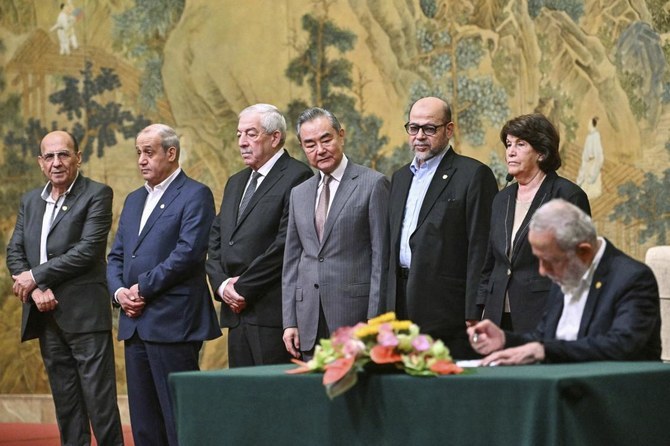
Chinese Foreign Minister Wang Yi exuded confidence in a photo with top representatives of Hamas and Fatah on Tuesday. The Chinese state media tabloid Global Times hailed the Palestinian deal as having “transcendent significance.”
A day later, Ukrainian Foreign Minister Dmytro Kuleba also posed with Wang, and said China has a role to play for peace.
The deal will “bring hope and a future to the Palestinian people, and is an important step toward resolving the Palestinian question and achieving peace and stability in the Middle East,” said Mao Ning, a spokesperson for the Chinese foreign ministry, on Wednesday.
Though some experts doubt the deal will succeed, Wang Jin, a Chinese scholar specializing in Israeli studies at Northwest University in the city of Xi’an, said the involvement of a non-Western power could inject “new force” into resolving the Israeli-Palestinian conflict.
In Washington, Matt Miller, spokesperson at the State Department, declined to comment on the declaration itself but said the US has generally encouraged China to “use their influence with countries in the region — especially countries with whom they have a relationship with where we don’t — to discourage any escalation in the conflict.”
China has long sought more power on the global stage, and it became more assertive around 2009, after Beijing successfully hosted the Olympics, an event seen as its global debut as a modern nation. It was a stark shift from former leader Deng Xiaoping’s characterization of Beijing’s foreign policy approach as “keep a low profile.”
The more self-assured, and at times brash, approach has only picked up under leader Xi Jinping, who came to power in 2012. Under Xi, China has urged its diplomats to pursue “major-country diplomacy with Chinese characteristics” — a call for Beijing to reclaim its historic status as a global power.
That has meant signature schemes like the now decade-old Belt and Road Initiative, under which the world’s second-largest economy gives loans to developing countries, as well as newer ones like the Global Security Initiative, a call for China to bring its vision to the world’s biggest security challenges.
While the Palestinian deal is a symbol of Beijing’s new influence in the Middle East, the Ukrainian foreign minister’s visit may be tied to the uncertainty the US presidential election could bring for Ukraine, and the recognition that China is one of three major players to engage with, alongside the US and the EU.
“I am convinced that a just peace in Ukraine is in China’s strategic interests, and China’s role as a global force for peace is important,” Kuleba, the highest-ranking Ukrainian official to visit China since Russia’s full-scale invasion in 2022, said Wednesday during the trip.
China is one of Russia’s biggest allies, and while it insists that it does not provide military aid to Moscow, it has maintained strong trade ties with its neighbor throughout the conflict. That includes technology that ends up in Russia’s arms.
But given China’s strategic partnership with Russia — and the gradual advance of the Kremlin’s forces — Ukraine has carefully courted Beijing, understanding that without its backing any ceasefire deal that benefits Kyiv would likely remain out of reach.
Kuleba’s visit was the result of calculation. The foreign minister sought to convince China that deepening ties with Ukraine would not only serve Kyiv’s interests, but feed Beijing’s ambitions to be a serious player on the global stage.
“Going forward, if there is to be peace at all, the Ukrainians realized that China cannot be left out of the equation,” said James Char, a research fellow at the Institute of Defense and Strategic Studies at Nanyang Technological University in Singapore.
Derek Grossman, a senior analyst at the RAND Corporation think tank, said while Beijing’s influence is increasing, it has a much more cautious approach than the US
For now, that could slow its rise.
“The last 12 years have shown that China is now a great power in the world,” said Grossman. But even while they want to build up their influence everywhere, “they don’t want the burdens of having influence everywhere.”


With Palestinian deal and Ukrainian foreign minister’s visit, China shows its rising influence
https://arab.news/45jew
With Palestinian deal and Ukrainian foreign minister’s visit, China shows its rising influence

- As Beijing and Washington vie for influence around the world, China is increasingly playing a role that had previously been the domain of world powers like the US and Russia
- Earlier this month, Western countries called some of China’s activities worrying and labeled Beijing a troublemaker


At least three dead as migrant boat capsizes off Greek island
- An accident occurred when the vessel approached the migrants’ wooden boat
- The search for survivors was continuing with four patrol boats
ATHENS: The bodies of three migrants were picked up in waters off the Greek island of Crete during a rescue effort involving a commercial ship, authorities said Friday.
Twenty migrants were rescued by the commercial vessel which was directed to the area on the orders of the Greek Search and Rescue Center.
According to Greek public broadcaster ERT, an accident occurred when the vessel approached the migrants’ wooden boat. As the passengers tried to climb up ladders into the vessel a sudden movement caused the small boat to capsize.
The search for survivors was continuing with four patrol boats, an aircraft, and two ships from the European border agency Frontex, a spokesperson for the Greek coast guard told AFP.
According to ERT, survivors said about 50 people were aboard the wooden boat.
A second boat carrying around forty migrants was spotted in the area, triggering another rescue operation.
For over a year, migrants have been attempting the perilous crossing from Libya to Crete, the gateway to the European Union.
According to the UN High Commissioner for Refugees (UNHCR), more than 16,770 people seeking asylum in the EU arrived in Crete in 2025.
Faced with the surge in arrivals, the conservative Greek government suspended the processing of asylum applications for three months last summer, particularly for those arriving from Libya.
UNHCR says 107 people died or went missing in Greek waters in 2025.


