



DARWIN, Australia: The US military is building infrastructure in northern Australia to help it project power into the South China Sea if a crisis with China erupts, a Reuters review of documents and interviews with US and Australian defense officials show.
Closer to the Philippines than Australia’s east coast capital, Canberra, Darwin has long been a garrison town for the Australian Defense Force and a US Marine Rotational Force that spends six months of each year there.
A few hundred kilometers to the south, RAAF Base Tindal is home to key elements of Australia’s airpower, and was a temporary base for US jets in recent exercises.
As northern Australia re-emerges as a strategically vital Indo-Pacific location amid rising tensions with China, the United States has quietly begun constructing hundreds of millions of dollars’ worth of facilities there to support B-52 bombers, F-22 stealth fighters, and refueling and transport aircraft — all part of a larger effort to distribute US forces around the region and make them less vulnerable.
“When you look at the positioning of northern Australia, particularly Darwin, in relation to the region ... it’s always good to have multiple options in where you would want to put your forces in any type of crisis,” said Col. Brian Mulvihill, commanding officer of the US Marine Rotational Force.
Tender documents show that intelligence briefing rooms, upgraded runways for bombers, warehouses, data centers and maintenance hangars are in the works. Massive fuel storage facilities are already built, officials told Reuters on a rare visit to the two northern bases.
The projects, scheduled for construction in 2024 and 2025, make northern Australia the top overseas location for US Air Force and Navy construction spending, with more than $300 million set aside under the US congressional defense authorizations for those years.
There is more on the horizon: The US Navy in June sought contractors for projects worth up to $2 billion to build wharves, runways, fuel storage and hangars in places including Australia’s Cocos Islands, and neighboring Papua New Guinea and Timor Leste, under a program to counter China.
China’s defense ministry did not immediately respond to a request for comment.
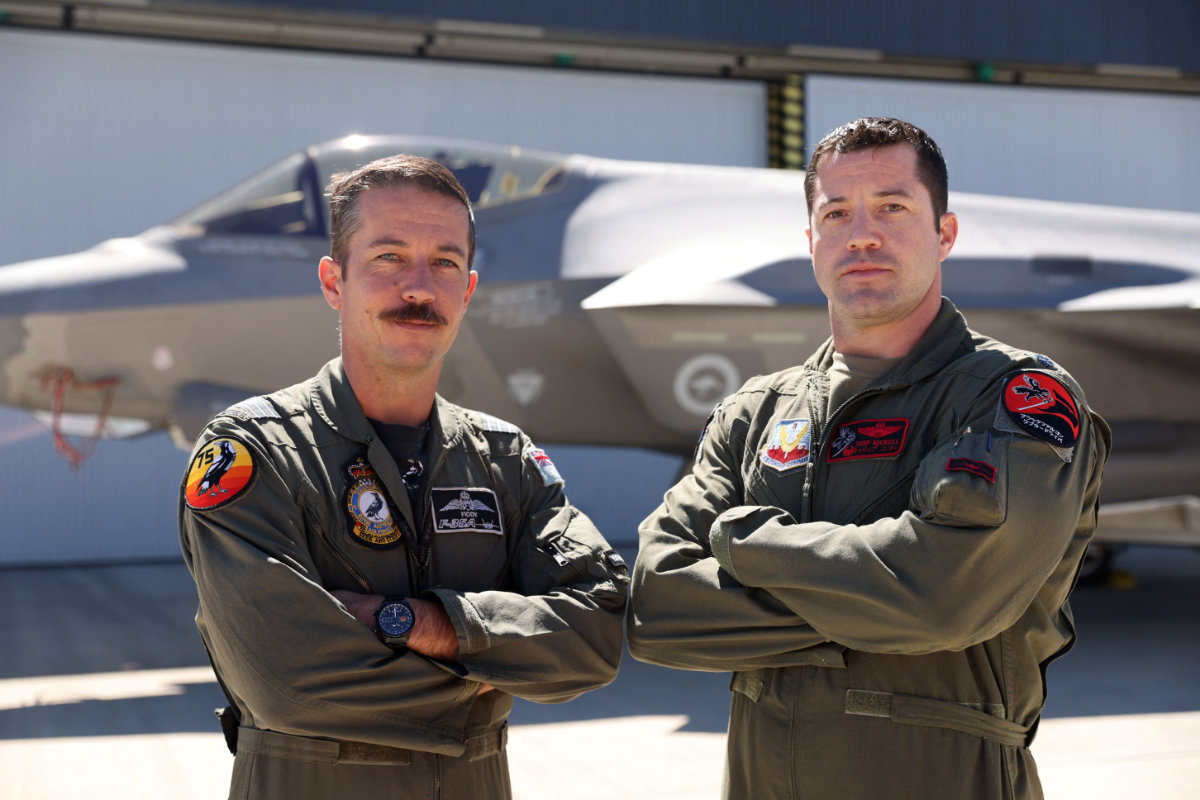
Wing Commander Andrew Nelson, commanding officer for Australia's F-35 Joint Strike Fighter squadron based at RAAF Tindal, and Lt. Col. Ryan Nickell from a visiting US F-22 squadron, pose for a photograph near the town of Katherine in the Northern Territory, Australia, on July 17, 2024. (REUTERS)
Air Commodore Ron Tilley, the Royal Australian Air Force director-general of capital facilities and infrastructure, confirmed Washington was paying for the facilities at Darwin and Tindal, which would support US operations.
“I don’t believe the US would be spending all this money on our northern bases if there wasn’t an arrangement in place where they could use those facilities they are funding in times of conflict,” he added.
Canberra has drawn closer to its top security ally, Washington, under the AUKUS pact to transfer US nuclear submarine technology to Australia next decade. Yet it has been largely silent on US military construction in the north.
The Australian government recently highlighted its own plans to spend A$14 billion “hardening” the northern bases under the country’s biggest defense shakeup since World War Two.
The Australian and US defense officials interviewed for this story said the new facilities should not be characterised as US bases. Foreign basing is a sensitive domestic political issue for Australia; successive governments, including that of Prime Minister Anthony Albanese, have said there are no US bases on Australian soil.
“All the bases will remain Australian bases, but will be able to be utilized by our international partners,” Tilley said.
Laying foundations
A 2011 agreement with Australia for the US Marine Corps to temporarily train in Darwin has evolved into a regional deterrence role for about 2,000 Marines each year, Mulvihill said. War games this month included troops from the Philippines and Timor Leste.
The Marines are adding facilities at Darwin for their MV-22 Osprey aircraft, which can shuttle troops and equipment.
“Darwin is absolutely key terrain for us to help bring stability to the region,” he said in an interview at Darwin’s Larrakeyah Barracks. “We are more focused on that interoperability with the Australian Defense Force – how can we project power from northern Australia into the region.”
The United States wants to be able to disperse its forces from its largest bases in the Pacific, such as Guam and Okinawa, to reduce vulnerability.
For Australia, the northern bases offer greater access to the South China Sea, and with Tindal, a secure inland location for Australia’s F-35A stealth aircraft and its MQ-4C Triton long-range surveillance drone. A US F-22 Raptor squadron shared the facilities this month during Exercise Pitch Black.
Tindal’s location is “vitally important,” said RAAF Base Tindal Wing Commander Fiona Pearce, with “greater reach into our near region.”
US tender documents and engineering plans for Tindal show parking and hangars for six B-52 bombers and refueling aircraft.
Australia is spending A$1.5 billion ($981.45 million) on Tindal’s redevelopment, and by July a new terminal, control tower, hangars and accommodation for extra personnel were near completion. Separate US and Australian jet fuel stores sit side by side, and the tarmac is being dug up for the bomber expansion.
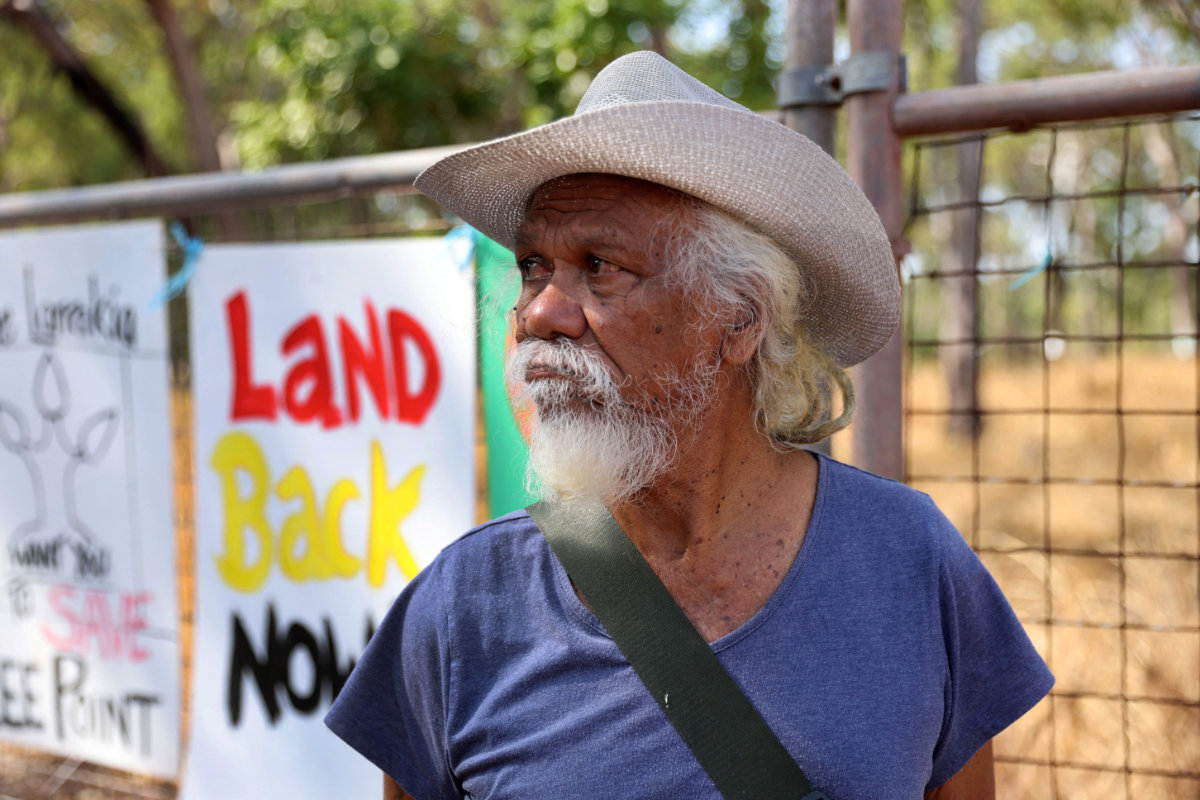
Tibby Quall, an indigenous Australian, is seen at a protest site in Darwin, Australia, on July 16, 2024. (REUTERS)
‘Already a target’
A third of residents in the sparsely populated Northern Territory are Indigenous Australians, although they make up just 10 percent of Darwin’s population.
Traditional Owners, as Indigenous Australians who have cultural access rights to an area of land or sea are referred to in Australia, can visit sacred sites on the bases, US and Australian officials said.
Tibby Quall, 75, is among several Traditional Owners who say growing demand for defense-related housing in Darwin has led to land-clearing of forests they want protected, while rising prices have pushed Indigenous families out of the city.
Despite visitation rights, he says, his family has no real voice on how the land is used.
“Defense are the prominent citizens,” said Quall, a military veteran.
Darwin Mayor Kon Vatskalis says his city, where a Chinese company runs the port, welcomes the economic boost as the defense presence grows, although some residents have raised concerns that hosting the US military could make the city a target.
“The reality is that we are already a target: We are the most northern port in Australia, we are the city that serves the gas and oil industry,” said Vatskalis, who supports the military expansion.


