

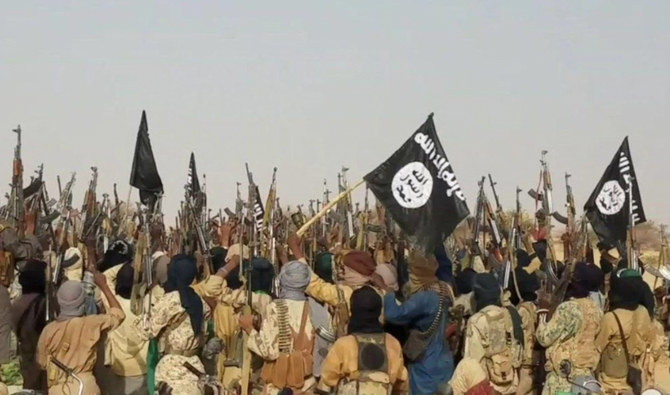

N’DJAMENA, Chad: A senior UN official delivered earlier this month a stark warning that terrorism and organized crime by violent extremist groups linked to Al-Qaeda and Daesh are escalating into a pervasive threat across West Africa and the Sahel region.
This menace is now spilling over into West Africa’s coastal countries, suggesting that the world might be waking up too late to the unfolding crisis.
The statements by Leonardo Simao, the UN special representative for the Sahel and West Africa, highlighted a surge in illegal trafficking in drugs, weapons, mineral resources, human beings, and even food.
The first half of 2024 alone has seen hundreds of people killed in terrorist attacks, reflecting a dramatic escalation in violence.

Members of the military junta arriving at the Malian Ministry of Defence in Bamako, Mali. (AFP)
These developments underscore the complex and multifaceted nature of the challenge. The intertwining of terrorism with organized crime networks has created a volatile environment where insecurity is the norm.
“This instability is significant also for the international community. As extremist groups tighten their grip, the humanitarian, economic and political fallout threatens to reverberate far beyond Africa’s borders,” Moustapha Saleh, a Chadian security expert, told Arab News.
The situation is further exacerbated by recent political upheavals. G5 Sahel, a French-backed alliance intended to coordinate security and development issues in West Africa, collapsed last year after the exit of the military-junta-run nations of Mali, Niger and Burkina Faso.
This prompted the US and other Western countries to assist Ghana and neighboring coastal West African nations in bolstering their defenses. Although Ghana has not yet faced direct militant violence, Togo, Benin, and Ivory Coast have suffered attacks near their borders in recent years, illustrating the growing threat of regional instability.
Still, aid for West Africa has been lacking compared with assistance offered to Ukraine, Ghana’s President Nana Addo Dankwa Akufo-Addo said in a recent interview.
US aid to Ukraine since the Russian invasion has climbed to $113 billion. In contrast, the combined assistance from the EU, the UK and the US to the Economic Community of West African States, the bloc known as ECOWAS, has amounted to a relatively tiny $29.6 million over the same period.

An operation in Menaka, Mali in 2020 aimed to lower the number of weapons in circulation. (AFP)
“Military regimes often struggle with legitimacy and resources, making them ill-equipped to handle the sophisticated and well-funded operations of extremist groups. The lack of international military support has left these nations vulnerable, and the consequences are becoming increasingly dire,” Saleh said.
This abrupt shift has opened the floodgates to a tide of extremism as these countries struggle to fill the security vacuum left by the withdrawal of foreign troops.
Many Sahel countries are now turning away from the West to find an ally to bolster their defenses. Russian mercenary group Wagner reportedly deployed contractors and military equipment in several West African countries, including Mali and Burkina Faso, over the past two years.
The human toll of this escalating crisis is staggering. In the first six months of 2024, hundreds of civilians have been killed in terrorist attacks. Communities are being torn apart, and the displacement of people is reaching unprecedented levels. Refugee camps are swelling as people flee the violence, resulting in a dire need for humanitarian aid.
Furthermore, human trafficking is becoming a critical issue. Vulnerable populations are being exploited, sold into slavery, or forced into militant groups. Illegal emigration from Western African countries into Europe, via the usual migratory routes, is soaring.

Cars supposedly burnt by members of the Islamic State West Africa Province (ISWAP). (AFP)
Meanwhile, trafficking in drugs and weapons not only funds extremist operations but also fuels further violence, creating a vicious cycle of instability.
The economic ramifications are equally grave. A booming illegal trade in mineral resources, which includes gold, diamond and other valuable commodities, is depriving nations of crucial revenue. Instead of funding development and infrastructure, these resources are financing terror and crime.
The disruption of legal trade routes due to insecurity has crippled local economies. Farmers and traders find it increasingly difficult to transport goods, leading to food shortages and price hikes.
“The broader economic instability discourages foreign investment and hampers development, further entrenching poverty and disenfranchisement,” Saleh said.
Until last year, global support for combating terrorism in the Sahel region was significant, with contributions from various countries and organizations. The US played a crucial role, with its drone bases in Niger and Burkina Faso and around 1,000 troops in the region.

The military junta took over power in Mali on August 19, 2020. (AFP)
France was a prominent supporter through its military operations such as Operation Barkhane, headquartered in Chad, and involving around 4,000 personnel at its peak. It was aimed at securing the region and fighting terrorism in partnership with local forces in Mali, Niger and Chad.
The EU Training Mission and the EU Capacity-Building Mission too played a role until the wave of coup d’etats took the region by surprise. Consequently, it become impossible for Western governments to continue military cooperation with hostile juntas.
But given the severity of the current crisis, many experts say the world can ill afford to look away. “The international community must recognize that the threats emanating from the Sahel and West Africa are not confined to the region but have global implications,” Souley Amalkher, a Nigerien security expert, told Arab News.
INNUMBERS
• 361 Conflict-related deaths in Niger in the first three months of 2024. (ACLED)
• 25.8m+ People in Burkina Faso, Mali, Niger and Nigeria in need of humanitarian assistance this year.
• 6.2m+ People currently internally displaced in Burkina Faso, Mali, Niger and Nigeria.
• 32.9m+ People facing food insecurity in Burkina Faso, Mali, Niger and Nigeria.
Terrorism and organized crime in these areas can destabilize entire continents, disrupt global trade, and fuel mass migrations. “There is also the risk of these extremist ideologies spreading beyond Africa, posing a security threat to other regions,” Amalkher said.
Experts say that the spread of extremist ideologies and the presence of terrorist groups in West Africa will lead to instability that may also affect the Arabian Peninsula.
They say the pro-West Gulf states, while already supportive of counterterrorism efforts in West Africa, must reconfigure their strategies given the recent dissolution of the G5 Sahel.
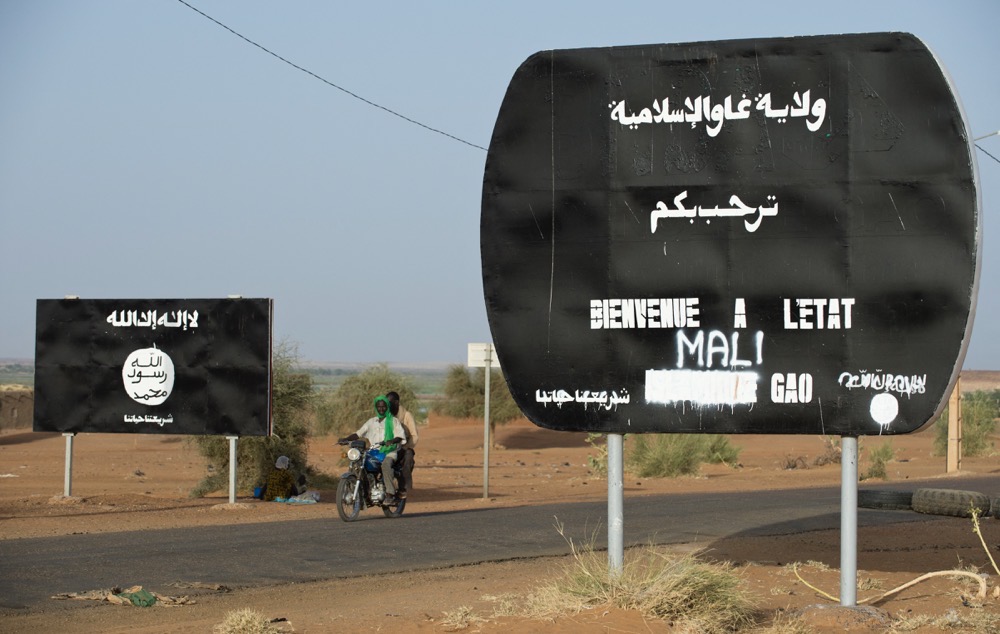
A motorbike drives past a sign welcoming people to the ‘Islamic State of Gao’, that was transformed to read ‘Welcome to the Malian State’, in the Malian city of Gao. (AFP)
Addressing this crisis requires a multipronged approach, the experts argue, pointing to what they say is the need for a combination of immediate and long-term strategies.
“Immediate actions should include re-establishing military partnerships. It is crucial to restore and strengthen military collaborations with international partners as this would provide the necessary support to local forces to counter the extremist threat effectively,” Lauren Mitchel, a security expert from the Washington-based Institute of Peace, told Arab News.
Humanitarian aid is also vital. Immediate and substantial assistance is needed to support displaced populations and provide basic necessities such as food, water and medical care.
Additionally, strengthening border controls and international cooperation is essential for the disruption of trafficking networks. This includes better intelligence sharing and coordinated law enforcement actions.
Long-term solutions focus mostly on economic development and support for projects that encourage self-sustainability.

The military junta took over power in Mali on August 19, 2020. (AFP)
“This involves building infrastructure, creating jobs, and promoting sustainable agricultural practices to ensure food security,” Mitchel said.
Analysts have found that the provision of education and vocational training to young people can help prevent them from being recruited by extremist groups. Social programs that address poverty and disenfranchisement are vital for long-term stability.
They say that international efforts should concentrate on facilitating the transition to stable, civilian-led administrations capable of effectively managing and addressing the needs of their populations.


