

Over 100,000 schools in Pakistan remain closed due to heat

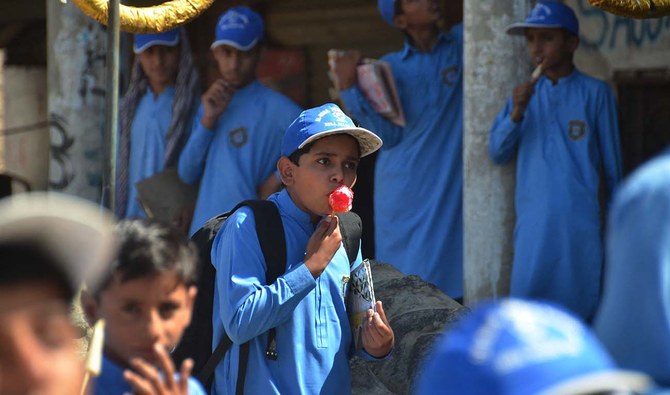
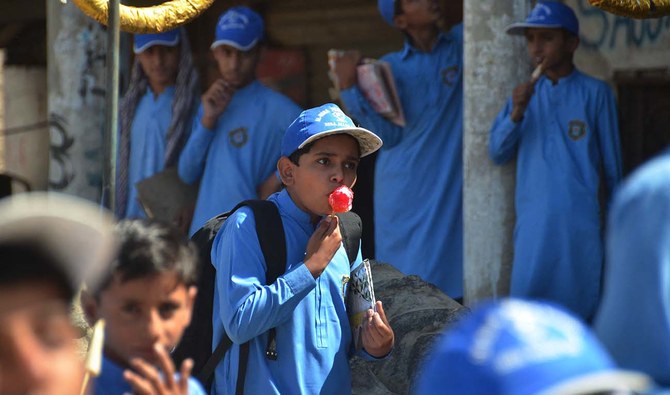
A school boy eats an ice gola (a street dessert made of crushing ice and syrups) outside his school during a hot summer day in Jaffarabad, in Pakistan's Balochistan province on May 29, 2024, amid the ongoing heatwave. (AFP/File)
Short Url
Updated 24 July 2024
Follow

Over 100,000 schools in Pakistan remain closed due to heat

  • Pakistan is increasingly vulnerable to extreme weather conditions resulting from climate change, including hotter heat waves
  • Pakistan’s southern Sindh province decides to close schools for additional two weeks to ensure children’s well-being

KARACHI: School summer holidays will be extended by two weeks in southern Pakistan because of high temperatures, affecting more than 100,000 schools, an education official said Tuesday.

Pakistan is increasingly vulnerable to extreme weather conditions resulting from climate change, including heatwaves that are hotter and more frequent and monsoons that are heavier and longer.

“We decided to close schools for an additional 14 days for the children’s well-being,” Atif Vighio, a spokesperson at the education department in Sindh province, told AFP.

Planned power cuts, also known as load-shedding, happen frequently in Pakistan due to an ongoing power supply crisis.

The load-shedding varies from city to city, but in rural areas of Sindh they can last for more than 12 hours a day, leaving schools without fans.

“As a teacher, I am worried about how I will complete the curriculum, but as a mother, I am concerned about kids going to school in this heat,” a public school teacher told AFP, asking for her name not to be used.

“It is the load-shedding we are worried about, not just the heat.”

The government has said more than 26 million children are out of school due to poverty.

Pakistan struggled through a series of heatwaves in May and June, with temperatures peaking at more than 50 degrees Celsius (122 degrees Fahrenheit) in parts of rural Sindh.

Authorities in Punjab province, the country’s most populous, started summer vacations in May one week early to protect children from the searing heat.

The UN children’s agency UNICEF said more than three-quarters of children in South Asia — or 460 million — are exposed to temperatures above 35C (95F) for at least 83 days per year.

Despite contributing less than one percent to global greenhouse gas emissions, Pakistan has experienced severe weather-related disasters in recent years due to changing weather patterns.


Pakistan, Iraq agree on tighter coordination over pilgrims under new regulated travel system

Updated 4 sec ago
Follow

Pakistan, Iraq agree on tighter coordination over pilgrims under new regulated travel system

  • New system requires all Iraq-Iran pilgrimages to be organized by licensed groups under state oversight
  • Long-running “Salar” model relied on informal caravan leaders, leading to overstays and missing pilgrims

ISLAMABAD: Pakistan and Iraq this week agreed to closely coordinate on the management and security of Pakistani pilgrims, as Islamabad rolls out a new, tightly regulated travel system aimed at preventing overstays, undocumented migration and security breaches during religious visits to Iraq and Iran.

The understanding was reached during a meeting between Pakistan’s Interior and Narcotics Control Minister Mohsin Naqvi and Iraq’s Interior Minister General Abdul Amir Al-Shammari on Thursday evening, where both sides discussed measures to facilitate pilgrims while strengthening oversight, Pakistan’s interior ministry said.

The agreement comes as Pakistan dismantles its decades-old pilgrim travel model and replaces it with a centralized, licensed system after authorities confirmed that tens of thousands of Pakistani pilgrims had overstayed or gone missing abroad over the past decade, triggering concerns from host governments.

“You have, for the first time during your tenure, taken effective measures to organize pilgrim groups, which are commendable,” Al-Shammari told Naqvi, according to Pakistan’s interior ministry.

“All pilgrims included in the list provided by Pakistan’s Ministry of Interior will be allowed to enter Iraq,” he added, making clear that only travelers cleared under the new system would be permitted.

Naqvi said Pakistan would strictly enforce return timelines under the revised framework.

“Pilgrims traveling to Iraq will not be allowed to stay beyond the designated period,” he said, adding that relevant authorities in both countries would remain in close coordination.

Both interior ministers also agreed to strengthen information-sharing and joint mechanisms on security cooperation, counterterrorism and the prevention of human smuggling, officials said.

“The safety, dignity, and facilitation of Pakistani pilgrims is the top priority of the Government of Pakistan,” Naqvi said.

Al-Shammari said he would visit Pakistan soon to finalize a joint roadmap to further improve pilgrim facilitation, security coordination and broader bilateral cooperation, according to the interior ministry.

Pakistan’s government has overhauled its pilgrim travel regime this year, abolishing the long-running “Salar” system under which informal caravan leaders managed pilgrimages. The move followed official confirmation that around 40,000 Pakistani pilgrims had overstayed or disappeared in Iran, Iraq and Syria over the past ten years.

Under the new Ziyarat Management Policy, only licensed Ziyarat Group Organizers (ZGOs) are allowed to arrange pilgrimages, with companies held directly responsible for ensuring pilgrims return on time. Authorities have completed security clearance for 585 companies seeking registration, while scrutiny of applications remains ongoing.

Islamabad has also barred overland travel for major pilgrimages, including Arbaeen, citing security risks in Pakistan’s southwestern Balochistan province, meaning all travel to Iraq and Iran is now restricted to regulated air routes.

Tens of thousands of Pakistani pilgrims travel each year to Iraq and Iran to visit some of the most revered shrines in Shia Islam, including the mausoleums of Imam Ali in Najaf and Imam Hussain in Karbala in Iraq, and major religious sites in Mashhad and Qom in Iran. Pilgrimages peak during religious occasions such as Arbaeen, when millions of worshippers converge on Karbala from across the region. The scale of travel, often involving long stays and cross-border movements, has long posed logistical, security and migration-management challenges for Pakistani authorities and host governments alike.